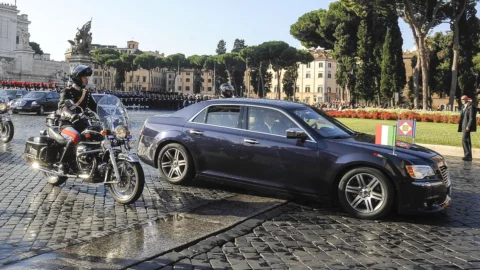
The ecological transition of Italian "blue cars" has slowed sharply in recent years and is now in reverse. Average emissions are rising, Fewer electric cars are being registered and the number of new cars violating emissions limits is growing. The maximum allowed by law, or 160 g/km of CO2, is the result of a study commissioned by T&E, the leading European organization working for the decarbonization of transport, and conducted by Withub with the support of Paolo Maranzano (University of Milan-Bicocca) and Gianluca Monturano (University of Bari). The study, based on an unpublished database of approximately 12.000 registrations from 2019 to 2025, was based on a previously unpublished database.
The Public Administration does not respect the law
Therefore, regarding "blue cars" the PA does not respect the lawThe most alarming figure concerns the failure to comply with the relevant legislation: the 2020 Budget Law requires that 50% of new registrations be electric, hybrid, or hydrogen; a target that was missed in 2020 (18%), almost reached in 2021 (49%), and largely exceeded thereafter, with peaks of 70% in 2022 and 2024.
Meanwhile, however, with the introduction of the Minimum Environmental Criteria (CAM) at the end of 2021, more stringent emissions requirements were added. The CAM requires that at least 38,5% of new PA vehicles be zero- and low-emission, meaning equal to or less than 50 g/km of CO2. At the aggregate level, that threshold—38,5%—has never been reached since the regulation came into force. In 2022, the first year of application of the regulation, the share stopped at 30,5%. in 2025 it dropped to 14%And this is reflected in the quantities of CO2 emitted. After reaching their lowest emission level in 2022—with an average of 89 g/km of CO2—public administration vehicle registrations reversed course: in 2025, the average rose to 124 g/km, significantly higher than the average emissions for all registered vehicles nationwide.
The coexistence of two rules that use different parameters – the type of power supply (hybrid, electric, hydrogen) for one, the level of emissions for the other – generates application uncertainties and compromises, as a whole, the effectiveness of the regulatory system.
The hybrid dead end: more registrations, more emissions
The growth in hybrid registrations has been rapid and constant: from 10% in 2020 to 64% in 2025. The “hybrid” category groups together technologies with very different emission levels and only a small portion of these vehicles fall within – in terms of homologation values – below the 50 g CO2/km threshold required by lawThese are Plug-In Hybrids (PHEVs), but there is clear evidence of actual emissions, demonstrating that real-world emissions are up to five times higher than approved values.
Meanwhile, the pure electric – the only technology that ensures zero emissions and full compliance with CAM – has lost momentum: after reaching 29,7% of registrations in 2022, it fell to 7,2% in 2024, only to partially recover to 14,1% in 2025. This non-linear trend signals the absence of a structured strategy and, more generally, a lack of compliance with the regulation.
The 160g CO2/km limit is ignored in one in three purchases
The study highlights a second critical issue: the CAMs also set a maximum limit of 160 g CO2/km for new registrations. In 2022, only 85 vehicles (4% of the total) exceeded that threshold. In 2025, the figure will be 417, equal to approximately 34% of registrations. Ministries and regional/provincial bodies are the worst performing administrations this year: almost all ministry vehicles are outside the threshold (96%), as are approximately three-quarters of regional/provincial vehicles (76%). Failure to comply with the minimum limit is not an exception: it has become the norm.
The most registered car in 2025 is the Fiat Panda hybrid (278 units), followed by the Subaru Forester (251 units), a highly emitting model with 185 g CO2/km. The only zero-emission car in the top five is the Dacia Spring, with only 40 units.
Who respects the rules and who doesn't: strong disparities between institutions
The analysis by institutional category reveals significant gaps. In 2022—the only year in which the 38,5% threshold for zero- or low-emission registrations was reached by some categories— Municipalities stood at 45% and Universities at 43%But by 2023, both categories had returned below the threshold, and the trend has not reversed. Ministries and regional and provincial authorities, however, show an opposite trajectory: according to the statistical model developed by the researchers, the average emissions of these categories have increased over time, not decreased. Local health authorities and hospitals stand out in one respect: in 2025, they did not register any vehicles above 160 g/km.
Rules will become stricter from 2026: an immediate change is needed
The regulatory context will soon become even more stringent: from 1 January 2026, the CAMs foresee that in order to fall within the minimum quota of 38,5% of "green" registered vehicles a vehicle must have emissions equal to 0 g/kmOnly pure electric cars will meet that requirement. With just 14% of BEVs registered in 2025, the Public Administration is starting from a baseline far from its target.
How to reverse course? T&E indicates some priority directions to reverse the trend: clarify the prevalence of CAM, and therefore the emissions parameter, as an updated regulatory standard, a significant increase in all-electric vehicle registrations, and a transparent and accessible monitoring system, as well as effective enforcement of the regulation. The data exist—from the Department of Public Administration's Auto Census, the Italian Automobile Club (ACI), and the European Environment Agency—but they are fragmented and difficult to obtain, so much so that the database used in this study was constructed in part through FOIA access.