The focus will be on figures who, despite having operated in prominent historical and cultural contexts, have long been marginalized by the dominant narrative, but who today emerge as crucial focal points for understanding both the evolution of taste and the new dynamics of the art market.
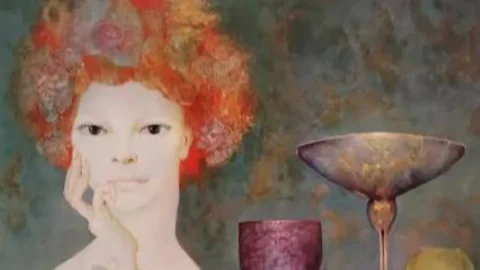
Leonor Fini (1907–1996) was a painter, illustrator, set designer and writer A highly original artist, often compared to Surrealism but always independent. Born in Buenos Aires to an Argentine father and a Triestine mother, she grew up in Trieste, where she was self-taught. As a young woman, she suffered from a serious eye disease that forced her to long periods of immobility. During this time, she developed an intense visual imagination and a precocious passion for drawing and painting. In the 1930s, she moved to Paris, where she came into contact with the avant-garde artistic scene. He frequented artists and intellectuals such as Max Ernst, Salvador Dalí, Paul Éluard and André BretonAlthough he exhibited with the Surrealists, he refused to officially join the movement, mainly because of his personal vision of identity and sexuality.
Leonor Fini and her "surrealism"
Eleonor Fini Today, Fini occupies a crucial position where critical analysis and market dynamics coincide, making her figure emblematic of the contemporary rewriting of twentieth-century art history. Long marginalized by official Surrealism, not due to qualitative limitations but rather by a conscious choice of autonomy, Fini has crafted a pictorial language that escapes the movement's hierarchies and challenges its ideological presuppositions. Her rejection of Surrealist orthodoxy, dominated by a masculine and often objectifying vision of the feminine, translates into an imagery in which women are the active subject, a symbolic force, and the narrative center of the work.
Refined technique and figuration
From a critical perspective, her painting stands out for its cultured, technically refined figuration, in which mythology, psychoanalysis, and the theater of identity converge. Leonor Fini's figures—sphinxes, queens, androgynous beings, and creatures in metamorphosis—do not represent the unconscious as an automatic process, but as a conscious, almost ritualistic construction. This makes her atypical compared to more orthodox Surrealism and, precisely for this reason, extremely relevant today: her work anticipates contemporary reflections on gender, power, fluid identity, and self-representation. Her oeuvre does not seek to be interpreted as a document of a historical avant-garde, but as an autonomous, coherent, and profoundly modern corpus.
A critical rereading had a direct impact on the market
In recent years, Leonor Fini has firmly entered the radar of international museums, curators, and collectors, within a broader context of the revival of historically underappreciated female artists. However, unlike purely corrective operations, Fini's case is based on a pictorial quality and iconographic strength that fully rivals the great names of Surrealism. Her growing presence in museum exhibitions and institutional acquisitions has served as definitive legitimacy, reducing perceived risk and making her market structurally more solid.
From a collector's point of view, his production presents particularly attractive characteristics.
A relatively limited number of paintings, an immediately recognizable style, and a strong thematic coherence. The paintings from the central years of her career are now the subject of growing international competition, while her works on paper—drawings, gouaches, illustrations—still represent a strategic entry point, especially for collectors attentive to their potential for revaluation. The market has shown progressive, non-speculative growth, supported by genuine, cross-sectional demand, combining modern art collecting, an attention to gender issues, and an interest in a critically revisited Surrealism. In this sense, Leonor Fini is not simply "rediscovered": she is being repositioned. LHer work is now seen as essential to understanding the twentieth century, and the market responds accordingly, rewarding a figure who combines conceptual strength, formal quality, and an imagery capable of engaging with the present. It is precisely this convergence of historical-critical value and cultural relevance that makes Leonor Fini one of the most significant and potentially enduring figures in contemporary collecting.