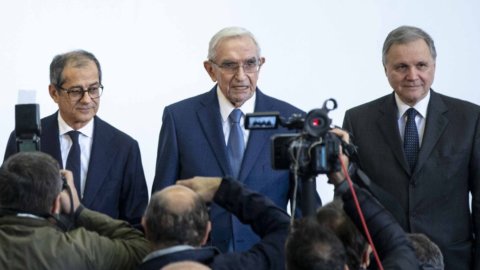
Eyes on the Visco-Tria confrontation at the 94th World Savings Day hosted – as it has every year for almost a century – by Acri. Or, also, the Bank of Italy versus the Ministry of the Economy, public finance rigor versus deficit maneuvering, a dilemma that takes place the day after the second warning letter for Italy from Brussels and a few hours after the presentation of the Law budget in Parliament. And it's raining "blows" on yellow-green politics which - they say without much periphrasis - bankers and economists - risks damaging Italian savings and slowing down development rather than relaunching it.
VISCO: "TAX" SPREAD OF 5 BILLION
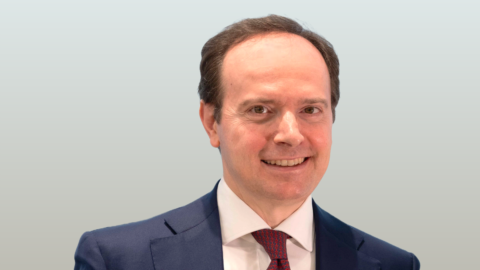
The Italian debt is sustainable but a credible reduction path is needed, says the governor of the Bank of Italy Ignazio Visco worried about "the uncertainty on the orientation of budgetary and structural policies and on the evolution of relations with the European institutions". It is this uncertainty at the origin of the increase in the spread which drives up the yields of public bonds whose prolonged rise "depresses the value of the savings accumulated by families" who directly or indirectly hold 100 billion of public bonds while the banks and companies to whom they entrust their savings, they have 850 billion. For banks, he explains, the effects can be seen "on the increase in the cost of funding" and the fall in shares (-35% since May) but there are also negative repercussions on the public budget. If this differential is not reabsorbed, "the increase recorded so far would cause, as early as next year, higher interest expenses for around 0,3 points of GDP, over 5 billion“. The burden - he adds - would rise to half a point in 2020 and to 0,7 points in 2021. And this "would increase the primary surplus necessary even if only to stabilize the ratio between public debt and gross domestic product". In conclusion, "Italy's public debt is sustainable but the determination to keep it so must be clear, placing the debt-to-product ratio on a credible path of lasting reduction". In this sense, according to Visco, “the uncertainties about Italy's convinced participation in the European Union and the single currency must be dispelled: uncertainties that fuel volatility on financial markets”.
TRIA QUOTES THE GREAT DEPRESSION: DEFICIT IS NECESSARY
"In no way does the government want to leave the euro." And "the deficit will not rise as feared by some institutional and non-institutional interlocutors". With these two answers, Economy Minister Giovanni Tria tried to dispel the doubts of the interlocutors present at World Savings Day. However, he does not seem to have managed to dent investor sentiment given that the spread, although decreasing, remains above 300 points.
'The expected deficit will not increase even in the event of a lower impact of the maneuver on growth - argues Tria - because it is based on the trend forecast for GDP growth of 0,9% for next year'. The minister lashes out against the "great misunderstanding" of Italy's exit from the euro: "It has never happened that the deviation from European fiscal rules has called into question the will of countries to belong to the euro", probably forgetting the numerous declarations of qualified exponents of the yellow-green majority on this point.
But it doesn't matter, what Tria wants to say seems to be that while everyone is scrambling to evaluate the costs of the deficit, no one takes into account "what would be the cost of a 'non-deficit', ie a non-investment in works and human capital. What would be the cost of not solving the problem of Italian growth which is too low. After ten years and two recessions, we are already beyond the effects of the Great Depression of the XNUMXs. This made us understand that the cost of the 'non-deficit' we cannot afford, either economically or socially”. For this he concludes, "the 'cost' of the deficit is sustainable and responsible" and "brings us closer to Europe and not the other way around". In Brussels, however, they don't seem to think the same way.
[smiling_video id="65986″]
[/smiling_video]
MATTARELLA: THERE IS NO SOVEREIGNTY WITHOUT ACCOUNTS IN ORDER
Without accounts in order, Italy's sovereignty cannot be guaranteed. Said more appropriately to the status of President of the Republic, "the balance of public finances - expressly referred to in the Constitution - is an essential condition for the exercise of effective sovereignty of the country“. This is how Sergio Mattarella sends his message to ministers and bankers gathered in Rome to celebrate the 94th World Savings Day the day after the sending of the second letter from Brussels to the M5S-Lega government and on the same day in which the Budget should finally arrive in Parliament.
In an age of sovereignty, the message is as clear as the alarm sounded by president of Acri Giuseppe Guzzetti, who presided over the event for the last time, whose mandate will expire next year. Not only, he said, would a credible rebalancing plan for the public accounts protect savings "both those intended for financing the Treasury and those entrusted to the banking system and specialized intermediaries", but he left himself to a consideration "as an elderly man who has spent many political, economic, social seasons, starting from the immediate post-war period, when the political confrontation was very hard, but respect for the adversary never failed”. According to Guzzetti, in the season we are experiencing “a poison is creeping into our daily lives and is affecting the most delicate ganglia of our democracy. It is hatred that splits the country, as emerges from episodes that alarm us every day. Hate doesn't come from nowhere. Real needs cannot be ignored. They should not be exploited, but faced and resolved“. According to the president of ACRI “the plurality of information must be protected as an asset of a democratic society. I entrust to you, the country's ruling class, the urgency of a reflection but, above all, of behaviors and acts that stop this drift that undermines our democracy at its roots".
Finally the president of ABI Antonio Patuelli. “We need more respect and trust in Italian banks”, are the main investors in BOTs and BTPs. “What would have happened or would happen if the banks in Italy held a few or points of government bonds? How much would the spread reach?”.