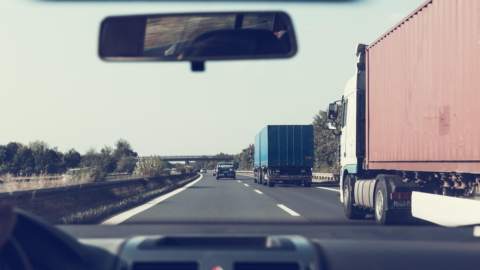
Despite the evolution of rail transport, the The engine of the European economy continues to run on four wheels. nell 'In the European Union, 78% of goods travel by road. and only 17% by rail. And Italy goes even further with 88% of land transport taking place by road and trains remaining at 12%. The numbers come from Connact, which elaborated on Eurostat data presented in Rome during the event "The Evolution of EU Transport Policies." This picture depicts a Europe still failing to shift freight traffic to more sustainable modes.
The initiative, organised by Connact in collaboration with the European Parliament in Italy, was a moment of comparison between institutions and protagonists of the sector of transport, dedicated to the issues of infrastructure modernization, sustainable transition, and the integration of different mobility systems – rail, road, maritime, and air.
Europe of wheels: the dominance of the road
In Europe the Road freight transport continues to dominateIt is not only Italy, with its 88%, that exceeds the European average of 78%: many other countries go well beyond. Spain leads the rankings with an impressive 95,8% of goods transported by road, followed by Greece (98,9%), Ireland (99,3%), France (88,9%), Italy (88%) and Portugal (85,9%).
More in line with the average Austria, while Germany, Belgium and several Eastern European countries rank slightly lower. Two exceptions: the Netherlands (52,8%), Romania (53,7%) and Latvia (56%). A picture that confirms how the road remains the backbone of European freight transport, supported by greater logistical flexibility, faster delivery times and lower costs than rail.
Freight transport, the railway is struggling
On the opposite front, the rail transport is falling behind. In Europe the share has dropped from 19% in 2015 to 17% in 2023, in contrast with the EU Strategy for Sustainable Mobility, which aims to double the rail share by 2050.
Italy is following the same trend. It has gone from 13% in 2015 to the current 12%, after a peak of 14,7% in 2016. The lowest rail transport figures are recorded in Spain (4,2%), France (9,2%), Belgium (11,7%), and the Netherlands (6,4%). Eastern Europe fares better, where the railway maintains a central roleAustria 29,3%, Slovenia 30,2%, Slovakia 30,4%, Hungary 25,2%, Poland 24,1%, Romania 24%. The highest rates are held by Lithuania (39,7%) and Latvia (44%). Northern Europe also has high levels, with Finland and Sweden at 22% and 29,7%, respectively.
Italy's electricity market: numbers growing but still far from Europe's.
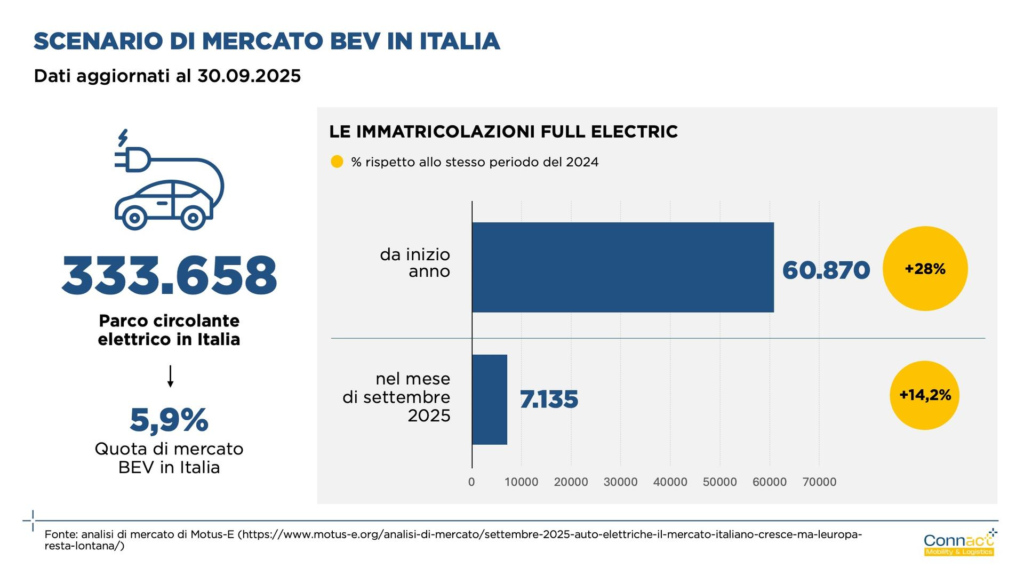
During the Connact event the issue was also addressed theme of electric mobility, according to an analysis by Motus-E and ACEA. At the end of September 2025, there were 333.658 battery-powered electric vehicles (BEVs) on the road in Italy, equal to 5,9% of the market. Since the beginning of the year, registrations have reached 60.870, a 28% increase compared to 2024.
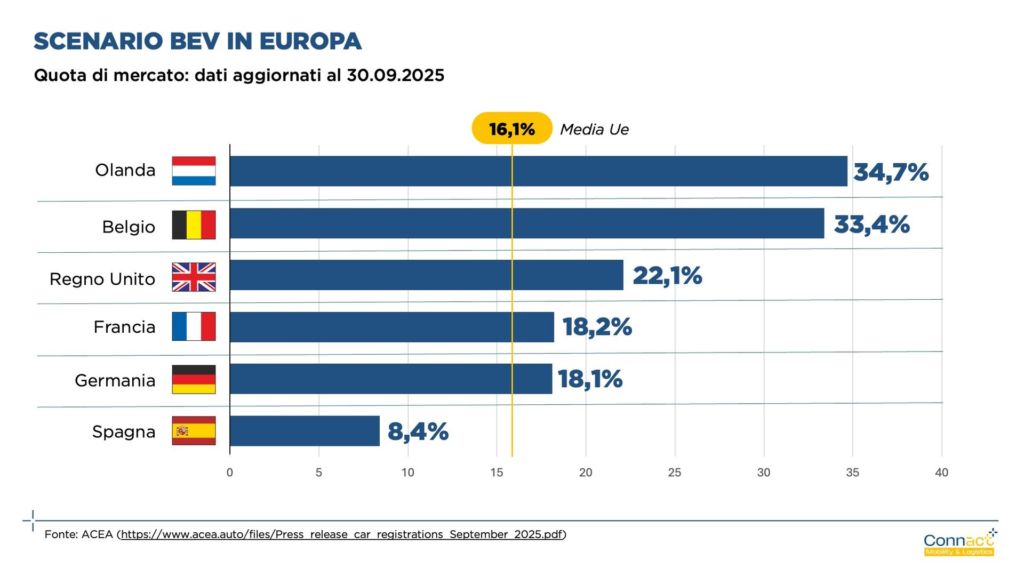
However, the European comparison remains merciless. The EU average is 16,1%, with peaks of 34,7% in the Netherlands, 33,4% in Belgium, 22,1% in the United Kingdom, 18,2% in France, and 18,1% in Germany. Spain (8,4%) also fares better than Italy.
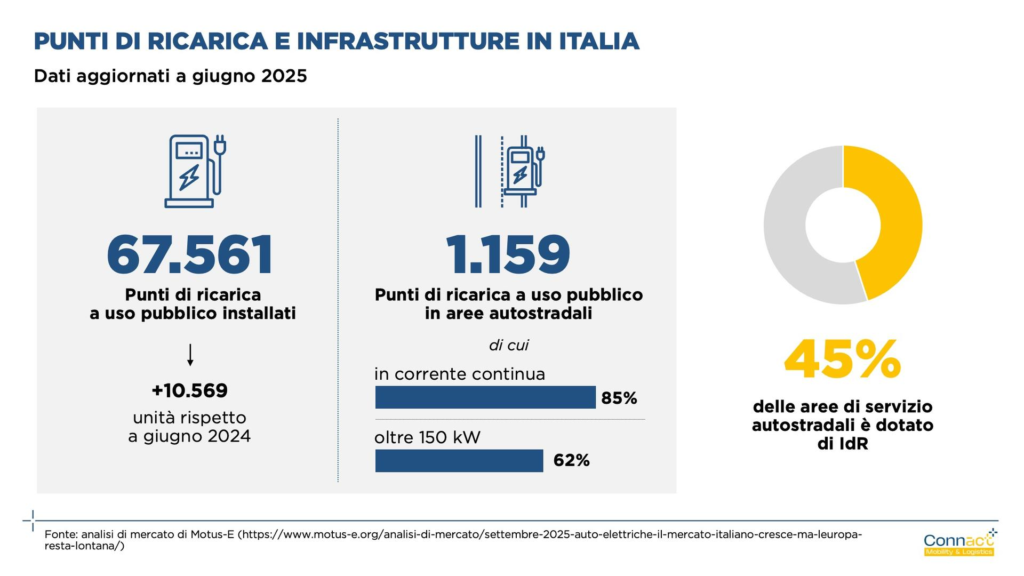
Sul infrastructure front, the country shows signs of acceleration: as of June 2025, 67.561 public charging points were installed, over 10.500 more than the previous year. columns on the highway There are 1.159, of which 85% are direct current and 62% exceed 150 kW. Nearly half of the service areas (45%) are now equipped with charging infrastructure.
“The transition is not ideology, but pragmatism”
" ecological transition is a global challenge and electric mobility is a lever capable of making a concrete contribution to the decarbonisation process" he commented Fabio Pressi, CEO of A2A E Mobility. According to Pressi, Italy is experiencing "constant growth in charging infrastructure," with a model that integrates "low-power City Plugs and fast charging hubs in high-traffic areas."
For Raffaele Latrofa, Extraordinary Commissioner of the Port Authority of the Central-Northern Tyrrhenian Sea, “there are projects worth 80 million euros for Cold Ironing and we are first in Italy in terms of hydrogen experience, with the prospect of producing 200 tons of green hydrogen per year”.
Massimiliano Calamea (Autostrade per l'Italia) recalled that "90 percent of passengers and 84% of goods travel by road," underlining how the sector "will continue to play a fundamental role in economic competitiveness and will be an enabler of decarbonization." More critical is the position of Maria Cristina Scarfia (Confetra), “the logistics sector is not against decarbonization, it is against an ideological approach that imposes unrealistic targets from above.”
Davide Cucino (Fincantieri) instead underlined that "the European maritime industry must focus on a new industrial policy and open up to new areas such as the underwater dimension". Marco Mannocchi (IP Gruppo api), "sustainable mobility can only be achieved through a variety of technologies: electric, hydrogen, and biofuels." Finally, Aimone of Savoy Aosta (Pirelli) reiterated that "to accelerate the transition, a stable regulatory framework is needed, with clear timeframes and realistic objectives."