Il Economy courier he recovered a study of Adapt on the impact betweendemographic winter and job market in which it is demonstrated for the umpteenth time that theunsustainability of the pension system it is determined not only by the impact of spending on GDP, but by many other structural factors that are difficult to modify.
Going into these reasonings is always difficult because everything is the same, that is, it is not possible to solve one problem at a time, but it is necessary to have a overall look. There is no doubt, for example, that theimpact of spending could decrease if the GDP in the denominator of the fraction that has the amount of spending in the numerator increased. But such an operation would solve a problem secondary aspect of the pension issue, in the sense that we could afford high pension spending with fewer worries than today, without prejudice to the fact that a country that grows more only to be able to dedicate a large amount of resources to pensions would continue to have no certain prospects. Then, there is still someone who believes he is a master in the three-card game and would like to cheat the international institutions as if he were some provincial traveler who approaches the banquet out of curiosity and is hooked by the person who acts as the manipulator's sidekick on the table outside the station.
It is not enough to separate social security and assistance
Who thinks of solving the problem through separation between pensions e assistance it is the most dangerous of all, because it provides a semblance of rationality in classifying the items of a balance sheet. We know the topic: does Europe maintain that the incidence of spending on GDP (16-17%) is too high? It is our fault that we persist, no one knows why, in providing a figure burdened by the burdens reserved for assistance, which if they were removed would bring us into the category of almost virtuous states. This ploy has no consistency for a series of reasons which we point out in summary. When data must be compared within a community of countries, we agree - in an objectively complex context such as the public finances of one State compared to others - on the criteria for classifying the items spent; you don't play morra. In providing our statistics and classifying them correctly we also comply with the rules agreed at European level.
Michele Raitano's opinion
Only a single country is allowed exceptions on your own. Secondly, pension expenditure cannot be classified on the basis of its financing: what is financed by contributions from production is social security, while contributions in the form of transfers from the state budget fall under assistance.
As he rightly wrote Michele Raitano “With regards to the financing method, it appears clear that it is in no way a decisive dimension since there is nothing to prevent - as actually occurs in many countries and also in Italy for some expenditure items - measures with clearly insurance and aimed only at workers are financed by general taxation. From this perspective – continues the economist – it does not appear legitimate identify as welfare the expenditure components if and only if they fall within the GIAS quota (and include them all in the assistance). Where the financing criterion as a discriminating factor there would be paradoxical effects. For example, it would follow that countries (such as Denmark) that finance more than 80% of their social protection spending with taxes are not insuring their citizens. Or, again, that the Integration fund it should be considered as a welfare instrument rather than a social security instrument when it is addressed in derogation to categories not covered (or insufficiently covered) by social security contributions. Similarly – adds Raitano – it should be considered as welfare the share of future pension paid to those who have benefited from the contribution relief of the Jobs Act, or that a redefinition of the contribution formula (with a guaranteed quota) becomes social security if financed with contributions within the pension or welfare system if general taxation contributes to its financing''.
To these considerations another more recent one could be added. Since the decontribution measures assumed by governments in recent years are replaced by the allocation of fiscal resources to cover the payment of existing pensions, it could be argued that the area of assistance is broadened to include the benefits paid for by the tax authorities (an operation not only impossible, but crossed by a streak of accounting madness. To conclude on this urban legend that many responsible people spread unchallenged, it is good to remember that the separation between social security and assistance has already been made with law n.88 of 1989 and completed with further interventions in the budget laws of 1998 and 1999. In essence, with these financial measures there is no escape from the harsh logic of the facts.
Demographic winter and the labor market
According to the Adapt Report cited by the Corriere «in less than 6 years we will have 730 thousand fewer workers, even if the percentage of employed people compared to the employable population remains unchanged. Therefore, however positive the current employment trend, the demographic transformations they cannot leave us indifferent, also because they will not be able to change in the medium term."
If the projection is extended to 2040 and then to 2050, the situation worsens drastically, with the Italian trend increasingly critical compared to the European average. Already in 2040, in less than twenty years, the decline in employment in Italy would reach 13,8% and 20,5% in 2050. Translated into absolute numbers, in 2040 it is estimated there will be 3,1 million fewer workers and in 2050 the decline would reach 4,6 million.
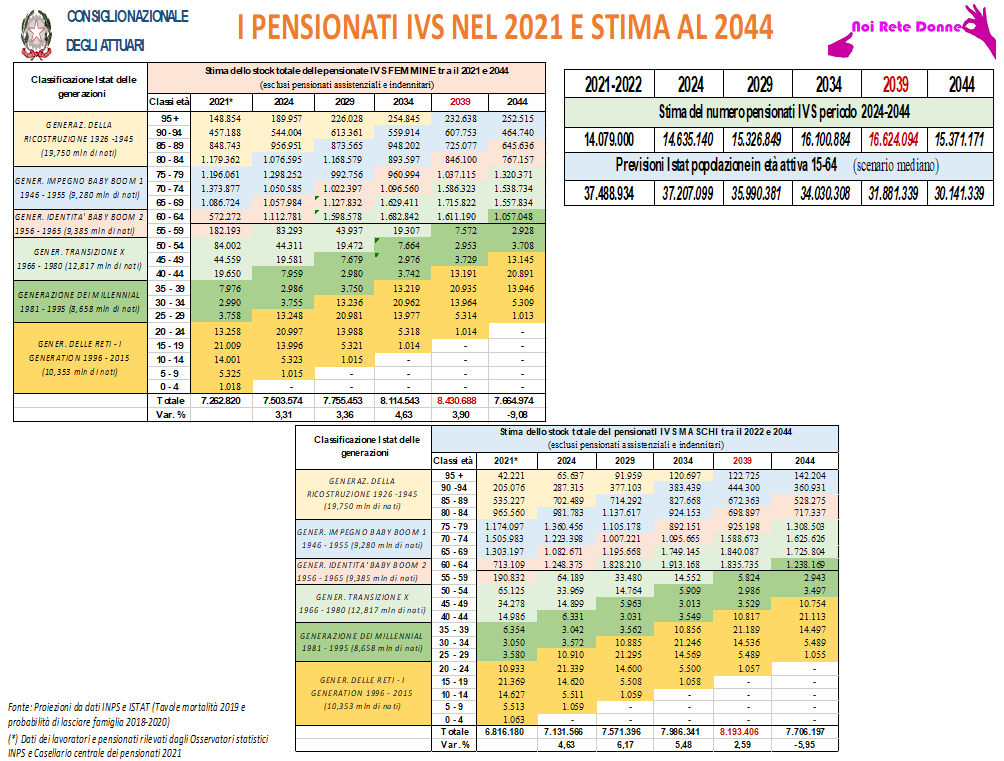
Le charts that follow are very indicative because they relate very significant data to each other to evaluate the relationship between the different cohorts at birth and at the time of pension commencement over a period of time from 2021 to 2044, for both men and women. Also to be observed in the same time frame ratio between the number of pensioners and that of people of working age. As can be seen in the overall tables 2039 is a key year because by that date the system will have to withstand the shock wave of the retirement of approximately 2,5 million new IVS pensioners, who will be added to the pensioners already existing today.
After 2040, however, the social security system will slowly tend to automatically rebalance, as the number of Baby Boomers II pensioners will reduce; the increase in longevity will most likely be offset by a longer tenure at work, by generating more continuous careers and therefore more adequate and shorter-term pensions, perhaps integrated with additional pensions, women will participate more actively in the labor market and the ratio of pensioners to employed will improve significantly due to the reduction in the numerator. Yet on the side of people of working age the decline remains inexorable with the inevitable difficulties on the financing side.