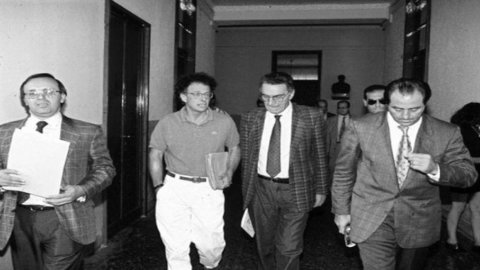
Twenty years after the launch of the great Mani Pulite investigation in Milan, corruption continues to spread in Italy; politics has changed, but for the worse; Public Administration, including Justice, is more expensive and less efficient than before. The great hopes for the regeneration of the country, aroused by Borrelli, Di Pietro and the others, have vanished like fog in the sun, and all the spectacular investigations and TV trials of leading politicians have been useless. It sure looks like it. Let's be clear, not that Mario Chiesa, the "rascal" caught red-handed, shouldn't be arrested, or the mother of all bribes should be exposed, namely the one involving Gardini and Montedison, but the mistake was to make the revolution through the courts, to make believe that the magistrates had not only the task of applying the laws, but also to change the Italians, to make them exemplary citizens, to get them out of the sinful system in which they were forced to live, to lead them to the right path.
It was a big mistake, or rather a collective blunder, think that a political change could be entrusted to the judges (moreover promoting the Public Prosecutors to judge judges) without a real political maturation behind them, and before that without an in-depth analysis of the real causes of corruption and of the overall degeneration of the economic and civil life of Italians.
The judicial investigation has generated in the newspapers and in public opinion the conviction that it was enough to modify some laws, increase penalties, perhaps give the accounting judiciary more penetrating investigative powers, to defeat corruption. It is the thesis presented again a few days ago by Piecamillo Davigo to Gruber, and which is underlying the umpteenth complaint by the president of the Court of Auditors on the enormous dimensions of the "illegality and malfeasance" still present in the country. The result was that of an abnormal increase in the interventions of the judiciary in all fields. We are now witnessing interventions by the Judicial Police to verify the absenteeism of public employees or, even, to punish children who skip school. All issues that should be addressed with "ordinary" checks by the office manager or the principal.
As for the Court of Auditors, it is not clear on what basis of scientific investigation the figures stated are based, such as that of 60 billion which would amount to corruption, or other positions taken on economic policy problems such as those recently presented in Parliament on the measures taken by the Government that would be too unbalanced on the side of revenues and not very effective on the side of cost containment. In short, even the Court of Auditors, which moreover years ago fiercely opposed the entry into its staff of economics graduates, preferring to continue to hire all law graduates, tends to expand its business into fields that are not its own, instead of reforming and deepening one's role as auditor (and not only of legitimacy) and possibly of suggesting a more efficient and effective organization of the administrative system of the single expenditure centres.
In other words the failure to identify the real causes of corruption and even more the ineffectiveness of the public sector's action has led to a situation in which everyone feels entitled to do a little bit of everything, setting themselves up as champions of the country's salvation, without understanding that the real contribution to improving the system could only come from the ability to reform themselves in the first place, to make that piece of the overall mosaic better and better which is their direct responsibility.
And what are the root causes not only of corruption but also of Italy's overall retreat? These are to be found in the excessive size of the public sector which, indeed in these years of government of the "liberal" Berlusconi, has further expanded above all at the local level. Not only has public spending, despite the many corrective measures, grown at a faster rate than the growth of nominal GDP, reaching 50% of income, but the joint-stock companies controlled by the public sector have increased significantly, ensuring that politics is able to intermediate an ever-increasing mass of money and is the most important employer in the country.
Of course it can be said that Berlusconi has eliminated false accounting thus hindering the task of those who were investigating corruption, but it is also true that many prosecutors were using that provision extensively going well beyond the letter and spirit of the law. It is also true that the anti-corruption rules are firm in Parliament and that they do not appear to be forthcoming. But the problem will never be resolved with very strict laws or even heavier controls. Unfortunately, public opinion has been distracted by the salvific expectation of the intervention of the Judiciary and has not developed a deeper awareness of the real evils of the system. There has been no push from citizens to reduce the role of politics in intermediating national wealth. There is no real popular movement in favor of reducing public spending and reducing state employees. Nor has real attention been paid to the streamlining of procedures, starting with the judicial ones, which last an infinite number of years. This is the reason why after twenty years we are back to square one.
There are trials for corruption in all countries of the world. The German president has resigned because he was indicted for a suspicious loan of 500 euros. The Israeli one for being convicted of rape. So no one wants to argue that the judiciary shouldn't do their job and that the laws in these matters must be clear and strict. But the intervention of the judges is the exception not the ordinary practice. If everything is done against the rules, just think of the swimming pools for the Rome Olympics, then it is the ordinary rules that must be reformed and above all the role and weight of the public sector must be reduced. By doing fewer things, politicians and administrators will have fewer temptations.
This is the mistake of the "heroes" of Tangentopoli: having made people believe that the salvation of Italy lay in their action. In reality, as can now be seen, that type of revolution has contributed to accentuating the degradation of the country, plunging us into the chaos from which the Monti government is now trying to rescue us. Few Italians really benefited from that season of easy handcuffs. The only ones satisfied are the coachman flies of the power of the prosecutors, like Marco Travaglio.