Never was a report more awaited. Yet it is unlikely that the minutes, or the report of the interventions of the meeting at the end of July of the heads of the monetary committee of the Federal Reserve, reveal new things about the orientation of the most powerful central bank on the planet. “We expect – comments a note from Barclays in this regard – that the texts confirm the attitude that emerged from the bankers' various interventions: a hawkish attitude prevails in the Fed with regard to cutting back on the purchases of securities on the markets, but a dovish attitude with regard to the trend of rates".
That is, barring sensational surprises, on 18 September, the date of the next FOMC meeting, the reduction from 85 to 75 billion/month of central bank purchases will be announced. An equally distributed reduction: Ben Bernanke will buy only 40 billion T Bonds (5 less than today) and 35 billion Abs, i.e. securities linked to mortgages, against the previous 40. In the hope that the cuts will not result in a race to rise in the yields of T bonds and, even more worrying, in a sharp rise in the conditions applied to mortgages, to the detriment of the recovery of the real estate market.
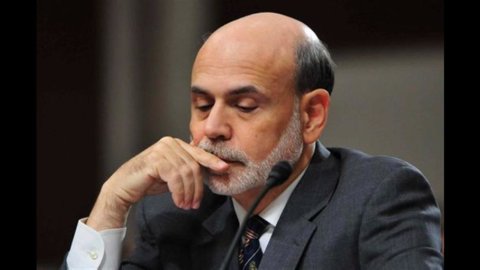
In short, there is very little suspense on the eve of the words of the Washington oracle, now with suitcases in hand. Or maybe there's too much. Ben Bernanke's presidency, winding down, will no doubt be remembered for the exceptional liquidity injection into the markets over the past three and a half years that staved off a repeat of the Great Depression. But we still don't know if Ben will deserve monuments to undying glory or he will be remembered with ignominy. Everything will depend on the success of the release operation which is starting these days. Never has the world been flooded with so much money, never has it found itself struggling to reabsorb so much liquidity before it translates into inflation or a new wave of recession. Start, with the Tapering a new, unprecedented phase in financial history. And let's hope it's a chapter with a happy ending. For now we just have to scrutinize the horizon of the markets, which are already adapting well in advance to the new situation.
1) US real rates have already recorded a sharp increase in yields, now over 2,8% for ten-year bonds. The phenomenon has already generated two consequences: a) the flight of capital from Emerging Countries, displaced by the redemptions of investment funds and ETFs from the positions accumulated on the Bric; b) the divestments of money managers Usa from bond funds, which in recent years have guaranteed fabulous profits thanks to the protective umbrella of the Fed, and their use in European equity funds, to exploit the start of the recovery of the Old Continent.
2) At the same time, there was in fact a strong recovery of the German economy. The novelty also pushed up the yields of the Bunds, which rose to around 1,85%, the highest in 17 months. In this case, the novelty, combined with the greater confidence in the fate of the euro, caused: a) an initial reduction of the spread with Italian and Spanish bonds, because the abundance of capital poured into Europe allowed for strong purchases of BTPs and Bonos; b) there is serious concern in German politics and in the Bundesbank about possible inflationary tensions.
3) The most relevant consequence regards Emerging Countries. Over the past decade, an estimated $1,2 trillion has been invested in the economies of what was once the Third World. What consequences can the exodus of this capital have? The first signs are evident: the Indian rupee is at its lowest against the dollar for ten years, the Indonesian government is trying to buffer the crisis of the ringitt and the stock market, like Thailand. Brazil's economy, like that of Turkey, is in a serious crisis while governments are forced to use the interest rate lever to avoid a collapse against the dollar. And so on, passing through the bad economic situation in Russia or the slowdown in China. It is something much more important than a stock market crisis. Only a few months ago the BRICS summit dictated conditions to the IMF against excessive exposure to Europe and claimed new top positions. Today New Delhi runs the risk of having to resort to the help of the Fund.
4) In short, a season has come to an end. Is there a risk of a new Asian crisis? Probably not, because emerging markets are much more solid, both from a financial and economic point of view, compared to the XNUMXs. But for some countries, excessively in debt in dollars and euros and engaged in colossal investment operations (Brazil and Turkey in the lead) the next few months will be difficult: the street riots during the Confederation Cup in Rio and the protests in Istanbul were the of the iceberg of a social malaise that is combined with the distrust of international investors.
5) Confidence in the euro has been restored thanks to the interventions of Mario Draghi. The early July guidance in favor of "a low cost of money for as long as necessary" was the European response to the Fed's tapering (i.e. the perceived reduction in market interventions). Europe, was the message, it will not follow the US because the economic cycle is at a different stage. But then Germany was still in the grip of a recession. Now, on the contrary, the locomotive promises to run at full capacity within a few months. And Wolfgang Schaueble has already declared that "interest rates must rise well beyond 2%". In the meantime, the German minister reopens the Greece dossier: the country will need new interventions in September.
6) In summary, one cannot fail to adopt the advice of Mohamd El-Erian, director of Pimco: "Don't wait for autumn to reposition your portfolio". In the name of security because, adds the manager, four areas of uncertainty are looming: a) The United States, next month, will have to decide on the change at the top of the Fed, which could result in greater volatility; b) In Europe, the autumn will bring with it three explosive dossiers, namely Greece, Cyprus and Portugal, hoping that a possible Italian political crisis will not introduce new alarms; c) in Japan, Abenomics marks time in the face of the most difficult passage: tax reform and the labor market. The "revolution" runs the risk of stalling halfway up the climb; d) finally, the Middle East does not promise anything good. And the withdrawal of dollars from the area could trigger new trouble spots.
In short, the long-awaited minutes of the Fed will not add much new. However, a process that will close a monetary policy season that lasted 1.500 days will start tonight. And many things, soon, will never be the same again.