A project that uses photos, videos and documentation to tell the stories of a place and the solitary beauty of the Royal Palace of Caserta, which has observed the violent transformation of the Campania region over time.
The exhibition is promoted by the Royal Palace of Caserta in collaboration with the aA29 Project Room gallery, Milan/Caserta and enjoys the patronage of the Ministry of Cultural Heritage and Activities and Tourism and the Municipality of Caserta. The event is organized with the support of Oliveo.it, Grand Hotel Vanvitelli, Axa Assicurazioni Loffredo Caserta, Artec, Costa Service, International Broker Art, Mario Diana Foundation.
The exhibition is accompanied by a bilingual catalog with images of the project and texts by Gabi Scardi and the curator Daniele Capra.
The exhibition hosted in the halls of the noble floor of the Reggia consists of large-scale photographic works, drawings, videos and documentation that tell "the path that led the Vinci-Galesi duo to question, thanks to the use of the flower, the individual identities but also the forgotten places marked by abandonment, neglect, civil decay”.
“All of this – adds the curator – is contrasted by the luxuriant sprouting of nature, an element of wonder, an expression of the voluntary search for redemption. It is the attempt of reversal, the expression of the need to overcome the impasse of the current situation that art must accomplish. To show how honesty, beauty and dignity can germinate even from extreme abandonment”.
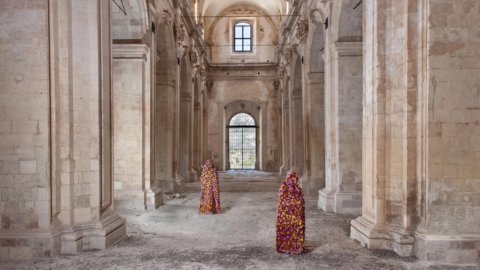
The images of Vinci–Galesi are visions full of contrasting elements. In contexts of symbolic value, such as a beach where sea and land vie for supremacy or in an abandoned quarry populated with stone residues, the two artists appear entirely wrapped in a colorful floral cloak that hides their facial features. Their figure thus becomes that of a spirit that disseminates color and the future in the gray and abandonment of the present.
The drape in which the artists are wrapped is made by hand sewing thousands and thousands of flowers on ethereal fabrics. Respecting an ancient tradition of the religious celebrations of another complex and difficult land, the Ragusa area, on whose coasts in recent years desperate people have landed from the other side of the Mediterranean fleeing war or bodies without hope have stranded. The beauty of those places, witnessed by some images of the latest projects, is a counterpoint that makes the limits of the human condition screech even more. Vinci–Galesi offer transitory visions, precious and fleeting opportunities. As fleeting as the beauty of a flower is fleeting, a marvel condemned to rapid decay.
The floral element transforms, enlivens, hides. It is a natural presence that contains a universe of meanings that have their roots in the most ancient mythologies. Flowers represent the image of life, rebirth and the seasonal cycle. They are an emblem of the transient fragility of the contemporary world, an image of joy and mourning. Of the eros that animates earthly love and of the peace that dissolves the celestial one.
On the opening day of the exhibition, May 20, Vinci–Galesi will give life to a performance together with two groups of bardatori from Scicli and a black Friesian stallion, Eros, gathered in a group completely cloaked in flowers. Transformed into floral evocations, they will advance from the garden through the telescope portico, designed by Vanvitelli to provide the visitor to the Reggia with a dizzying perspective, and then ascend to the noble floor through the majestic central staircase of the residence.
As the curator Daniele Capra writes in his text, “the performance suggests, in a symbolic way, the mimetic and metamorphic potential inherent in the floral element, which is brought to the maximum degree. The simple but haughty beauty of gerberas and chrysanthemums embodies the reaction to the decay of a territory subjugated by crime and pollution caused by waste. It is a metaphor for the possible reversal of the forced circumstance of imprisonment, it is the dream of rebellion against a situation from which, rationally, one could not have imagined a viable way out”.
The La terra dei fiori project is realized thanks to the groups of bardatori Le Milizie and Balucu and Pagghiara.