Milan, Florence and Venice are the more sustainable cities according to the Agici Sustainable Mobility Index. The Lombard capital is confirmed in first place for the third consecutive year (with a score of 69,2), followed by Florence (62,6), Venice (57,5), Rome (53,5) and Bologna (52,7). Among the worst Messina (23,4) Catania (23,6) and SIRACUSA (23,7). Also this year, the North-South gap in the overall level of sustainability of urban transport remains. The South recorded worse performances in all areas, except for health and safety indicators, i.e. air quality and accident rates. The widest gaps are due to soft mobility - pedestrian and cycle and last mile logistics.
Il Agici Sustainable Mobility Report 2022 was presented during the event “Building the future of Italian mobility. Mobility as a Service: from a promise to a concrete opportunity for citizens and operators", held in Milan on Friday 7 October at 11.00, at the Palazzo delle Stelline.
Agici Sustainable Mobility Report: the IMS index
The IMS index is calculated on 43 Italian cities (provincial capitals with over 100 inhabitants). The ranking (with a score from 0 to 100) is based on different aspects of the urban mobility: 24 indicators grouped into 7 thematic macro-areas: 1) private transport; 2) public transport; 3) soft mobility; 4) sharing mobility; 5) integration and policies; 6) health and safety; 7) last-mile logistics.
The electrification of buses is growing, the motorization rate is decreasing
In general, trends also emerge from the report, accelerated by the pandemic, in all the cities analysed. The electrification of bus fleets is growing by 15%. and the renewal of the car fleet is constantly increasing - albeit slowly -. There is also a trend of reduction in the motorization rate, for now in the cities of the North. The share of NO2 then improves: -14% and the levels of PM10 and PM2.5 particulate are stable.
Sharing mobility: boom in scooters, increasing cycle paths
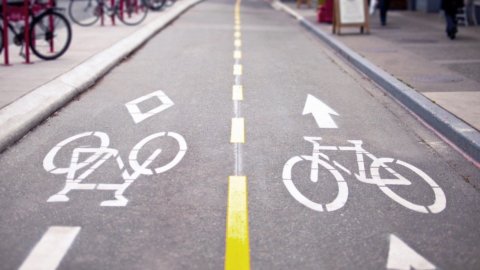
With regard to the sharing mobility, car sharing fleets grow by 11% and the boom in scooters (+38%). They also increase cycle paths (+5km on average per city), in particular, in Genoa +20km; Milan +13km; Venice +14km; Palermo +13km; Cagliari +12km. Pedestrian islands show a stable average extension. They decrease in Naples and Palermo; they grow up in Rome and Turin.
- investments in sharing mobility once again they see Milan as the leader (82,8) followed by Bergamo (50,3) and Florence (47,8). While on health and safety, ie air quality and the accident rate, the record goes to Reggio Calabria (99), followed by Sassari (90,5) and Perugia (88,4). Finally, for last mile logistics, i.e. commercial vehicles, the rankings are led by Florence (99), Milan (90,5) and Bologna (88,4).
Milan in first place in private and public transport
As regards the thematic macro-areas, Florence (93,9), Milan (91,7) and Bologna (86,4) lead the ranking in private transport, with a decrease in the motorisation rate and an increase in the sustainability of the car fleet, while for the public transport the Lombard capital reaches the maximum score (100) followed by Rome (89,2) and Venice (85,3).
The smaller cities such as Rimini (88,6), Padua (88,4) and Ravenna (79,7), on the other hand, have a better ranking as regards gentle mobility with spaces and infrastructures dedicated to cycling and walking.
Sustainability impact based on city size
The report also highlights the impact on sustainability determined by the size of cities, for which it is necessary to use different levers depending on the context. For the large and very large cities (from 250 to over 500 inhabitants), for example, major investments in infrastructure will need to be evaluated to enhance local public transport, making it more efficient. Just as it will be strategic to fill the gap on soft mobility with smaller companies. A process already started by Milan, Turin and Bologna. Furthermore, in large areas, investments in sharing mobility will have to continue with an enhancement of opportunities for citizens.
for medium cities (from 150 to 250 inhabitants) the integration between local public transport and sharing mobility will be fundamental, also going to cover those areas which, for reasons of cost-effectiveness, are not currently served by public transport, just as it will be successful to continue in the infrastructure development process of soft mobility.
in small towns (under 150 inhabitants), in which the local public transport offer is lower than in larger cities, an integration of the latter with on-call services and sharing offers is conceivable. Incentives for the replacement of the car fleet with a greater diffusion of the recharging infrastructure will also be needed for these centres. Finally, as far as pedestrian and cycle paths are concerned, it is desirable to provide stalls and tracks to connect points of interest such as shopping centres, schools, universities and stations.