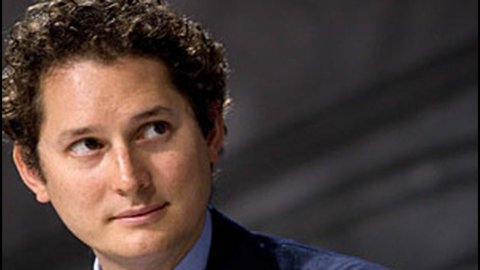
The telephone calls with which the president of Fiat John Elkann first informed the Head of State and then the prime minister and finally the other members of the RCS syndicate agreement of the doubling of Fiat's share in RCS itself with an investment in the Stock Exchange of 90 million euros they are worth more than any comment and capture the importance of an unexpected operation that goes far beyond the shareholding strengthening of the editorial group that publishes Corriere della Sera. Elkann's move makes Fiat the first shareholder of RCS, gives stability to the publishing group, changes the balance in Italian publishing by putting it in a position to open up to international partners (will the first be Murdoch?) without being colonized by it but sends two messages that go beyond RCS and publishing and which have a general value.
The first signal, in the aftermath of the visit - also unexpected - by the CEO of Fiat, Sergio Marchionne, to the Pomigliano plant to thank the workers for their willingness to work on Saturdays when production is busy, says that Fiat may also have his head in the world and in the USA but he continues to have his heart in Italy and when business opportunities arise, as in RCS, he does not hold back.
The second signal tells of an Italian capitalism which, however asphyxiated and opaque, is beginning to show some signs of vitality, starting with the first law that should inspire modern capitalism, namely that business is done by investing and opening the wallet and not by planning or by strengthening Chinese boxes to control capitalless companies.
But what matters is that the initiative of Fiat and its young president is not isolated but comes only a few days after the Mediobanca revolution which in the new business plan conceived by its CEO, Alberto Nagel, sends the logic of the parlor to the attic , which made the fortune of Enrico Cuccia and the Milanese merchant bank, however plastering Italian capitalism, announcing a disruptive novelty such as the progressive sale of all the shareholdings (except for Generali), the exit from the syndicate agreements and the concentration of resources and energies in the characteristic activity of a real bank.
If we add the less advertised but no less relevant decision of the CEO of Intesa Sanpolo, Enrico Cucchiani, to retire the ambiguous concept of banking system - which could have made sense when banks were public but would simply be anti-historical today – and the renewal of governance and the internationalization of Generali's management launched by the new CEO of the Leone, Mario Greco, it is difficult to deny that the crisis is finally pushing the major Italian groups to renew themselves and to change the way of being of national capitalism.
Franco Bernabè's project to free Telecom Italia from the shoals of a paralysis induced by a debt both past and present with the launch of the spin-off of the network and its future opening up to new shareholders to strengthen a key infrastructure for the country must also be counted in the column of the positive news that mark this phase of Italian capitalism.
The only discordant note is the lack of public shareholder change. The contradictory rules wanted by the Parliament on the new public appointments and the disappearance from the horizon of the Government of any even minimal privatization and liberalization project leave one incredulous. Fortunately, in the control room there are men of the value of Enrico Letta and Fabrizio Saccomanni and this leaves the door open to the hope of renewal, but it is time that they find the courage to play on the counterattack and to adopt innovative decisions on public enterprises that can also play unwelcome to Pd and Pdl but of which the major parties of the majority will sooner or later have to come to terms with it. In short, dear Letta and Saccomanni, if you're here it's time to strike a blow.