After two years of work, entrusted to the technicians of Royal Manufacturers De Wit of Mechelen in Belgium, the seven large tapestries, treasure of Palazzo Borromeo on Isola Bella, will be able to be admired again by the public starting next April.
The restoration of the delicate Renaissance fabrics was desired and financed by the Borromeo princes to safeguard the seven masterpieces (these are among the most beautiful tapestries of this era in Europe), damaged by time, dust and humidity, as well as parasites. The Borromeo princes received these works in 1787, the year in which the tapestries came to the family as a gift from Cardinal Vitaliano VII Borromeo to his nephew Gilberto V. First kept in the Palazzo in Milan, they were later transferred to Isola Bella where, to house them in an appropriate way, it was the “Gallery of Tapestries” has been prepared.
The earlier provenance is not certain but according to a very likely hypothesis the tapestries may have been part of the collection of Cardinal Mazarin, in whose inventory (1661) appears a series of "cloths" which correspond to this one in terms of format, subjects and themes of the borders . The powerful minister of Louis XIII had purchased these tapestries in 1654 from the Guise family and it is probable that it was the Lorraine cardinal Charles de Guise (1525-1574) who ordered their execution. A prominent figure such as the French prelate, with an eminent role on both the political and religious levels (he was the protagonist of the fight against the French Protestants and of the final phase of the Council of Trent, 1562-1563), can explain in part not only the exceptional artistic quality of the series but also the choice of subjects that under the veil of allegory illustrate the theme of "Sin" and that of "Redemption" made possible by Grace and divine Providence. The man and his work are absent from the images, but the titles continually refer to Christian morality and to the theme of sin and redemption. In this series, Evil takes on the appearance of wild or mythical animals such as the unicorn, according to a key to symbolic interpretation suggested by ancient and Christian sources.
The cloths have similar heights (412 cm) but different widths (from 502 to 650 cm) and all belong to the same set as demonstrated, in addition to the style data, by the identical design of the borders in each of the pieces (with the exception of the cartouches with the texts and medallions that vary in each example) and the coherence of the execution technique: a weft of wool and silk with gold and silver threads with a warp density of 9 threads per cm, and a chromatic range of great variety, with nuanced tones and pictorial effects of great refinement
All the elements of the series have identical borders: they include, among the foliage and vegetation, ten groups of figures facing the centre, representing mythological characters distinguished by a significant relationship with an animal whose name evokes that of a constellation; on the left Hercules kills the Lion (top) and Diana the huntress with the Dog (bottom); below Prometheus with the Eagle and Europa and the Bull (left), Phryxus and the Ram, Leda and the Swan (right); to the right Igea crowned with the Serpent (above) and Orpheus with the lyre and a Genetta; above Nod with the Dolphin (left) and Romulus and Remus with the She-wolf (right). Within this common decorative system which constitutes a sort of illustrated cosmography, each cloth includes three circular medallions and a large cartouche with texts and subjects in relation to the main figure.
There is no animal, vegetable or motto that does not respond to precise religious dictates and meanings. In fact, the works represent scenes that have an "apparent" aspect which, however, underlies a reading "by codes" and knowledge, a reading aimed at transmitting precise messages that we could define as "catechetical", in the sense that they refer to precise biblical teachings.
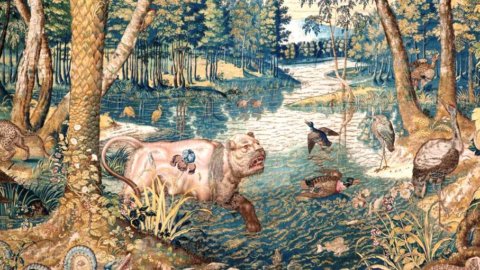
The "reading" of one of the Borromeo tapestries can provide an example. The one in which the central depiction is reserved for a lioness crossing a stream while a panther roams the forest. The other animals present in this scene move and live in perfect agreement with each other: a heron and a duck soar in flight, a snake gets rid of its venom so as not to poison, while drinking the waters of the river, the landscape is varied and rich in plants with medicinal properties such as iris and date palm. Nature is originally good and dictates its own code of behavior to animals; the edifying value of his example is underlined by the texts reproduced in the central cartouche which states: «Be prudent as serpents and simple as doves» (Matthew, 10, 16); « Observe the ant, lazy one, take example from its behavior » (Proverbs, 6, 6). In the left medallion there are two doves pecking at each other, symbolizing Chastity and Fidelity. In the central medallion, a snake closes its ear with its tail: snakes are sensitive to song and are often captured by this means. Their prudence and their instinct therefore lead them to close their ears so as not to listen. So the man who must not listen to deceitful voices that lead him to perdition. In the opposite medallion two snakes are depicted, one of which coiled around a tree: powerful antidotes are extracted from the snakes, the snake therefore has the power to heal, it also prefigures Christ, who healed man and gave him salvation .
As can be seen, a fascinating reading represented in images by a great artist and translated into silk, gold and silver by one of the best workshops on the Continent, to clarify the dictates of a Council, that of Trent closed in 1563, which gave the art the function of transmitting the dictates of a religion that permeated society. And it was precisely a family Cardinal, Carlo Borromeo, Archbishop of Milan, who was the key figure in implementing the principles of the Counter-Reformation of Tridentine origin.
The iconographic contents of the Borromeo Tapestries on Isola Bella
The man and his work are absent from the images but the titles continually refer to Christian morality and to the theme of sin and redemption. In this series, Evil takes on the appearance of wild or mythical animals such as the unicorn, according to a key to symbolic interpretation suggested by ancient and Christian sources.
All the elements of the series have identical borders: they include, among the foliage and vegetation, ten groups of figures facing the center representing mythological characters distinguished by a significant relationship with an animal whose name evokes that of a constellation; on the left Hercules kills the Lion (top) and Diana the huntress with the Dog (bottom); below Prometheus with the Eagle and Europa and the Bull (left), Phryxus and the Ram, Leda and the Swan (right); to the right Igea crowned with the Serpent (above) and Orpheus with the lyre and a Genetta; above Amphitrite with the Dolphin (left) and Romulus and Remus with the she-wolf (right). Within this common decorative system which constitutes a sort of illustrated cosmography, each cloth includes three circular medallions and a large cartouche with texts and subjects in relation to the main figuration. Observation begins along the right wall, from left to right.
First tapestry
A lioness crosses a stream, a panther prowls the forest. The other animals present in this scene move and live in perfect agreement with each other: a heron and a duck soar in flight, a snake gets rid of its poison so as not to poison by drinking the waters of the river, the landscape is varied and rich in plants with medicinal properties such as iris and date palm. Nature is originally good and dictates its own code of behavior to animals; the edifying value of his example is underlined by the texts reproduced in the central cartouche
Central cartouche: "Be prudent as serpents and simple as doves" (Matthew, 10, 16); «Observe the ant, lazy one, take example from her behavior» (Proverbs, 6, 6)
Left medallion: two doves peck at each other; they symbolize Chastity and Fidelity
Central medallion: a snake closing its ear with its tail: snakes are sensitive to song and are often captured by this means. Their prudence and their instinct therefore lead them to close their ears so as not to listen. So the man who must not listen to deceitful voices that lead him to perdition.
Right medallion: two snakes, one of which coiled around a tree; powerful antidotes are extracted from snakes, the snake therefore has the power to heal, moreover it prefigures Christ, who healed man and gave him salvation.
Second tapestry
On the left, the unicorn pierces a lion and pins it to a tree; in the foreground a monkey carries two fleeing children, below a shell, a magnificent lobster, a bird of prey killing a fish, to the right a large starfish can be seen through the transparency of the water. In the background various animals graze, an elephant, a giraffe, a zebra, panthers and donkeys. The unicorn is here the symbol of evil and the image of the pierced lion has been interpreted as an allegory of Christ and his Passion. the pleading tone of the comment text seems to confirm this reading
Central cartouche: "Save me from the jaws of the lion and from the horn of the unicorn, defend my fragile existence" (Psalms, 22, 22); « God protected me from the claws of the lion and the bear and will save me from the hand of Goliath » (I, Samuel, 17, 37)
Left medallion: a deer pierced by an arrow, alludes to the ability to bear suffering as Christ endured it for the salvation of man.
Central medallion: A lion and a rooster, the lion trembles before the rooster, so worldly power must tremble before divine power. Right medallion: two lizards, one of which eats leaves, are probably chameleons which, according to legend, if injured by the crow, are saved by eating laurel, a plant well known for its health benefits.
Third tapestry
The Unicorn is attacked by two lions and two panthers, on the left parrots and three turtles against the background of a dense forest. The text from Ecclesiastes that comments on the image evokes man's ability to tame the brute forces of nature thanks to God.
Central cartouche: « The Lord gave men power over the things that are on the earth. He put the fear of man on every living thing and his dominion over wild beasts and fowl" (Ecclesiasticus, 17, 3-4)
Left medallion: a goat feeds a snake; as the goat feeds the snake that when it is an adult will devour it, so the wicked must not be allowed to fortify himself and attack his benefactor.
Central medallion: a unicorn cannot feed itself because its horn touches the ground and prevents it from approaching food with its muzzle, around other animals, on the right a lion. Here the unicorn seems to symbolize the pride that can do nothing without God's help.
Right medallion: a lion chasing a cow; as the lion, a brave animal, attacks only enemies worthy of him, so noble souls pursue only worthy high goals.
Fourth tapestry
Two large ostriches appear in the foreground; one looks at four eggs (according to the legend ostriches do not brood their own eggs), the other pecks some grapes from a vineyard (symbol of the Church and eternal life). The ostriches, in Saint Jerome, represent the Church, the eggs her spiritual children that the church abandons to persecution but that God will strengthen with the light of his faith. Behind them are other animals: a third ostrich and a running horse, the clash of two deer, a lion carrying its prey to its young, a predatory bird devouring another bird. These depictions tend to underline the unfathomable character of divine designs and the need for man to abandon himself to Providence.
Central cartouche: « The ostrich leaves its eggs on the ground and lets them heat up in the dust; forget that a foot can trample them, a wild animal can crush them" (Job, 39, 14-15)
Left medallion: A monkey flees with her young; the favorite close to the chest risks being suffocated while the less loved one, clinging to the mother's back, has a better chance of being saved. He alludes to divine Providence which takes care of the humble, the outcast, the poor. Central medallion: An ostrich looks at the constellation of the Pleiades in the sky: according to another legend, the ostrich, after laying its eggs, incubates them with the rays that come from its eyes. The ostrich is here the symbol of the spiritual father, that is of the Heavenly Father.
Right medallion: An elephant; animal endowed with rare virtues including that of piety that men should imitate.
Fifth tapestry
A lioness feeds her young in a den at the base of a group of trees; on the left a lion kills its prey, on the right two large lizards. In the branches of the trees a monkey and a pheasant; in the distance two giraffes and an elephant fighting a rhinoceros. The depiction seems to allegorically evoke the theme of free will: God allows the existence of evil but supports the just in the fight against sin.
Central cartouche: "By your Wisdom, Lord, you formed man to dominate the created beings made by you" (Wisdom, 9, 1-2)
Left medallion: A fish in the stormy sea in front of a rock; that is, as one who lives according to his natural condition cannot be harmed, so the Christian who follows the Gospel can overcome spiritual and material difficulties.
Central medallion: a lion is reflected in the water of a river; according to ancient exegetical texts, when hunters capture a tiger cub, they deceive her mother by placing mirrors on her fireplace. The mother thinks she has found her son but she realizes her mistake too late. That is, the illusion of the senses misleads us from the truth; here the tiger is replaced by a lion but the symbolic meaning is the same.
Right medallion: two lions chasing monkeys; as the sick lion is healed if he eats monkey flesh, so man gets spiritual healing if he annihilates the devil who leads him to sin.
Sixth tapestry (on the left wall, next to the entrance)
A panther attacks a lion, to the right an otter devours a fish; other panthers stalk monkeys and a goat; all the animals are portrayed here in the act of attacking or chasing other animals. Brute strength without Grace without Reason is inferior to man.
Central cartouche: "Every species of beast, bird, reptile and even marine animal is tamed by men" (Letter of St. James, 3, 7)
Left Medallion: A hedgehog facing a lion; according to legend, the porcupine is able to launch its quills like projectiles, here perhaps it alludes to the struggles unleashed by passions
Central medallion: A lamb pierced by an arrow; alludes to Christ, wounded by the sins of men
Right Medallion: Monstrous reptile hypnotizes bird; perhaps it illustrates a passage from Pliny according to which some reptiles can subdue even high-flying birds with their gaze; the moralized reading of the enterprise seems to allude to the dangers of voluptuousness and the ability to fly easily.
The seventh element of the series is dominated by two large snakes and a panther killing a monkey, and seems to allude to the damnation of the guilty.
Six of the seven tapestries restored they can be admired in the tour of Isola Bella and Palazzo Borromeo.