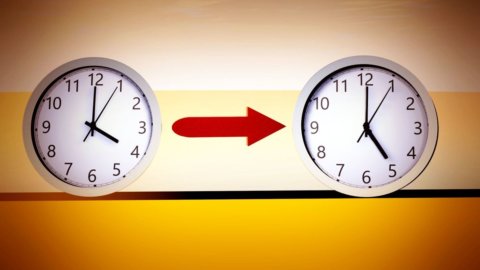
The last weekend of March arrives and as usual (at least for now) we will return to move the clock hands. In notte between Saturday 25 and Sunday 26 March will enter daylight saving time 2023. at two in the morning we'll have to move the hands forward one hour. We will sleep less for one night but we will have more light during the day and will therefore be able to enjoy an extra hour of sunshine, with savings also on energy costs.
Daylight saving time will last seven months: on Winter time will return to effect on October 29 and we'll have to turn the clock back one hour.
What is daylight saving time for and how much can you save?
Lo purpose is to optimize daylight hours for reduce consumption. Terna, the company that manages the Italian electricity grid, said in a note which – thanks tosummer time 2023 – Italy it will save about 220 million euros, thanks to a lower consumption of electricity equal to about 410 million kWh, equivalent to the average annual requirement of around 150 families. While from 2004 to 2022 the lower electricity consumption for Italy due to summer time was a total of 10,9 billion kWh, for a total of 2 billion euros. In environmental terms, the benefit can be quantified in a very significant cut in emissions: we are talking about about 200 tonnes of carbon dioxide less in the atmosphere.
“The months that mark the greatest energy savings are April and October – explains Terna – Moving the hands forward by one hour, in fact, delays the use of artificial light at a time when work activities are still in full swing. In the summer months, the delay effect in turning on the light bulbs occurs in the evening hours, when work activities are mostly finished, and records less evident values in terms of electricity savings”.
Since when is daylight saving time in effect and why do we want to keep it all year round?
Daylight saving time was introduced in Italy in 1916, with the legislative decree 631: with interruptions between 1921 and 1939 and then between 1948 and 1965. A EU level has been in force since 1976 and has been adopted with a common timetable since 1996.
For years though in Brussels there is talk of abolishing alternation and maintain daylight saving time all year round. The president of the European Commission had announced thestart of the bureaucratic process for the cancellation of the changeover between summer time and standard time but to date no decision has been made yet. In 2018, discussions began on the changeover from standard time to summer time. In 2019 the European Parliament he pronounced himself, with 84% of the votes, in favor of abolishing summer time; however, the final decision was deferred to the individual Member States. With the freedom of choice, however, a second problem has emerged: if each country decides on its own, in Europe there will be different times in addition to the time zones already present. The idea would be to leave each EU state free to choose whether or not to continue alternating summer time and standard time. However the international dispute is resolved, Italy does not seem inclined to change the time change that has been in force for decades now.
They are, in fact, above all the northern European countries, wanting to eliminate summer time, as in those latitudes, having an extra hour in the summer months does not offer the same benefits as in southern countries.
Il debate, at European level, is always very heated but the final decision seems far away. The time change it will therefore also continue in the coming years on the beautiful country.
Abolition of solar and daylight saving time change: the pros and cons
The abolition of solar time would really bring positive effects on bills? According to many, there would not be all these advantages because the estimates do not take into account the greater consumption of electricity in the morning that would be created with permanent daylight saving time.
One of the reasons why some countries are instead unfavorable to the time change is linked to the negative effects that this has on the body: the time change every year causes a lot stress. e physical discomforts which are recorded mainly on the most sensitive subjects, including children and the elderly. However, other experts warn that daylight saving time deviates from the human body's circadian rhythms to a greater extent than solar time: waking up before dawn is one of the underlying causes of metabolic disorders, cardiovascular problems and insomnia.