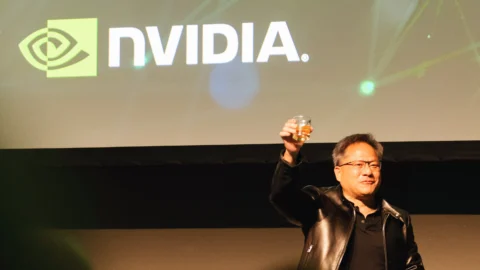
Dressed in his signature black leather jacket, in an ice rink with a capacity of over 18.000 people, the Nvidia CEO Jensen Huang He once again managed to impress with his speech at the four-day conference, the Nvidia Gtc in San Jose, California, which has become one of the largest showcases of AI technology.
The focus on Huang was no longer just on the new "AI-related wizardry" that the company, with the largest market capitalization in the world, would be able to churn out. But above all, whether the new products would be able to attract sufficient demand to maintain at astronomical levels turnover and company profits. Hung's response was primarily aimed at allaying these fears: the opportunities for turnover for its chips of artificial intelligence could reach at least $1 trillion by 2027, said the CEO. The new forecasts represent a notable increase compared to the $500 billion expected by 2026 and indicate that there is steady demand, analysts say.
Techies overcome fear of war's repercussions
Not only did the stock rise yesterday Wall Street, closing up 1,6% at 183,19 dollars, well below the session high (189 dollars), dragging the rest of the US sector along and causing the Nasdaq up 1,22%, but it also brought benefits to the Asian markets and in particular to the index Kospi of South Korea with a high technological concentration (+3%). All this in a context of extreme weakness in stock markets under pressure from the conflict in the Middle East, rising energy costs, fears of rising inflation and an economic slowdown.
Nvidia is coming off a run that has seen its stock price rise more than 1.000% in about five years. Over the past 12 months, it has gained 53%, and by October 2025, the chip giant will become the first company in history to reach a market capitalization of $5 trillion. In pre-market trading today, the stock is virtually stable.
Hang's ace in the hole is in perfecting the responses to user requests
Huang knows well that the new frontier of the sector is the so-called inferential calculus, or the process of answering queries, that is, requests for tasks or information placed by the user, and wants Nvidia to consolidate its position by addressing the competition of central processing units and custom processors made by companies such as GoogleFor years, Nvidia chips have dominated the training process for artificial intelligence models.
Huang presented a new central processor (the brain of digital devices, the so-called CPU) and a work of artificial intelligence based on Groq technology, a chip startup that Nvidia licensed for $17 billion last December, during its annual GTC developer conference in San Jose, California.
Consequently the inference, Huang said, could be divided into two phases. The chips Vera Rubin Nvidia will handle a first phase called “pre-filling,” where the user's request is transformed by human words in the language of “tokens” used by computers equipped with artificial intelligence. Then the new Groq chips will run a second “decoding” phase where the computer will provide the answer the user is looking for.”This will definitely become a multi-billion dollar business for us“, Hung said.
During the GTC 2026, Nvidia also officially announced the Dlss 5, new evolution of its rendering technology based on artificial intelligence. Coming this fall, it is described by the company as “the most significant advance in computer graphics since the debut of real-time ray tracing in 2018.” The system introduces a real-time neural rendering model capable of enriching pixels with photorealistic lighting and content, bridging the gap between traditional rendering and close-to-life images.
STMicroelectronics Announces Alliance with Nvidia to Accelerate Physical AI and Humanoid Robotics
Meanwhile, STMicroelectronics announced a strategic alliance with Nvidia to accelerate Physical AI and humanoid robotics. The stock lost 1,1% on the Milan Stock Exchange. The agreement aims to integration STMicroelectronics' broad portfolio of sensors, microcontrollers (STM32) and motor control solutions, with theNvidia's robotics ecosystem, to provide developers with more efficient tools for designing humanoid, industrial, and healthcare robots, the company said. The goal is to provide calibrated robotic models that faithfully mirror the devices' real-world behavior, improving robot learning and reducing training cycles.
“Our collaboration with Nvidia aims to kickstart a new cycle of innovation at the forefront of field of robotics "This simplifies the developer and customer experience at all stages, from AI algorithm conception to full sensor and actuator integration," said Rino Peruzzi, Executive Vice President, Sales & Marketing, Americas & Global Key Account Organization at STMicroelectronics. "This will accelerate the evolution of sophisticated AI-based physical platforms."