The Apocalypse clock that had stopped since 2015 at three minutes to midnight (for the University of Chicago scientists who created it in 1947 and who qualify midnight as the end of the world) since Trump's election marks only two minutes to midnight. As in 1983, during the period of the first cold war between the USA and the USSR. There are two options for a certain end of the world: climate change or the renewed use of nuclear weapons. Believe the Doomsday Clock or not, certainly after the latest massacre of innocents in chronological order in Aleppo the questions about who finances the Assad regime and the over 70 rebel groups present on the Syrian war theater, and why North Korea you continue to break fine the sanctions are becoming more and more pressing.
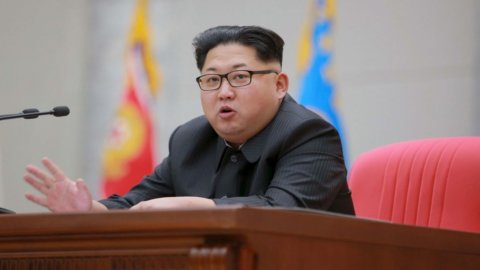
US Vice President Pence takes the term "strategic patience" out of his hat and we wonder if it could connote and therefore explain the passive and incomprehensible behavior of the Obama administration in letting the ISIS phenomenon grow and act and in leaving the US spectators of the immense Syrian massacre. And behind this "strategy of not doing and standing by" there are those like the North Korean leader, who instead has worked hard to strengthen international trade relations by circumventing sanctions. Thus continuing to use Chinese enterprises as a screen and also access to international banking channels without any obstacles. First of all by selling raw materials such as rare earth metals to China of which the territory is rich, which are crucial for the technology industry and with which components for mobile phones, computers, LCD screens and cars are produced.
Kim Jong exports not only commodities but also manpower to China, Russia, Eastern Europe and Southeast Asia. In fact, it is known that there are no problems of labor flows with countries like Malaysia, where there are tens of thousands of North Koreans. And then there are FDI, investment flows from abroad, which dominate: for example, the Egyptians have invested heavily in the telecommunications and industrial sectors, leaving the mining and fishing and large-scale retail sectors to the Chinese. Until a year ago, the Chinese supplied North Korea with oil and energy at subsidized prices, in perfect accordance with the US strategy of non-aggression. We must also not forget that, again up until a year ago and therefore before the resumption of nuclear tests, attempts at cooperation with South Korea had brought hundreds of millions of US dollars towards the border industrial districts.
It should be clarified that China does not want the implosion of the North Korean regime and even less the reunification with South Korea because, exactly as in the case of Ukraine, it would mean having US troops at the borders. Exactly the same problem Russia has with the EU.
It is clear that Kim Jong knows perfectly well that China cannot afford the fall of its dictatorship also because, where the Chinese are pulling the oars to avoid an immediate clash with the USA, the Russians make themselves available to cover the needs of the small state which it has abandoned the strategy of the simple threat to have livelihoods and has developed a rather well organized war industry, including digital violation of Western computer networks, as in the famous Sony case of 2014.
Russia sees North Korea as an ideal partner for an energy corridor to Southeast Asia and from South Korea to Europe via the Trans-Siberian route. The paradox of the sanctions also derives from an interpretation of convenience for which one should not be surprised if, when staying in the luxurious Sky Resort in Masik, all the lifts were supplied by Austria.
And if there is no shortage of electoral appointments with the recently announced French and British elections, we must not forget the May 9 presidential elections in South Korea. These could bring constructive dialogue back to the center of the risk of an unprecedented war confrontation after 10 years, from 1998 to 2008, of the Sunshine Policy launched with Bill Clinton and interrupted by George Bush with the declarations on the "axis of the devil", Iran, Syria and North Korea. Because Bush then, like Trump now, needed to shift US attention to a war confrontation in order to recover consensus and favor the arms lobbies which have always had a considerable weight in the support of American government administrations.
Among the lenders of North Korea then also the United Kingdom which has supported with over 4 million pounds in the last six years and 740 thousand pounds in 2015 alone aid projects aimed at "safeguarding Western values", according to official documents.
To summarize: if we add up the early elections in the United Kingdom (which are placed between the French and German elections), the tensions with North Korea, the collapse of steel and other commodities except oil and gold (for obvious reasons linked to widespread political uncertainty), the new prospects for a reduction in Draghi's Qe and Trump's war anxieties, we have sufficient elements to start a portfolio repositioning in favor of the British pound, of core European equity markets versus peripherals and towards emerging markets. Excluding Turkey of course.
Thus, in the era of FinTech and the fourth industrial and technological revolution of Big Data and BlockChain, if an agreement has never been found on the monitoring of financial flows to current accounts in support of Islamic extremists or Kim Jong, by placing no brake on financial exchanges linked to armaments in countries under sanctions, one should not be surprised. It seems evident that there is no interest in making the conflict escalate but rather in finding favorable agreements for the maintenance of buffer states such as North Korea and the continuation of that dialogue with South Korea and the USA to prevent an Iran creates a negative spiral with the ongoing Middle East conflict, where Israel is becoming another crucial player to resume the lost dialogue on the word of end of the civil war in Syria.