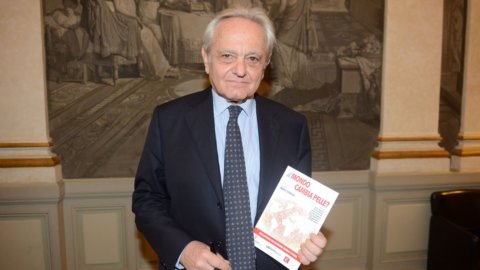
Goodbye globalization. Or maybe not. "But an epoch leap such as the one we are experiencing cannot be treated as an emergency or an uninterrupted series of emergencies of various types that can be overcome with the previous situation". Mario Deaglio thus he resorts to a previous image by Massimo Cacciari: "in a leap in time nothing is destined to return: in this perspective, those who can must act".
Four proposals for the new legislature
It is the challenge that the Turin economist, columnist de The print after directing Il Sole 24 Ore in one of his brightest seasons, he wanted to pick up in the last one global economy report now in season number 26. Not only analysis, but also the indication of paths to follow to emerge from the pond. A compass for Italy, today like yesterday. Then, the year 1997, a brilliant idea to place the Italian economy in the context of the global New World, smelling of the Renaissance. Today, between Covid and flashes of war, a way to face the post-global world, complicated and driven by protectionist intentions. A problem of no small importance for Italy which in the meantime has exports multiplied, going from 30 to 100 billion in value.
From here four proposals concrete at the start of the legislature:
- An tax reform that makes it convenient to work and invest,
- An review of the tax discipline on mergers,
- The introduction of the family quotient in direct taxation,
- The experimental introduction of the four-day work week supplemented by distance learning activities, increasingly necessary during working life.
The four big disruptions of 2022
It is the result of a comparative analysis between the great areas of capitalism through the reading of four major disruptions which marked a very difficult year. In particular:
- the fragility of the global economic system in the face of the problems of value chains that emerged with the pandemic and the widening of the gaps between different classes. The reduction of value chains has invested a large part of the businesses. “In a matter of months, global value chains have become chains of scarcity and fear.”
- La environmental crisis associated with the use of energy resources. For some time we have been grappling with a long-lasting crisis, exacerbated by drought, largely connected to the use of energy resources and the virtual world. If the Internet were a nation, it would have the fourth largest electricity consumption in the world, surpassing Japan. And data mining, or rather the extraction of results from databases, is starting to beat the consumption of the mining industry.
- La economic and social crisis with its repercussions on generations, starting with the youngest. As well as the acceleration of the trend to work remotely with effects on the real estate market but also on the reduction of the difference between work (in constant evolution over the course of existence) and free time.
- La geopolitical crisis of the planet and the possible consequences on the evolution of the global economy. The Ukrainian war is only the most dramatic aspect of the breakdown of the foundations of the world order that emerged from the World War. Hence more tensions and conflicts, less trade and less development.
European therapies for the four crises
But also a reminder of the tasks that Europe is obliged to do it in a short time. In particular:
- The modification of the treaties and the abolition of the unanimous vote
- The establishment of European armed forces;
- A common energy policy,
- ECB loans to individual Member States
- Maintenance of the Next Generation Eu fund to be spent on long-term development plans
- Institutionalization of Sure, the support tool against unemployment
- Improved health coordination.
There are no unusual ones therapies for the four crises which, all together, have put traditional ideologies and value systems to the test. Without getting caught up in the temptation of slogans or shortcuts which today as yesterday can only translate into disappointments.
“Something like this happened at the time of the plague of Manzoni, when the virus of that time seemed to have been defeated and a thanksgiving procession carried the relics of San Carlo around Milan, thus favoring a new comeback of the disease". On the contrary, Deaglio recommends, in order to act "it is good first to observe in a non-excited way, refraining from making conclusive judgments: in this context, ideologies and politics have a different role than usual: they must critically analyze themselves not looking for the culprits but at the discovery of causes and establishment of facts”. This is the method which, once again, makes this report unique (also for the quality of the writing) in journalism.