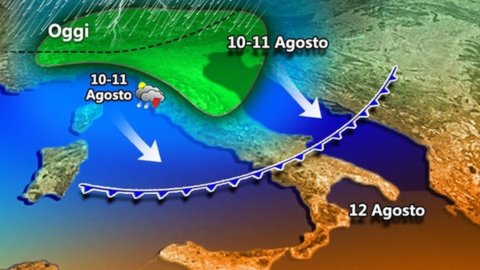
Lucifer is leaving. The long period of scorching weather that has gripped the whole of Italy for weeks is (finally) coming to an end: over the weekend, to be precise starting from Saturday 12, a further thermal decrease is announced, which this time should also benefit the South, where temperatures are still around 35-40 degrees in the maximum values, with the air now unbreathable in the main urban centres.
While the North has already been breathing for a few days, the Center-South has in fact to resist a little longer: there won't be too many storms over the weekend, which would have been good also for the drought problem, but certainly cooler air, with the temperatures that will also drop by 10-11 degrees compared to the current ones. Thursday 10 August there are still 14 Italian cities with a red dot, including all the provincial capitals of Lazio including Rome, Perugia, Naples and all the monitored centers of Puglia, Calabria and the Islands, while from Friday 11 according to the Bulletin of the Ministry of Health the scepter will remain in the hands of Catania alone and from Saturday it will feel good everywhere.
The heat wave is therefore gradually ending, and – if the trend is confirmed – it should be a sunny mid-August but with bearable heat. In Rome, for example, 28 degrees are expected on Friday, in Naples 30, in Bari 25 and in Palermo 27 and the trend will also be confirmed on Saturday, when a maximum of 30 degrees will be recorded only in Bari, Florence and Bologna, while in the other main capitals it will remain below. There will be a small increase on Sunday 13 August but the heat should remain within the limits of bearable until August 34th, when however in Rome and other cities the maximum could return to 35-XNUMX degrees.
The drop in temperatures in the North will also be accompanied by some stormy phases, but as already mentioned only in the North, while in the South there will probably not be significant rainfall for many more days. The drought that has been affecting our country for months is therefore destined to worsen and also the fire danger remains extremely high. The great heat has also affected bees, causing serious repercussions on honey production, which has collapsed to a minimum in 35 years.