Being born the son of Ezio Santin, one, together with Gualtiero Marchesi, of the absolute great masters of Italian cuisine, one who for 30 years, from the kitchens of the Antica Osteria del Ponte in Cassinetta di Lugagnano was a beacon of reference for generations of Chefs skyrocketing, is equivalent to being born with a nice life insurance. With so much father, a cooking genius who arrived in the kitchen after different professions at the age of 39, the second in Italy to historically conquer, after Marchesi, three Michelin stars, and the second who after Marchesi, at the age of 72 had the courage to give them back because had enough of feeling subjected to the judgments of the Red Guide inspectors, the young Maurizio Santin, born in 1969, would have had a smooth and golden life in accepting his father's inheritance and living on his laurels in a restaurant that aroused reverence just by naming him.
And instead the boy Santin decided immediately that he would not be a father's son. Mind you, no rebellion, far from it. The young Maurizio "proud son of one of the fathers of great Italian cuisine" while aware of the fact that carrying an important surname in the world of food allows you to find open doors, immediately chose stubbornly to take the path of pastry: "with a surname like mine I had to assert myself, he declares, with even more strength – but the determination and passion for this job have never lacked me – in a similar but parallel path to that traced by my family”.
Certainly that surname – he acknowledges – ensured him a “happy, rigorous youth, with a good dose of vices on the part of my paternal grandmother, between Milan and Cassinetta di Lugagnano”, a delightful village that occupies the two banks of the Naviglio Grande, a time chosen by families well to build the villas outside the city. All this has contributed to forming his character which is decisive, meticulous, severe and passionate, all qualities that have helped him in his professional training. It is true that the thing that most interested him as a young man was travelling, discovering the world and doing something that fascinated him and today he says: "... I was lucky: I was able to do it and I still do it". But the passion for pastry - with a "restaurant" declination - I have always breathed. And God only knows how fundamental rigor, determination and meticulousness are in pastry-making.
The passe-partout of the name and that of the character have thus allowed him not to enter the world of higher professional training through the back door but to burn all the stages. First obligatory stop France where he has access to the kitchens of the most important restaurants and where "somehow I always managed to get assigned to the pastry shop... it was irresistible for me".
Decisive for his training are the professional pastry courses at the prestigious school of Gastone Lenôtre in Plaisir and those of the Etna-University school of La Sorbonne. Trained at the two high schools, he then embarks on the path of work experience in restaurants with high-sounding names: the Taillevent in Paris, considered more than a restaurant, the embodiment of French haute cuisine, 3 Michelin stars, the George Blanc in Vonnas 3 stars in the The Michelin Guide which talks about it in these terms: "the kitchen here rises to the rank of art", Joel Robuchon's Jamin the undisputed leader of the Michelin Guide with 32 stars conquered during his extraordinary career, the Louis XV of the Principality of Monaco Alain Ducasse is the chef at the head of a group with 1400 employees that controls 20 restaurants in various countries, the only Chef who has succeeded in the remarkable feat of simultaneously managing three 3-Michelin star restaurants in three different countries.
By now he is an established pastry chef and can return home to the 3-Michelin-starred family restaurant in Cassinetta di Lugagnano, where he remained from 1991 to 2004.
Almost a duty, but Maurizio Santin is too free a spirit to feel caged in even a golden family cage. He wants to try his hand at constant challenges, to enrich his cultural horizon, to immerse himself in different gastronomic realities, to approach new ways of pastry-making. And he takes off. He leaves Milan and lands in Rome where he becomes a consultant and executive-chef at Gambero Rosso's City of Taste. For ten years he taught pastry-making at the Città del gusto-Gambero Rosso schools in Rome, Naples, Catania, Palermo, and was a guest-judge in the show “This I did myself” on GamberoRosso Channel Sky. From Gambero Rosso – by now he is a TV star – he passes to Raiuno, where Antonella Clerici makes sure of him for two years as a guest in the test of the cook, from which he bestows sweets on half of Italy on television. At the same time he was requested in Italy and abroad for technical-professional consultancy, he became a consultant for the Sant Ambroeus restaurant in New York, became a pastry teacher at the Castalimenti and Alma professional schools, held amateur courses at institutes and cooking schools throughout Italy. Twice he has been recognized, in 1998 and 2008, as best pastry chef of the year, the Gambero Rosso Pastry Guide assigns him the three cakes the highest recognition.
Frantic, tireless, he also finds the time to write a series of books that are soon sold out, such as "The sweets of Maurizio Santin" published by Gambero Rosso, "Pastry my basic recipes", "Frollini", "The sweets of my house" , “Cioccosantin”, all published with Tommasi Editore. In addition, from 2011 to today he has edited a regular column in the sector monthly "Il pastry chef" Italian Gourmet editions.
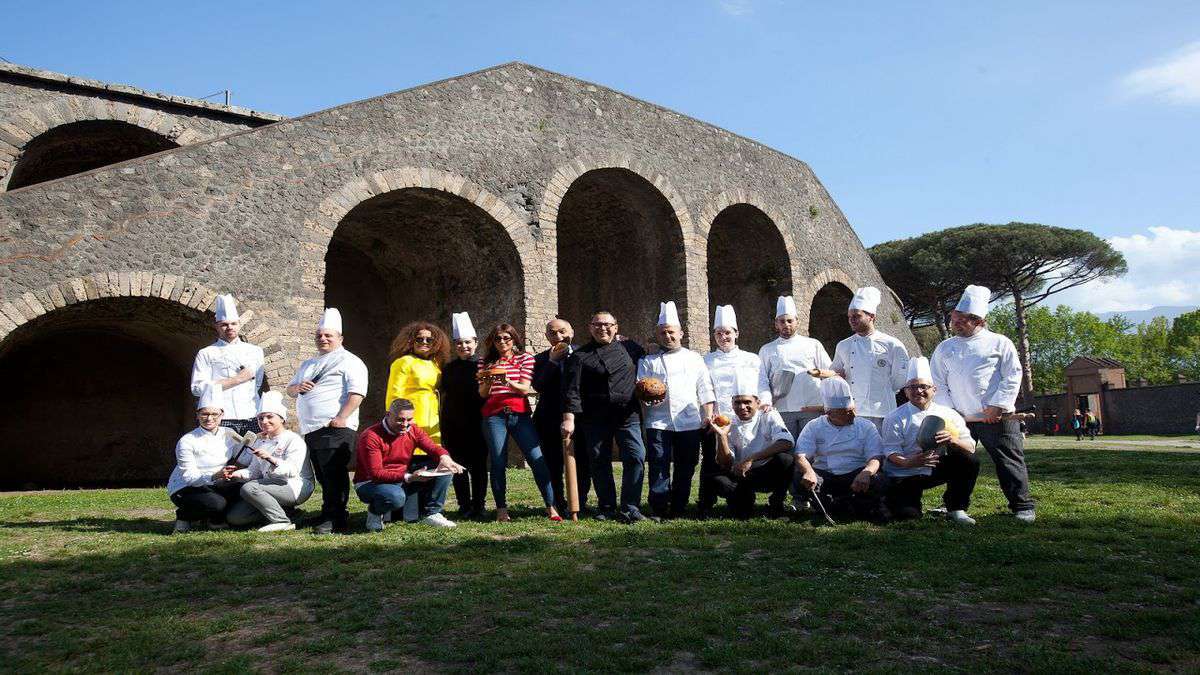
Maurizio Santin and the pastry brigade De Vivo in Pompeii
And that's not all, because always driven by his desire to experiment and experiment with new experiences, he goes to Palermo, where he starts a three-year collaboration with the Spinnato café, a real institution for the Palermitans that has its roots in the distant 1860, the year of Garibaldi's Expedition of the Thousand, in via Principe di Belmonte, a stone's throw from the Politeama, the cultural nerve center of the Sicilian capital.
Spinnato, an old friend, had called him to give a new set-up to the Cafeteria laboratory that had been in business since 1860, "a beautiful and stimulating adventure".
But it is in 2019 that Santin starts a new important chapter of his "sweet" life experience.
In Pompeii, a few hundred meters from the entrance to the archaeological excavations, a destination for almost four million visitors every year, there is an ancient traditional pastry shop, the De Vivo pastry and ice cream shop, born in the XNUMXs as a bakery for gourmet who passed between the archaeological excavations and the sanctuary. From the XNUMXs to today, the De Vivo family religiously observes a fundamental rule: the use of mother yeast, and this makes you understand how tied they feel to tradition. Sixty years and two generations later, today the pastry shop is led by Marco De Vivo with his wife Ester and daughter Simona who has given a strong acceleration to the family business, making it one of the most successful pastry chefs in Campania and therefore d Italy in compliance with teachings and techniques handed down and refined over the years, which today, despite having maintained its artisan structure, exports its products abroad to France, Switzerland, Spain and Germany.
A Nordic who arrives in Pompeii via Palermo? And above all a Milanese in love with his Milan who leaves the mists for the sun of the Gulf of Naples, a conversion? “I remain in love with Milan but I also have to say – he replies – that the south is an irresistible attraction, here sweets are loved like nowhere else. It is no coincidence that Italian pastry has its roots in Sicily and Campania”.
What does Santin propose from the meeting with De Vivo?
“We have now passed – he smiles – the meeting phase… we are a combination that works; a successful marriage could be said: high quality, innovation, respect for tradition, we look to the future with determination.
Which translated into operational terms becomes: "I wanted to leave the traditional proposal of leavened products and sweets typical of the Neapolitan tradition unchanged, where De Vivo is already well established. the only attention I have towards this production is to always have rigorous control over the quality of the product”.
And the first child of this successful marriage was presented by Santin at Festa Vico, the great haute cuisine gastronomic event held every year in Vico Equense which is attended by over 80 starred chefs from all over Italy. An anticipation of the cake dedicated to De Vivo which went into production this year and Santin presented in a decomposed form: a cake that recalls some ingredients that were there in Roman times, consequently honey, pine nuts, hazelnuts and almonds”. A tempting and enjoyable homage to Pompeii, therefore, but also an "irresistible attraction" for tourists from all over the world who, after visiting the excavations, "then stop for a delicious break in the pastry shop".
Going into the specifics, "the cake - explains Santin - consists of two hazelnut financier biscuits, an almond and pine nut brittle, a blancmange insert with honey and almonds and, lastly, a 70% tulakalum chocolate Bavarian cream, which has a high acidity and freshness that goes well with the other elements. everything is covered by a chocolate slab with letters that make up the name De Vivo with a chocolate decoration”.
A dessert that expresses a bit of Maurizio Santin's philosophy that goes straight to the problem without cloaking itself in great rhetorical expedients.
“The dessert – he says – must be good and beautiful, but above all good. the dress must be captivating to the eye, but the flavor must conquer. I don't like compromises, the quality of the raw material, of the production processes, professionalism cannot be derogated from, ever".
“Elementary, my dear Watson,” he would say Sherlock Holmes. But it is with this rigor that the pastry chef reaches the palate directly and from there he moves on to the most enjoyable feelings because he is aware that he is giving joy to the world which needs it very much these days. Because whatever people say, as Charles Baudelaire said "The world is a cake full of sweetness", it's up to us to savor it and those who know how to savor it live well. Also because “Men come and go, but the cake – George Augustus Salas wittily underlined in the 800th century – remains forever”.