It had to defend itself over time from various dangers. Widespread in the 800th century in a vast area of the western coast of Sicily, that of the province of Agrigento, which extended from the Carboj river to the current Foce del Belìce Nature Reserve, it was much appreciated for its peculiarities which made it suitable for cooking in the embers, i roasted cacocciuli, and for the fact that it lent itself well to the preparation of pickles which the housewives then consumed throughout the year. Let's talk about the Thorny Artichoke of Menfi.
Indeed the presence of artichokes in Sicily dates back many centuries. According to some they would have arrived in the West through the Greeks. But the thesis that their arrival on the island is due to Saracen domination is more accredited, it is no coincidence that the name has Arab origins, in fact it derives from the word "kharshūf". Regardless of the origins in Sicily, the artichokes found a favorable climate to the point that the island soon became the largest producer of artichokes in the Mediterranean area.
In 1735, Baron F. Nicosia in his work "The fruitful and delightful farm" refers that the artichoke was known in Sicily with the name of cacocciulo and that two species were cultivated: one with non-spine leaves called "cacocciuli ordinary open of la sciorta of Palermo” comprising two varieties: “cacocciola with pine cone vranchigna and cacocciola paulina with reddish pine cone”; the other with prickled leaves called “carduni domesticu spinusu” or “cacocciola a pinecone spinusa paulina” or “di mala sciorta”. Another variety was described by Nicosia with the name "cacocciola a pigna nigrigna a li punti" or "di Bassa sciorta".
Be that as it may the Memphis spiny artichoke, progenitor of the cinariculture of the southern Sicilian coast, it is the closest genetically to the spontaneous artichoke and therefore retains a very special flavor. Just for his special taste and for its versatility in being cooked on the grill or put in oil it conquered its own precise space on the market. Even Goethe spoke about it during his trip to Sicily in 1787, on the custom of eating it raw: "however, this meant that here they are much more tender, and of a much more exquisite taste than in our country".
However, on the 600 hectares originally planted with artichokes, little by little the Spinoso di Menfi had to give way to other varieties such as Thema2000, remontant with a delicate taste, violet de Provence, some varieties of Romanesco, all much more profitable species for farmers who with the various thornless hybrids (this also counts for the market) have been able to quadruple the production per hectare. And so the cultivation of the poor Spinoso di Menfi was restricted to no more than 10 hectares, with all due respect to the defense of the traditional local ecotypicality between the municipalities of Menfi, Selinunte, Castelvetrano, Partanna, Montevago, Santa Margherita Belìce, Sciacca and Sambuca .
It should be added that with the great development of quality winemaking, in which Sicily occupies a leading position on a national level, many artichoke fields had been transformed into vineyards.
In short, dark times were ahead. Until some Menfi producers decided to resume the cultivation of traditional spinoso, they formed an association and began to look for new markets, for fresh artichoke but also for pickles. Then it came the recognition of the spiny artichoke of Menfi as a Slow Food presidium. And all this reversed the negative trend. This acknowledgment is all the more necessary because for some time now spurious thorns have been starting to be found on the market, so-called traditional fakes (larger, and of a less intense violet than the thorny of Menfi) which are found in some markets in Palermo or other places to answer to the request of gourmets who were looking for the artichoke from Menfi.
The growers of the garrison are now making propagation material available to other interested farmers, thus trying to encourage the cultivation of the buckthorn. The goal is to affirm the quality of this artichoke, safeguard it by increasing the cultivated areas so that it does not get lost, find new markets and try to avoid, by producing high quality preserves, selling off artichokes when the market is invaded by other varieties . For the preserves they use local extra virgin olive oil and the result is exceptional.
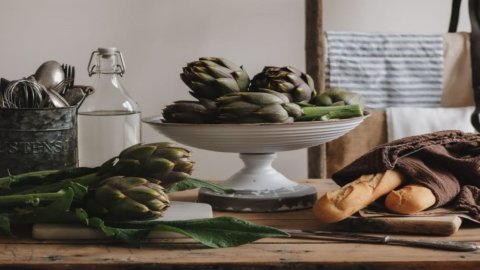
But let's take a closer look at it now to understand what we're talking about. It is an artichoke of medium size compared to the other autumn varieties, the bracts, or the edible part of the artichoke, have a green base color and a violet overcolour and in the upper part there are large golden thorns. For this characteristic, in the past it was also known by the name of "spinel". Thorns are undoubtedly an obstacle on the market and require a little patience in the kitchen, but spinoso has many other excellent qualities: it is aromatic, crunchy, delicate. Much sought after for cooking on the grill, and also for the production of pickles, caponata and paté. Its high lignin content makes it more resistant both to preservation in oil (it does not flake easily) and also more resistant to the intense heat of the embers.
And the scarcity of water becomes its virtue. He explains it well Filippo Romano, owner together with his brother Calogero of a model farm of 40 hectares which produces not only the Menfi artichoke but also top quality extra virgin olive oil, almonds and legumes, collaborates with the chefs of the slow food alliance and is one of the promoters of the 'rebirth' of the spinoso which it ships to order throughout Italy. This variety of artichoke – he says – is particularly tasty because its leaves, the bracts have a reduced water content in the texture, compared to other modern varieties. These characteristics - explains Romano - derive from the fact that the spinoso is a direct descendant of the wild artichoke (Cynara cardunculus altilis) of which it possesses many characteristics. The thorns are the result of millennia of evolution and adaptations implemented by the plant to reduce the loss of water especially in the hot and dry months, but this means that the plant has a higher percentage content of all the beneficial substances typical of the artichoke”.
Obviously the organoleptic peculiarity of Spinoso di Menfi, influenced by the territory of origin, penalizes its productivity. “In fact – explains Romano – it produces less than half compared to modern varieties and manages to concentrate in a few artichokes per plant the substances that a newly selected plant distributes on a much greater number of artichokes, which will however be less tasty and more watery” . Romano suggests verifying the organoleptic difference by tasting boiled artichokes of different varieties. “You will notice that the latter is more fibrous, tastier, less watery and above all does not have the herbaceous aftertaste that other varieties have. A very amusing test is to compare the perceived sweet taste when drinking water at the end of tasting the artichoke. Cynarin which is a bitter molecule, during chewing it binds to the taste receptors, sensitive to sweetness and inhibits them, during the meal we do not notice anything but when we drink water, the receptors clean themselves and resume function, and although the water is tasteless it will seem sweet by contrast with respect to before, the more intense the perception of sweetness, the greater the cynarin content, during the consumption of Memphis spinoso the sensation of sweetness at the end of the meal is very intense because the higher the cynarin content”.
And so far we have talked about taste. As for the beneficial properties for our body, an understanding could be opened that would require several pages. The late Ernesto Calindri reminded us that it is an invigorating against the wear and tear of modern life in one of the legendary Carosello commercials on TV since the 70s. functioning of the intestine and reduces the risk of colon cancer by providing a good amount of fiber. The latter, together with cinerine and lactone sesquiterpenes, also help to reduce blood cholesterol levels. The artichoke – reads a study by Humanitas Research Hospital – is also a source of molecules characterized by antioxidant properties which help defend the body from the action of free radicals and B vitamins, important for the good functioning of the metabolism. In particular, vitamin B9 (provided by the artichoke in the form of folate) promotes the correct development of the nervous system in the early stages of pregnancy. Vitamin K, on the other hand, is useful for bone and brain health, potassium protects the cardiovascular health, copper and iron are important for production of red blood cells. What more will you want?
It should also be added that artichoke fields need little water and as they do not need many nutrients they are rarely fertilized with manure. When artichokes are not made, broad beans are grown, which once again enrich the soil with nitrogen. The harvest takes place manually from the end of November until the end of April. After that, all that is left is shredded. Chopping the dry part of the plant facilitates the recovery of the best ovules, previously marked with the color at the base of the stock. Although with modern cultivation techniques they can be found throughout the year, officially the end of the production season is May XNUMXst, when the menfitani meet in the countryside to roast the last remaining artichokes cooked on pruned embers of olive or olive tree. Before being placed on the grill, the artichoke is beaten with all the thorns on a marble base to favor the opening of the bracts and is thus seasoned with extra virgin olive oil, salt and garlic.
At the end of April, a great festival is dedicated to the artichoke of Menfi, supported by the Assessorate of agricultural and food resources of the Sicilian Region, which involves the whole town. During the event you can experience the artichoke harvest but also taste it in various cooking methods, in particular the grilled version, and in various recipes prepared by all the restaurants in the area.