
REAL INDICATORS
E the ship goes. Ship = world economy, marching "half forward" as a whole and in the individual parts that compose it. Fellini's surreal film comes to mind when seeing the resilience of the global economic system. Nor can the enemy battleship that will sink it be seen on the horizon. Also because, as attentive readers of the Economy hands, the whole is greater than the sum of the parts, and if all the components march in the same direction, the pushes reinforce each other, prolonging and reinforcing the expansion.
The ship is crossing, like a liner, the gentle waters of an Alpine lake, the strongest monetary tightening since the time of Paul Volcker. Or so some view rate hikes so far all around the worldand especially in the USA. Which is arithmetically true if we look at the change in interest rates, less so if we look at the levels. In particular, those that matter most for spending decisions, i.e. i decennial, which are today across the Atlantic almost one and a half percentage points lower than where they were in 2006, when thewage inflation it was two points lower. From this point of view, US monetary policy, and even more so that of the Euro area, is still expansive.
This is surely part of the explanation for why, despite the "unheard of" restriction, the ship keeps going. The other is that the debt position of households and businesses is much more sustainable, because i public budgets they took it upon themselves to support the economy, and this should show both the new rules of the European Stability Pact and the limit on American public debt in a different light. As the title of a recent and beautiful book states (The wealth of public debt, by Angela Orlandi) not all state debt is a silver lining.
In short, the indications given in the Lancet last month on the reasons for the stability of economic activity can only be confirmed, despite the fact that there have been (in America more than in Europe) new episodes of malaise in the banking system; and despite the June 1 deadline approaching, which US Treasury Secretary Janet Yellen had already indicated as the day ad quem, beyond which the US Treasury default would have devastated the world economy. But neither of these black sygnet (signet is the chick of the swan) will be able to do derail the train of the economy.
On the one hand, the US banking system has broad shoulders: achieved in the past quarter record profits (80 billion dollars), and in any case the Treasury and the Fed are ready to put out any outbreak of fire (and learn, hopefully, from the leaks of regolazione that led to those ailments). A good banker might argue that Credit Suisse was over-regulated and yet went belly-up just the same; so it would be a problem undercapitalization. But if you steer a ship badly, you send it to the rocks to sink anyway, even if it is solid and safe (Schettino docet). So? There is no solution to this delicate and crucial busillis.
As for the limit to the US public debt there may be a temporary increase, or a real agreement or – we hope – a strong initiative by the President aimed at using the leverage of the XNUMXth amendment to challenge the constitutionality of that strange law (which today allows Republicans to blackmail a President of the other shore, but tomorrow the opposite could happen – better to disarm blackmail). For other solutions, see below.
The other threat to the stability of economies is the cost of money. But the pause is near in America and, even if in Europe "there is still work to be done", as Madame Lagarde said, the key rates and, what is more important, the rates that banks apply to businesses and households , are still negative (in real terms).
In general, the soft indicators of activity continue to signal good weather, even if in America (where the two 'chicks' mentioned above are scratching around with more vigor), understandable concerns emerge. Concerns which, moreover, do not emerge at all from the US labor market: you have to go back to 1953 (seventy years ago!) to find a lower unemployment rate than the current one.
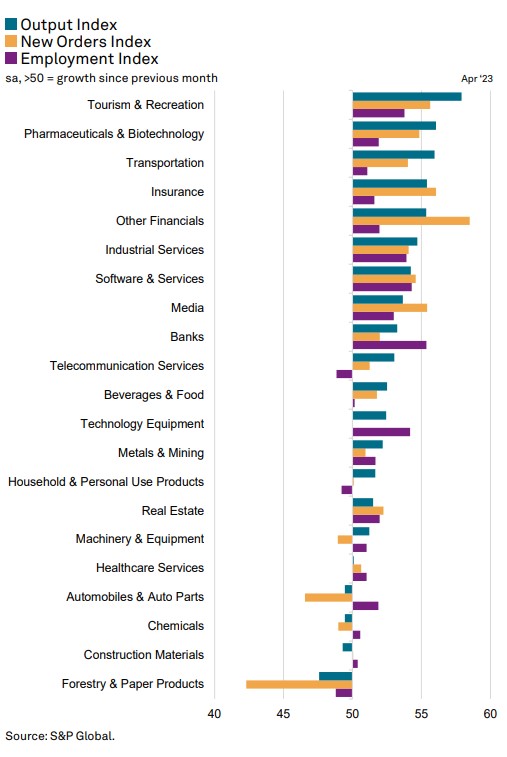
In fact, the job machine America is manufacturing new jobs as much as I can, even if at a slower pace than in 2022 but still higher than the pre-pandemic and accelerating ones. Also, globally, as seen in the graph below employment is increasing in almost all sectors and in April it reached the highest increase in ten months.
What needs to be said here is that the European labor market as well it seems no less: wherever you look, jobs are increasing, businesses are struggling to find people and wages are rising. Unfortunately, labor market statistics in continental Europe are much more sketchy than in the USA and one has to expect national accounts data once every three months and with a delay of at least a couple of months. So that at the end of May we will know how the first quarter went: if there is anyone among the readers of the Lancette who is «so there where you can» perhaps it could improve this field of European data.
Returning to the available and most recent information, we observe theacceleration of orders, and therefore of future production and employment. More on the domestic front than on the international one and more in services than in manufacturing. How natural it is, because: the draw comes from travel, from tourism and social activities and also from less smart-working, which also have not returned to pre-pandemic levels, especially due to the absence of the Chinese, which is to say it's a lasting draw (although much higher lodging and restaurant prices make it a mirage to return to 2019 attendance); manufactured goods have reveled immediately after the first lockdown for reasons examined in the past Lancet (revaluation of staying at home, diversion towards goods of impulses to purchases to the detriment of services); durable and investment goods are the ones that suffer the most from the monetary tightening.
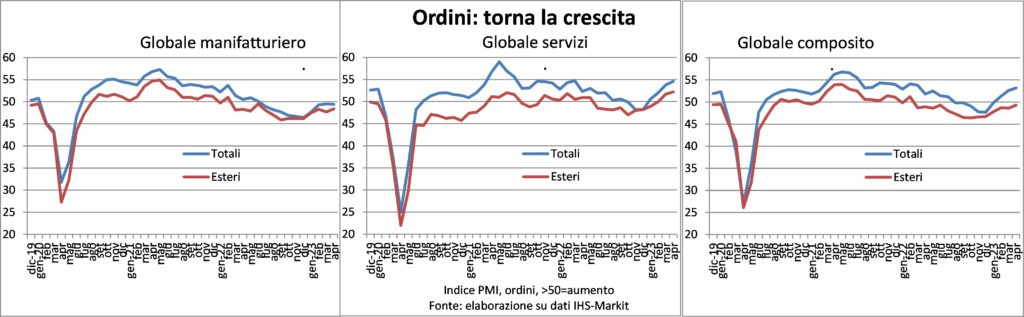
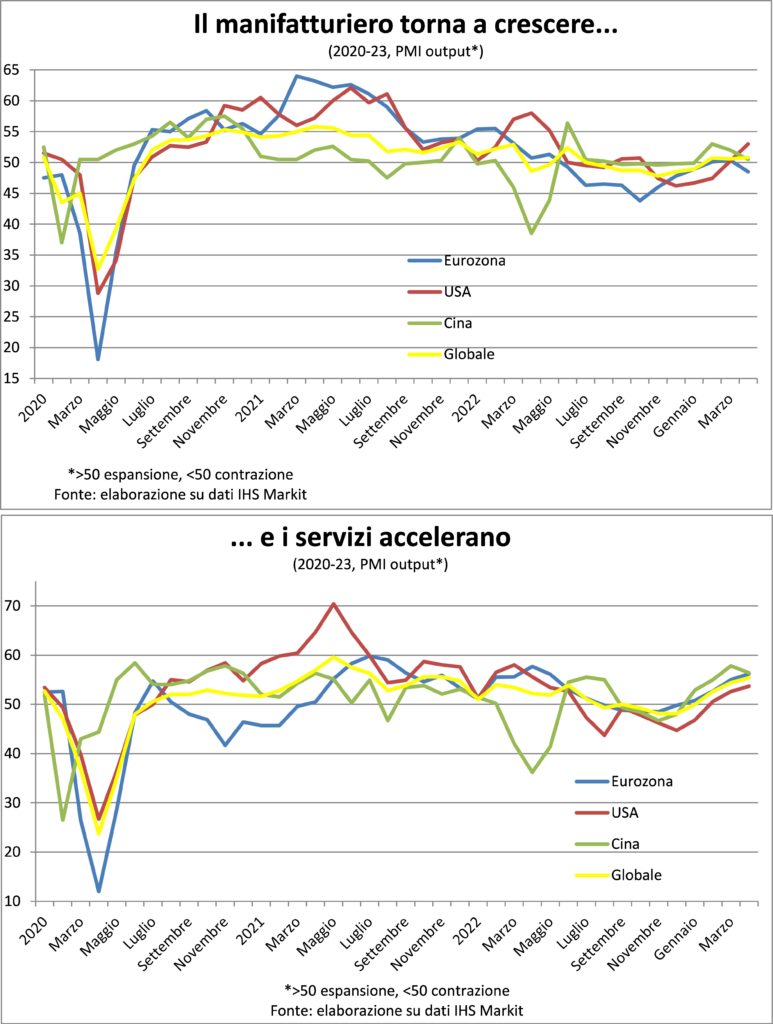
Also 'productive activity is accelerating, and here we note that the industrial recession has disappeared while in services the pace of expansion that of last spring has returned, indeed slightly higher because twelve months ago the zero-Covid policy was still in force in China, while now even the subjects of the empire, once Celestial and now red, are free to roam in and out of the Great Wall.
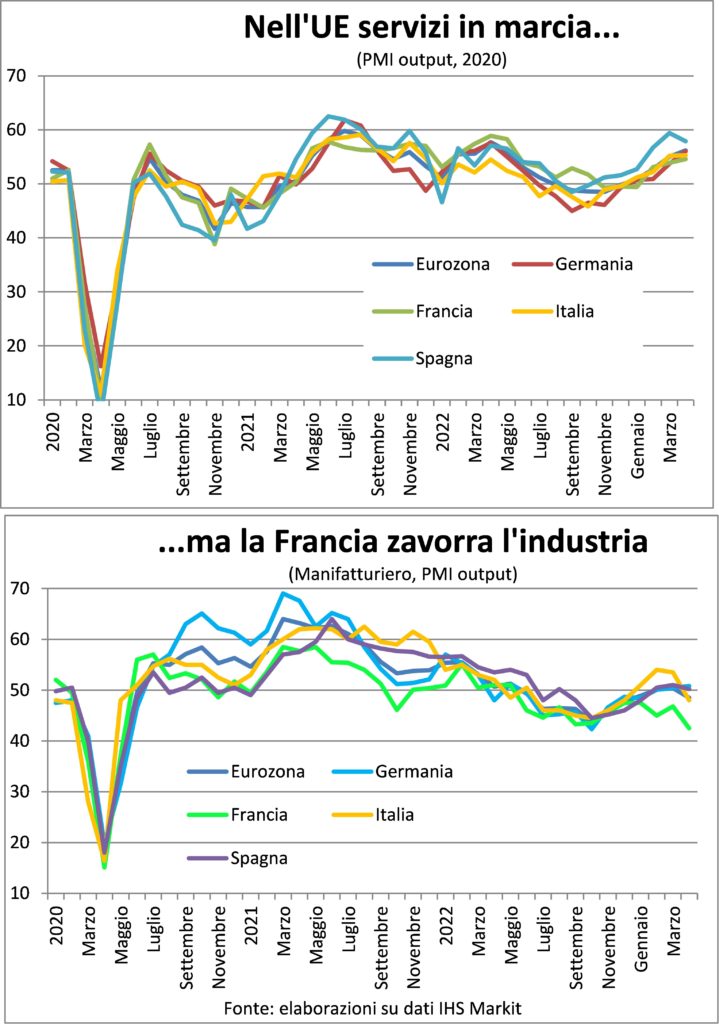
And theItaly? After surprising with one of the best GDP increases in the first quarter (+0,5% cyclical, like Spain) continues to enjoy being prime tourist destination. This also applies to the Iberian Peninsula. Less for the France, plagued by strikes which have visibly influenced the industry, with strong repercussions on all international supply chains, so much so as to impact Italy and Germany above all.
INFLATION
a head of thebicephalous hydra it was severed. This ruling can be declined sectorally, geographically and by origin, but not by factors. Sectorally, a further deceleration of input and output prices is observed globally in the manufacturing, so much so that these have returned to travel at the pre-pandemic pace (while the levels remain several percentage points higher); on the contrary, in tertiary you notice one acceleration which, however contained, goes in the opposite direction to that desired by the central banks. It should be underlined that in this case the rents (often imputed to the enemy as intendants) are not really there, because they are not in the construction field of the PMI price indicator. Furthermore, the pace of growth in the tertiary sector, although much lower than a year ago, remains significantly higher than before the pandemic. Now, that wouldn't be a bad thing either, in the sense that then the fear of deflation dominated. But we are still one speed too high to be compatible with monetary stability and not to risk triggering a price-wage spiral (the wage component is more important for the costs/prices of services than for manufacturing).
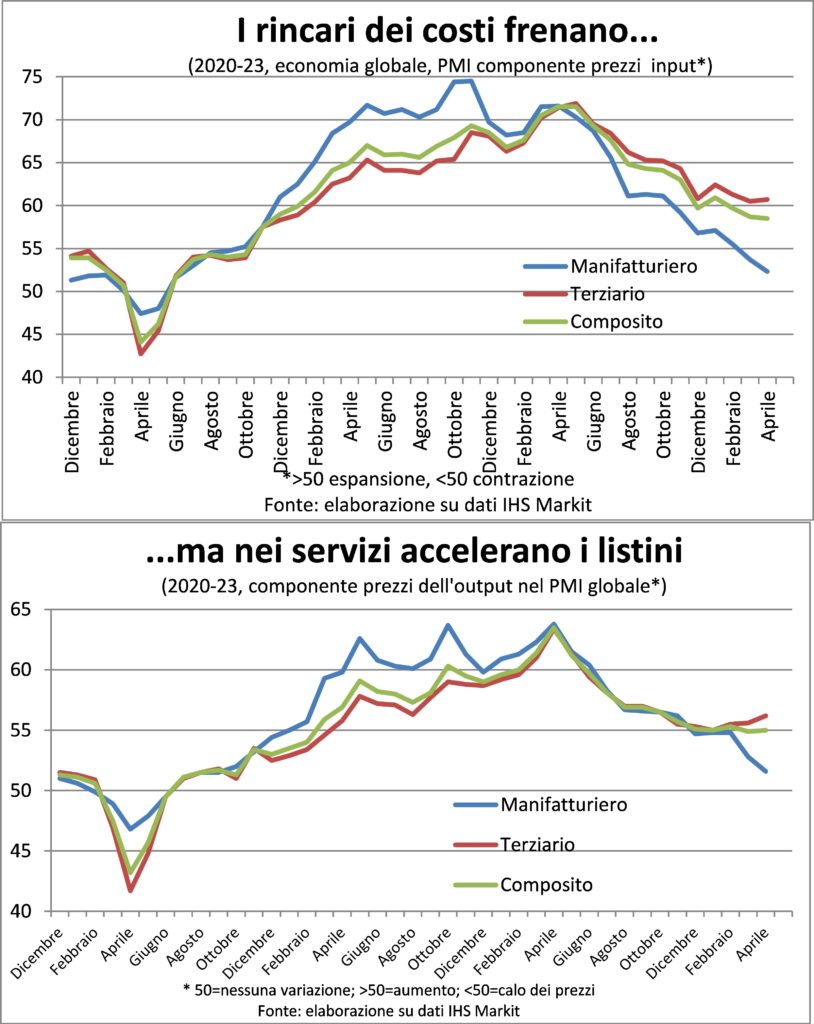
Geographically it can be verified that in China, i.e. in the largest economy on the planet and the real engine room of manufacturing, which in turn is theengine room of economic growth, prices are cut to stimulate demand. Conversely, in USA, Eurozone, Japan, UK and India service-driven inflation dynamics remain unacceptably high.
In the origin, the international components they have calmed down, both in the form of lower raw material costs and in the form of maritime freight rates and in that of exchange rates (the dollar has stopped appreciating). While the home components they keep pushing.
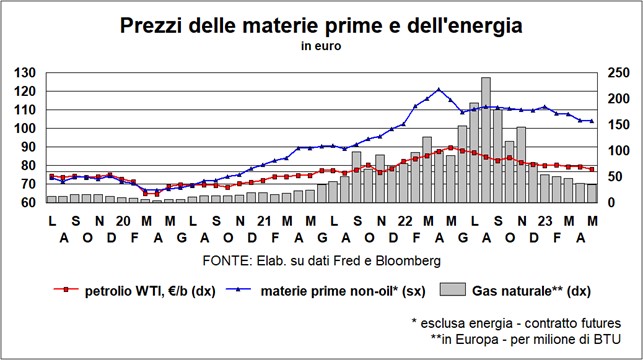
And that brings us to the real reason why a head is still firmly attached to the inflationary hydra's neck: wages and profits. Wage dynamics has two components: the run-up to the cost of living, to recover the lost purchasing power, and here the donors struggle to resist; and the shortage of workers, and here the employers find it even more difficult, because without workers the plants stand still and orders are not fulfilled. The point is, entrepreneurs aren't even willing to sacrifice margins, and offload the higher costs downstream. So then there are those who talk about inflation from profits (in particular by the ECB). But profit-driven inflation, it was already written last time, is demand inflation and, let us now add, from low competition. There low competition exists only in a few sectors, therefore introducing or even just announcing taxes on extra profits smacks a lot of Manzonian cries (this year is the one hundred and fiftieth anniversary of our death: he too was): it would be better to liberalize taxis and beaches… Except, of course , where the mechanisms of a distorted market, such as that of energy, have not generated excess position annuity (let's call it by its real name).
In the end, scratch-scratch, it remains that it is still there too much question around and that more restrictive policies are needed, so that workers and entrepreneurs have fewer demands. With a footnote: since thedemographic winter, the knife on the side of the handle is more the former than the latter, especially if you want high quality productions resulting from high quality workers.
It would be desirable that a visible hand of concertation convinced workers and entrepreneurs to milder advice, but since it seems that it operates above all the invisible hand of competition, then it is worth remembering, by way of warning, what a former Fed Chairman (Paul Volker) replied to a former Fed Vice Chairman (Alan Blinder) on how monetary policy had managed to break the backs of inflation: «By causing failures".
RATES AND CURRENCIES
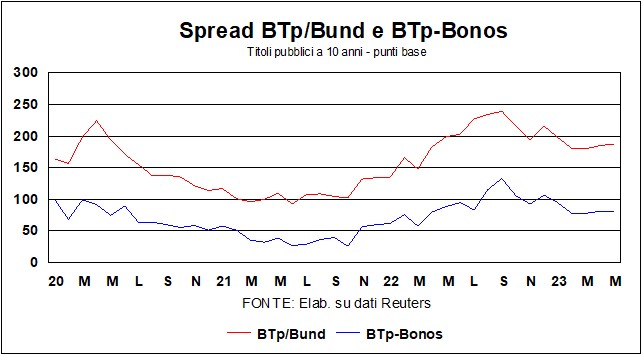
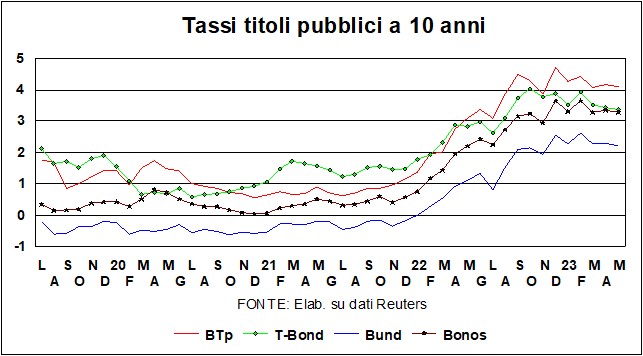
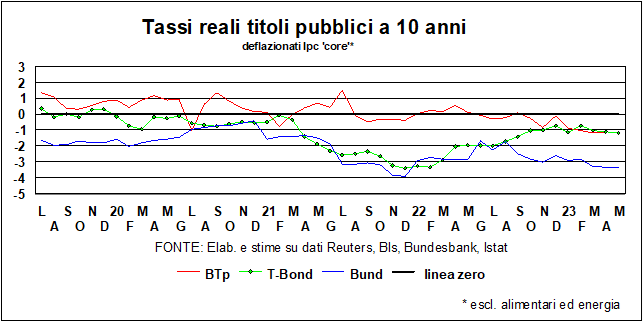
Rates remain at last month's levels – still lower, however, than the highs of early March, when the T Bond had reached 4%. They climbed in slightly Italy, but, if we look at the 'litmus test' of the spread among the Italians btp and passes Spaniards, we see that the problem is not Italian: it comes from the usual gust of risk aversion due to the two 'cignetti' mentioned above. T-Bond, however, maintains an Olympian composure and doesn't seem too bothered by the famous debt limit. Even if i CDS on US bonds in euros reached 166, more than Greece, Mexico, Brazil (and Italy)…
There are many proposed solutions to the 'strange' reads which establishes that limit to the American public debt. Why strange? For this reason: there is no dollar that comes out of the federal coffers that is not justified by a spending law. Just as there is no dollar that enters the coffers that is not linked to some tax law legislated by Congress. Don't like the resulting deficit? So the high road is to change the revenue and expenditure laws that led to that deficit, not to refuse to honor the commitments already made. It's a bit like going to a restaurant and gobbling up an appetizer, first course, second course, dessert, wine, coffee and ammazzacaffe and then, when it comes to paying, saying you can't because you've reached the limit of what you can spend.
But let's go proposals: some a series of, such as the one cited above, of the constitutionality appeal (il XNUMXth amendment of the Constitution states that the "validity of the public debt of the United States ... will not be called into question"; to which Biden, instructs the Treasury to continue issuing bonds to finance expenses since it does not want to violate the Constitution). Other semi-series: for example, issue securities of face value x, with an interest rate of 10%; they would immediately see the price rise by a lot, but only the face value counts for the debt, and the US would finance itself with the premium. This seems a bit tricky, but not as fun as the 'very much money': in America the creation of metal coins by the mint has no limits (unlike the Eurozone): apart from coins, there is a law which authorizes the Government to mint, for various commemorations, legal tender platinum coins, without denomination limits. Thus, some nice wit (including the Nobel laureate Paul Krugman) has proposed to mint a 'coin' with a face value of a trillion (one trillion) dollars, deposit it with the Fed, and then draw on the account to pay public expenses without having to issue debt securities. Yes, that would be money creation galore, but it does not create dangers for inflation, as the Fed easily could sterilize these injections of liquidity by selling part of the many trillions of dollars in government securities it has in its portfolio. And then there are those who propose to sell theFort Knox gold: but it's only a few hundred billion, it's not a permanent solution (that would be to "kick the can").
in Lancet last month we had defined the 'banking crisis' triggered in America by the Silicon Valley Bank affair like a 'paper tiger'. There have been other tremors, from First Republic to Signature Bank, and then PacWest, First Horizon… But they are tremors limited to regional banks, the big banks are immune (in Europe the case Credit Suisse concerns a large bank - not from the Eurozone - but has different motivations, and was promptly confined).
There are certainly some vulnerability in smaller American banks, which often have portfolios too concentrated in particular sectors, but the consequences will be limited to one greater concentration in the banking sector, with big fish eating little fish (as already happened with the First Republic). This concentration is also driven by the likely increase in regulatory costs for banks under $250 billion of assets. In any case, the root cause of fears and trembling – the Fed's rapid rate hike – goes to downsize: the break it is safe, even if perhaps not immediate and in any case a retracement is yet to come.
In Europe there was a net slowdown in the dynamics of bank loansboth for families and businesses. All in all, a trend physiological, which finds motivation in both supply and demand. For the question, was it easy to borrow money with low interest rates (a July 2022 the weighted average rate of bank loans to households and businesses in Germany and Italy was under the 2%); now that we are (the latest data is from March) to much more than 4%, firms are more selective (and there is also, for businesses, more self-financing). Just as, on the supply side, the banks are also more selective, who see, among swans and signet (all black), more risk than before. However, as stated above, i real market rates are still negative in Europe (which is no longer true in America, with consumer prices at 4,9%, Federal Funds at 5,1%, Prime rates at 8,25% and 6,4-year mortgages at XNUMX%).
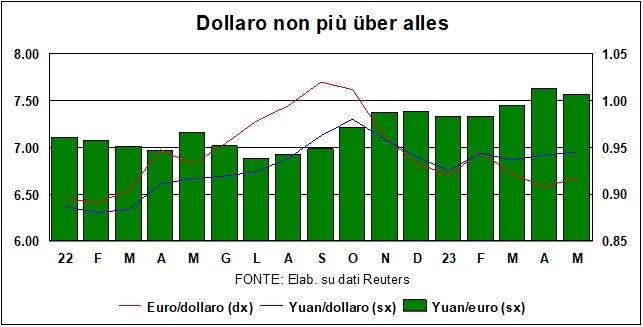
On the foreign exchange front, the dollar it is not far from the level of 1,10 against the euro which it reached last month. the 'break' next venture of Fed ensures, in conjunction with the 'non-pause' of ECB, That the rate differential it will shrink and will continue to weigh on the exchange rate of the greenback. Nor are there any reasons to think that the growth differential come and support the dollar: on the contrary, the probability of a recession in America is higher than in the Eurozone. For the chinese coin, this has not strengthened as much as the euro against the dollar in recent months, and is therefore depreciated against the single currency. Yes, the foreign exchange market seems to be saying: China is rebounding, but it is better to hold on to price competitiveness.
I stock markets I'm on the waiting list (drawers, don't worry). On the one hand they look at the moves of the Fed (by now the 'Fed-watchers' have become a full-time profession), marked by the boastful analysis of the trend of inflation (another 'full time' for the 'inflation-watchers'). On the other hand, they gnaw their nails on vexed question of the debt limit. And on the other hand they are still kept on a leash by the odds (albeit very low) of banking crises with bank runs. Want to know how it will end? Ask ChatGPT…
REAL INDICATORS
E the ship goes. Ship = world economy, marching "half forward" as a whole and in the individual parts that compose it. Fellini's surreal film comes to mind when seeing the resilience of the global economic system. Nor can the enemy battleship that will sink it be seen on the horizon. Also because, as attentive readers of the Economy hands, the whole is greater than the sum of the parts, and if all the components march in the same direction, the pushes reinforce each other, prolonging and reinforcing the expansion.
The ship is crossing, like a liner, the gentle waters of an Alpine lake, the strongest monetary tightening since the time of Paul Volcker. Or so some view rate hikes so far all around the worldand especially in the USA. Which is arithmetically true if we look at the change in interest rates, less so if we look at the levels. In particular, those that matter most for spending decisions, i.e. i decennial, which are today across the Atlantic almost one and a half percentage points lower than where they were in 2006, when thewage inflation it was two points lower. From this point of view, US monetary policy, and even more so that of the Euro area, is still expansive.
This is surely part of the explanation for why, despite the "unheard of" restriction, the ship keeps going. The other is that the debt position of households and businesses is much more sustainable, because i public budgets they took it upon themselves to support the economy, and this should show both the new rules of the European Stability Pact and the limit on American public debt in a different light. As the title of a recent and beautiful book states (The wealth of public debt, by Angela Orlandi) not all state debt is a silver lining.
In short, the indications given in the Lancet last month on the reasons for the stability of economic activity can only be confirmed, despite the fact that there have been (in America more than in Europe) new episodes of malaise in the banking system; and despite the June 1 deadline approaching, which US Treasury Secretary Janet Yellen had already indicated as the day ad quem, beyond which the US Treasury default would have devastated the world economy. But neither of these black sygnet (signet is the chick of the swan) will be able to do derail the train of the economy.
On the one hand, the US banking system has broad shoulders: achieved in the past quarter record profits (80 billion dollars), and in any case the Treasury and the Fed are ready to put out any outbreak of fire (and learn, hopefully, from the leaks of regolazione that led to those ailments). A good banker might argue that Credit Suisse was over-regulated and yet went belly-up just the same; so it would be a problem undercapitalization. But if you steer a ship badly, you send it to the rocks to sink anyway, even if it is solid and safe (Schettino docet). So? There is no solution to this delicate and crucial busillis.
As for the limit to the US public debt there may be a temporary increase, or a real agreement or – we hope – a strong initiative by the President aimed at using the leverage of the XNUMXth amendment to challenge the constitutionality of that strange law (which today allows Republicans to blackmail a President of the other shore, but tomorrow the opposite could happen – better to disarm blackmail). For other solutions, see below.
The other threat to the stability of economies is the cost of money. But the pause is near in America and, even if in Europe "there is still work to be done", as Madame Lagarde said, the key rates and, what is more important, the rates that banks apply to businesses and households , are still negative (in real terms).
In general, the soft indicators of activity continue to signal good weather, even if in America (where the two 'chicks' mentioned above are scratching around with more vigor), understandable concerns emerge. Concerns which, moreover, do not emerge at all from the US labor market: you have to go back to 1953 (seventy years ago!) to find a lower unemployment rate than the current one.
In fact, the job machine America is manufacturing new jobs as much as I can, even if at a slower pace than in 2022 but still higher than the pre-pandemic and accelerating ones. Also, globally, as seen in the graph below employment is increasing in almost all sectors and in April it reached the highest increase in ten months.
What needs to be said here is that the European labor market as well it seems no less: wherever you look, jobs are increasing, businesses are struggling to find people and wages are rising. Unfortunately, labor market statistics in continental Europe are much more sketchy than in the USA and one has to expect national accounts data once every three months and with a delay of at least a couple of months. So that at the end of May we will know how the first quarter went: if there is anyone among the readers of the Lancette who is «so there where you can» perhaps it could improve this field of European data.
Returning to the available and most recent information, we observe theacceleration of orders, and therefore of future production and employment. More on the domestic front than on the international one and more in services than in manufacturing. How natural it is, because: the draw comes from travel, from tourism and social activities and also from less smart-working, which also have not returned to pre-pandemic levels, especially due to the absence of the Chinese, which means that it is a long-lasting draw; manufactured goods have reveled immediately after the first lockdown for reasons examined in the past Lancet (revaluation of staying at home, diversion towards goods of impulses to purchases to the detriment of services); durable and investment goods are the ones that suffer the most from the monetary tightening.
Also 'productive activity is accelerating, and here we note that the industrial recession has disappeared while in services the pace of expansion that of last spring has returned, indeed slightly higher because twelve months ago the zero-Covid policy was still in force in China, while now even the subjects of the empire, once Celestial and now red, are free to roam in and out of the Great Wall.
And theItaly? After surprising with one of the best GDP increases in the first quarter (+0,5% cyclical, like Spain) continues to enjoy being prime tourist destination. This also applies to the Iberian Peninsula. Less for the France, plagued by strikes which have visibly influenced the industry, with strong repercussions on all international supply chains, so much so as to impact Italy and Germany above all.
INFLATION
a head of thebicephalous hydra it was severed. This ruling can be declined sectorally, geographically and by origin, but not by factors. Sectorally, a further deceleration of input and output prices is observed globally in the manufacturing, so much so that these have returned to travel at the pre-pandemic pace (while the levels remain several percentage points higher); on the contrary, in tertiary you notice one acceleration which, however contained, goes in the opposite direction to that desired by the central banks. It should be underlined that in this case the rents (often imputed to the enemy as intendants) are not really there, because they are not in the construction field of the PMI price indicator. Furthermore, the pace of growth in the tertiary sector, although much lower than a year ago, remains significantly higher than before the pandemic. Now, that wouldn't be a bad thing either, in the sense that then the fear of deflation dominated. But we are still one speed too high to be compatible with monetary stability and not to risk triggering a price-wage spiral (the wage component is more important for the costs/prices of services than for manufacturing).
Geographically it can be verified that in China, i.e. in the largest economy on the planet and the real engine room of manufacturing, which in turn is theengine room of economic growth, prices are cut to stimulate demand. Conversely, in USA, Eurozone, Japan, UK and India service-driven inflation dynamics remain unacceptably high.
In the origin, the international components they have calmed down, both in the form of lower raw material costs and in the form of maritime freight rates and in that of exchange rates (the dollar has stopped appreciating). While the home components they keep pushing.
And that brings us to the real reason why a head is still firmly attached to the inflationary hydra's neck: wages and profits. Wage dynamics has two components: the run-up to the cost of living, to recover the lost purchasing power, and here the donors struggle to resist; and the shortage of workers, and here the employers find it even more difficult, because without workers the plants stand still and orders are not fulfilled. The point is, entrepreneurs aren't even willing to sacrifice margins, and offload the higher costs downstream. So then there are those who talk about inflation from profits (in particular by the ECB). But profit-driven inflation, it was already written last time, is demand inflation and, let us now add, from low competition. There low competition exists only in a few sectors, therefore introducing or even just announcing taxes on extra profits smacks a lot of Manzonian cries (this year is the one hundred and fiftieth anniversary of our death: he too was): it would be better to liberalize taxis and beaches… Except, of course , where the mechanisms of a distorted market, such as that of energy, have not generated excess position annuity (let's call it by its real name).
In the end, scratch-scratch, it remains that it is still there too much question around and that more restrictive policies are needed, so that workers and entrepreneurs have fewer demands. With a footnote: since thedemographic winter, the knife on the side of the handle is more the former than the latter, especially if you want high quality productions resulting from high quality workers.
It would be desirable that a visible hand of concertation convinced workers and entrepreneurs to milder advice, but since it seems that it operates above all the invisible hand of competition, then it is worth remembering, by way of warning, what a former Fed Chairman (Paul Volker) replied to a former Fed Vice Chairman (Alan Blinder) on how monetary policy had managed to break the backs of inflation: «By causing failures".
RATES AND CURRENCIES
Rates remain at last month's levels – still lower, however, than the highs of early March, when the T Bond had reached 4%. They climbed in slightly Italy, but, if we look at the 'litmus test' of the spread among the Italians btp and passes Spaniards, we see that the problem is not Italian: it comes from the usual gust of risk aversion due to the two 'cignetti' mentioned above. T-Bond, however, maintains an Olympian composure and doesn't seem too bothered by the famous debt limit. Even if i CDS on US bonds in euros reached 166, more than Greece, Mexico, Brazil (and Italy)…
There are many proposed solutions to the 'strange' reads which establishes that limit to the American public debt. Why strange? For this reason: there is no dollar that comes out of the federal coffers that is not justified by a spending law. Just as there is no dollar that enters the coffers that is not linked to some tax law legislated by Congress. Don't like the resulting deficit? So the high road is to change the revenue and expenditure laws that led to that deficit, not to refuse to honor the commitments already made. It's a bit like going to a restaurant and gobbling up an appetizer, first course, second course, dessert, wine, coffee and ammazzacaffe and then, when it comes to paying, saying you can't because you've reached the limit of what you can spend.
But let's go proposals: some a series of, such as the one cited above, of the constitutionality appeal (il XNUMXth amendment of the Constitution states that the "validity of the public debt of the United States ... will not be called into question"; to which Biden, instructs the Treasury to continue issuing bonds to finance expenses since it does not want to violate the Constitution). Other semi-series: for example, issue securities of face value x, with an interest rate of 10%; they would immediately see the price rise by a lot, but only the face value counts for the debt, and the US would finance itself with the premium. This seems a bit tricky, but not as fun as the 'very much money': in America the creation of metal coins by the mint has no limits (unlike the Eurozone): apart from coins, there is a law which authorizes the Government to mint, for various commemorations, legal tender platinum coins, without denomination limits. Thus, some nice wit (including the Nobel laureate Paul Krugman) has proposed to mint a 'coin' with a face value of a trillion (one trillion) dollars, deposit it with the Fed, and then draw on the account to pay public expenses without having to issue debt securities. Yes, that would be money creation galore, but it does not create dangers for inflation, as the Fed easily could sterilize these injections of liquidity by selling part of the many trillions of dollars in government securities it has in its portfolio. And then there are those who propose to sell theFort Knox gold: but it's only a few hundred billion, it's not a permanent solution (that would be to "kick the can").
in Lancet last month we had defined the 'banking crisis' triggered in America by the Silicon Valley Bank affair like a 'paper tiger'. There have been other tremors, from First Republic to Signature Bank, and then PacWest, First Horizon… But they are tremors limited to regional banks, the big banks are immune (in Europe the case Credit Suisse concerns a large bank - not from the Eurozone - but has different motivations, and was promptly confined).
There are certainly some vulnerability in smaller American banks, which often have portfolios too concentrated in particular sectors, but the consequences will be limited to one greater concentration in the banking sector, with big fish eating little fish (as already happened with the First Republic). This concentration is also driven by the likely increase in regulatory costs for banks under $250 billion of assets. In any case, the root cause of fears and trembling – the Fed's rapid rate hike – goes to downsize: the break it is safe, even if perhaps not immediate and in any case a retracement is yet to come.
In Europe there was a net slowdown in the dynamics of bank loansboth for families and businesses. All in all, a trend physiological, which finds motivation in both supply and demand. For the question, was it easy to borrow money with low interest rates (a July 2022 the weighted average rate of bank loans to households and businesses in Germany and Italy was under the 2%); now that we are (the latest data is from March) to much more than 4%, firms are more selective (and there is also, for businesses, more self-financing). Just as, on the supply side, the banks are also more selective, who see, among swans and signet (all black), more risk than before. However, as stated above, i real market rates are still negative in Europe (which is no longer true in America, with consumer prices at 4,9%, Federal Funds at 5,1%, Prime rates at 8,25% and 6,4-year mortgages at XNUMX%).
On the foreign exchange front, the dollar it is not far from the level of 1,10 against the euro which it reached last month. the 'break' next venture of Fed ensures, in conjunction with the 'non-pause' of ECB, That the rate differential it will shrink and will continue to weigh on the exchange rate of the greenback. Nor are there any reasons to think that the growth differential come and support the dollar: on the contrary, the probability of a recession in America is higher than in the Eurozone. For the chinese coin, this has not strengthened as much as the euro against the dollar in recent months, and is therefore depreciated against the single currency. Yes, the foreign exchange market seems to be saying: China is rebounding, but it is better to hold on to price competitiveness.
I stock markets I'm on the waiting list (drawers, don't worry). On the one hand they look at the moves of the Fed (by now the 'Fed-watchers' have become a full-time profession), marked by the boastful analysis of the trend of inflation (another 'full time' for the 'inflation-watchers'). On the other hand, they gnaw their nails on vexed question of the debt limit. And on the other hand they are still kept on a leash by the odds (albeit very low) of banking crises with bank runs. Want to know how it will end? Ask ChatGPT…