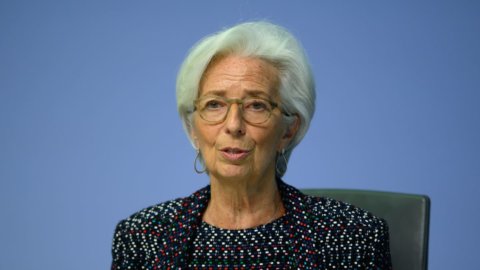
With the war “Europe is entering a difficult phase. In the short term, we will meet higher inflation and lower growth. There is considerable uncertainty about how large these effects will be and how long they will last." She said it ECB President Christine Lagarde speaking at an event organized by the central bank of Cyprus, referring to the fallout of the war in Ukraine on Europe.
Then Lagarde's warning: "the longer the war lasts, the higher the economic costs will be and the greater the probability of ending up in more adverse scenarios". At the same time, the number one of the ECB underlined that we have learned the lesson of each past crisis and have come out stronger. “This was true after the sovereign debt crisis and the pandemic, and all signs suggest that the Russian invasion will be a game changer for Europe as well.” After the strong increases recorded on Tuesday, the European stock exchanges they remained in negative territory but welcomed the signal launched by Lagarde, recovering ground at the end of the morning: Milan went from -0,8 to -0,2 per cent.
Lagarde (ECB): the war has changed the cards on the table
Lagarde reiterated that the economic impact of the war and the sanctions against Moscow is to be seen in what economists define as a "supply shock", which simultaneously raises inflation and reduces growth. According to the president of the ECB there are three major factors that will push up the cost of living. First, energy prices will stay high for longer, with gas prices up 52% year-to-date and oil prices up 64%. Second, food inflation pressures are likely to mount given the two countries' prominence on several key supplies, such as wheat and corn, but also fertilizers.
Finally, bottlenecks in global supply chains in some sectors are likely to persist. Europe is a net importer of energy and rising prices imply a loss of purchasing power for households. The conflict has already started to reduce the confidence of households (which could reduce consumption expenditure) and businesses (which could reduce investments). Indeed, the European Commission's economic sentiment index for the 19 eurozone countries fell to 108,5 points in March from 113,9 in February, when economists had estimated a contraction at 109 points.
Lagarde (ECB): "Ready to review the purchasing programme"
Based on the evolution of the ongoing conflict, the ECB will take "all necessary actions to pursue price stability and safeguard financial stability", said the ECB president, adding that it continues to monitor incoming data and update accordingly. analyzes.
In this context "optionality, gradualness and flexibility“, are the watchwords for the conduct of the ECB's monetary policy. “Optionality means that we are ready to react to a number of scenarios and the course we take will depend on incoming data. In particular, if incoming data supports the expectation that the medium-term inflation outlook will not weaken even after our net asset purchases end, we will conclude the net purchases under the asset purchase program in the third quarter . But if the medium-term inflation outlook were to change and if financing conditions become inconsistent with further progress towards our 2% target, we stand ready to revise our program for net asset purchases in terms of size and/or duration". Secondly – continued Lagarde – gradualism means that we will move carefully and adjust our policy as we receive feedback on our actions.
Any interest rate adjustments, therefore, will occur some time after the end of net purchases within the app and will be gradual. As for flexibility, it means that “we will use our toolkit to ensure that our policy is transmitted uniformly in all parts of the euro area”.
Lagarde (ECB): "Fiscal cuts and aid to deal with the crisis"
According to Lagarde with the right political response we can mitigate the economic consequences of war and manage the high levels of uncertainty we are facing. “To offset the short-term effects of rising energy prices and sanctions, national fiscal policies have a number of tools to implement, such as tax cuts and subsidies,” Lagarde said. And EU-wide rules are being relaxed so governments can take the necessary measures to protect their own populations. The additional fiscal measures announced in the euro area since the invasion amount to 0,4% of euro area GDP this year. But in the long run, we need a European approach, which works across borders, to adjust to the post-invasion world."
The war - added the president - highlighted the deep strategic vulnerabilities in trade and security relations. “We can only face them by being more united”. Lagarde then mentioned Europe's goal of achieving strategic autonomy with ambitious targets such as doubling the European share of the semiconductor market to 20% by 2030 as well as the decision to focus on energy transition also the Next Generation Eu. But public investment alone is not enough.
“We also need private financing to grow and for this we need to better mobilize Europe's large pool of private capital. Currently, capital markets in Europe are segmented along national lines rather than spanning the continent. This is why the capital markets union, the project to integrate European capital markets, has become more important than ever”, concluded the number one of the ECB.