Sculpture has always been considered a difficult art to understand and therefore also to collect. The preference is for small and medium-sized works, therefore easy to place in a residence, while, for others of recognized monumentality, it has always entered public and institutional works. There is no important square that doesn't have its stone, marble, bronze or metal to commemorate some cult figure or hero. Here the memory of an event that you don't want to forget, participates motionless while time passes slowly. Now sculpture is also design, architecture and form of contemporaneity. But its story goes back a long way.
In past centuries sculptors used only materials that lend themselves to being modelled, such as clay. Or harder material such as stone or marble which, however, under the skilled hands of a stonemason could be transformed into harmonious shapes. While today, modern sculptors have expanded to use other materials as well, such as steel or resins up to biological substances that perish over time.
In ancient times the term "artifex" referred to both the artist and the sculptor, while the term "operarius" was addressed to the worker. But often, they were coined into a single figure capable of modeling and shaping matter. Thus also the Castilian stonemason and the French sculptors belonged to the same class, they were equally worthy of representation.
In the middle of the Renaissance, Donatello was called "scarillator" or stonemason, while Leonardo, in his Comparison between the arts, without hesitation placed the "painting above the sculpture". And while da Vinci meditated on the principles that governed the activity of sculpture, Michelangelo, twenty-three years his junior, created his most beautiful sculptural works. Let us then recall Cellini, Vasari, Pigalle, Bouchardon, or Bernini. Later, Falconet and Canova, to reach the nineteenth century with Rodin and Hildebrand. In the following century, the twentieth, the forms are influenced by the historical period. The works must range over time, space and must get rid of any excrescence until they become aware and pure in an all-round complex form like that of Moore, Harp, Boccioni. Space thus becomes one of the fundamental attributes of sculpture in this last century.
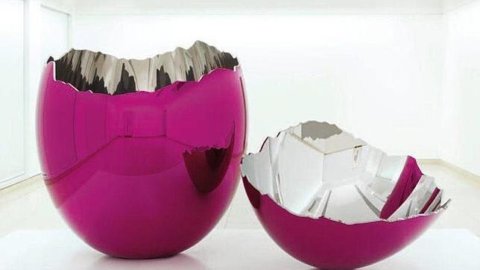
Today, sculpture is planning and drawing in space with the help of new methods, using this space and building with it, as if it were a new generation material. Hence the new forms that are sometimes performant like those of Anish Kapoor or contextualizing the symbology that has entered our new world, see Jeff Koons, with his large hearts in welded and colored metal that appear like balloons inflated and suspended in the air and broken eggs.
Its plasticity no longer takes up any mythological or religious iconography as in ancient times, but is expressed only in forms that evoke objects, decomposed nature, to arrive at items apparently to be used, sometimes encroaching on the meaning of design. However, it has in itself a severe rigidity of thought, because it will always remain respectful of the shape and proportions. In it lies perfection, whether it can be perceived or imagined. You have to go around it to understand that she lives in space, that she talks to whoever observes her, that she plays her role as a great stage performer. And when it becomes monumental then it gives way to architecture, when instead it is pure artistic creation of lines, objectivity and usability then it is design.
But sculpture still transforms, it participates in social life in spaces where people can also reflect themselves in it, as in the work of the Indian artist Kapoor "Cloud Gate" from Chicago. A real door that exists and isn't there, but which, passing under or around it, mirrors the life of the visitor, from which he can no longer escape. While the lights of the day fix the buildings and the lights of the night the skies, a work that changes every day, which immortalizes life but never fixes it. A long short film without film.
That's why it finds less and less place in private spaces, such as works inserted in the corner of the house or on the table, because for years now they have been replaced by design objects, increasingly colorful and which also have a use, they give light or give us allow us to sit.
In reality I believe that there has been a real abuse of the term "design" which, according to a fashionable lexicon, refers to anything that has a stylistic line, round or square, Made in Italy or China, it doesn't matter. While true Design is something else, it is art where its inspirer, the designer, has been able to grasp the essential and has produced an extreme cleanliness of the created object.
Even in fashion there is more and more talk of "sculpture clothes" and "fashion design", but what will be the real meaning?
The sculpture dresses start from very ancient concepts, a reworking of ancient costumes, in shapes and lines, just think of Japanese stylists such as Issey Miyake who crosses the spaces of the materials used with the voids created like real architectures. The same goes for the design applied to the design of any accessory, and if the rules are strict the product will be not only successful but also long-lasting, an example is the Maison Hermes, lines without any second thoughts.
In all of this, the rules are dictated by the principles of creative thought inspired by nature and by human thought that tries to interpret it with any discipline.
In the meantime there are Easter eggs – better if broken – which are auctioned off at high prices.