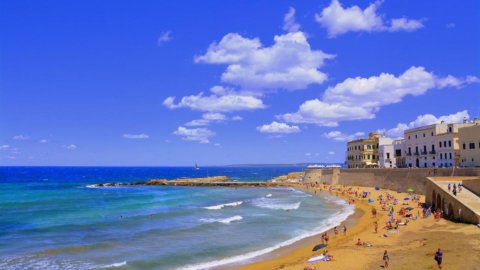
For a long time the representatives of the Puglia region they never miss an opportunity to remember that their territory is among the most sustainable and protected in Italy. In support of such successes since 2000 they recall the increase in tourists, the visits to exhibitions and places of art, the increase in accommodation facilities, the growth of the GDP. Seeing all this while wandering around the Region, from Foggia to Lecce, let's say, is certainly an exhilarating experience. Lands, stones, sea, farms, residences meet: a set, in short, of historical pre-existences that capture the mind and cheer the spirit. Puglia has made progress in terms of sustainability and care for the environment, except for some oversights on energy infrastructure issues. But even when this happened the area was not affected much and tourists continued to disembark by the thousands.
However, we need to understand if all this heritage has the same effect on people when it is exported. When the Region tries to show itself away from itself. It is probably the sense of the exhibition "APULIA. Mystères des Pouilles entre terre, pierres et mer” (The mysteries of Puglia between land, stones and sea) in courso at Italian Cultural Institute in Paris. A challenge away from home that will last a long time, until 28 September . It wants to show the evolution of the cultural environment and the architectural landscape over the centuries, from Magna Graecia to today.
«The mysteries of Puglia between land, stones and sea»: an exhibition with four sections
France and the French love our Region- he says Grace DiBari, councilor responsible for cultural policies. Works of art, archaeological and medieval treasures, art photographs and contemporary sculptures are exhibited in Paris. «Our Region with its beauties and its immense archaeological and artistic heritage has always been much loved in France» she adds. They are at the Institute four sections - archaeological, rock, medieval and contemporary - with many images of rock churches and contemporary works.
The staging was curated by the art historian Frances Moroccan which availed itself of a Scientific Committee. In reality, everyone has worked to represent the so-called in a different way from the usual stereotypes talon de la botte (heel of the boot). An operation certainly “eco" because agoing to Paris la Puglia try toohe di seasonally adjust tourism and make it clear that the marine or inland territory can and must be enjoyed 365 days a year. There are seven participating Apulian museums: National Archaeological Museum of Taranto; Swabian Castle Museum, Bari; Archaeological Museum – De Palo-Ungaro Foundation, Bitonto; National Archaeological Museum, Canosa di Puglia; Sigismondo Castromediano Museum, Lecce; Jatta National Archaeological Museum, Ruvo di Puglia; Jatta private collection, Ruvo di Puglia.
All 'museum exhibition the photographers Gabriele Torsello (Kash), Domenico Fioriello, Paolo Azzella, Lorenzo Scaraggi, Nicola and Giorgio Amato joined; the plastic artists Lino Sivilli and Francesco Schiavulli; John Bozzi. A large team that will also want to honor that old definition of "Southern California".