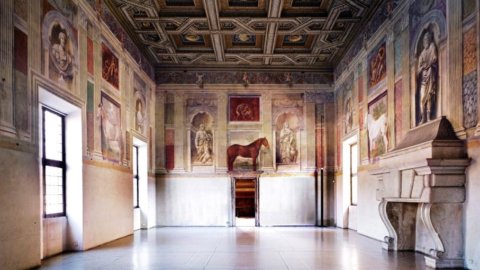
In the Napoleonic Wing, the exhibition presents 8 photographs that the German artist took, between 2010 and 2011, inside monumental buildings in Mantua, such as the Bibiena Scientific Theater, the Civic Museum of Palazzo Te, the Teresiana, Palazzo Ducale, the Basilica of Santa Barbara, Palazzo Canossa, the Museum of Palazzo d'Arco.
“Mantua portrayed by Candida Höfer – says Marco Tonelli, Councilor for Culture of the Municipality of Mantua – is a perfect, ideal city, so balanced and Olympic as to seem fake. Each of these photographs gives the impression of having been constructed and designed in the artist's mind even before being seen through her eyes. Yet everything is so clear, luminous and optically real, observed down to the smallest architectural, decorative or pictorial detail".
The exhibition is accompanied by a bilingual catalog (Italian/English), published by Publi Paolini, which contains all the works of the series dedicated to Mantua, the introduction edited by Marco Tonelli, Councilor for Culture of the Municipality of Mantua, and a critical text by the architect Simona Malvezzi, founder of the Kuehn Malvezzi studio in Berlin.
Biographical notes.
Candida Höfer was born in 1944 in Eberswalde in the Brandenburg region, daughter of the journalist Werner Höfer.
Main exponent, together with Thomas Ruff and Thomas Struth, of the so-called Düsseldorf School, deeply influenced by the work of Bernd and Hilla Becher, he portrayed the interior environments of both public and private buildings in a documentary style, in a condition of total absence of man and with particular meticulous attention to decorative details (Residenzschloss Weimar XIV).
The first solo exhibition held at the Konrad Fischer Galerie in Dusseldorf (1975) was followed by many others, among which Candida Höfer: Architecture of absence in 2005, at the Norton Museum of Art in West Palm Beach (Florida) and at the University Art Museum in Long Beach (California), and those at the Rena Bransten Gallery in San Francisco (2000-2001; 2003; 2005; 2008). Together with Martin Kippenberger you represented Germany at the Venice Biennale in 2003.
CANDIDA HÖFER: At Palazzo Te there are eight of my photographs. Eight is not a lot. But when I exhibit my photographs I prefer to adopt a reductionist approach. The exhibition tries to adapt to the place where it is hosted. It is a reflection on that sense of proportion that Palazzo Te transmits to me. When I took those photographs I was working in different cities and places in Northern Italy. What struck me most about Mantua and its buildings is that sense of proportion, the spatial relationships between height, width and length, its light, the landscape that surrounds the city and its palaces. It seems to me that this sense of proportion indicates a perfect balance between a tendency to ostentatious power and, at the same time, an awareness of the real dimension of the human being, of his desire for beauty but also of his being constantly exposed to history and change. At Palazzo Te this is perceived in the touching simplicity of its elements, having been robbed of much of its former glory by these changes in history. Exhibiting these photographs at Palazzo Te, in the same place where two of these were taken, is like coming home. Those who observe them are invited to take some time to reflect on the reality that is perceived when they are in Mantua, to reflect on its various representations and on what can make the difference. For me, exhibiting these photographs at Palazzo Te is also an act of gratitude towards what the spaces in Mantua have given me.
Mantua, Palazzo Te – Napoleonic Wing (Viale Te)
March 15 - June 1, 2014
Conceived and promoted by the Department of Cultural Policies and Tourism Promotion of the Municipality of Mantua.