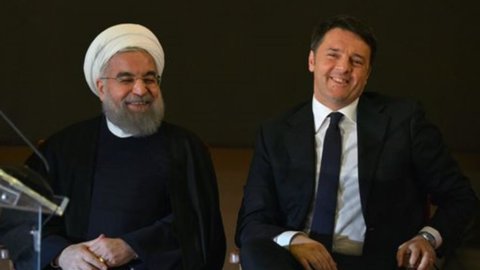
Iran is restarting and for Italian companies it is a great business opportunity. Between 8 and 10 February, a delegation made up of representatives of the government and companies of our country will visit the Middle Eastern country after agreements were signed at the end of January, on the occasion of the visit to Italy of Iranian president Hassan Rouhani between Italian and Iranian companies and institutions for a value of approximately 17 billion euros.
In light of the importance that the Iranian market will have for Italy in the coming years, we are publishing a fact sheet by Sace on the overall situation in the country.
1. POLITICAL CONTEXT
Rohani has been in the presidency since 2013. The nuclear deal is the administration's most successful foreign policy, but it represents a turning point shared by the entire Iranian establishment, having received the consent of Supreme Leader Khamenei. Thanks to the respect of the commitments entered into by Iran in the July agreement, the Implementation day was triggered on 16 January, starting from which the progressive removal of international sanctions began. The parliamentary elections, scheduled for February 2016, will make it possible to measure consensus towards the Administration. However, the agreement does not constitute a change in foreign policy on a large scale and leaves elements of conflict between Iran, the West and the Gulf countries unchanged. Syria and Yemen remain among the main elements of divergence.
2. ECONOMIC CONTEXT
International sanctions have greatly weakened the Iranian economy and limited the possibility for foreign companies to operate in the country. Crude oil exports plummeted and the fiscal position deteriorated. However, the current administration managed to reduce the fiscal deficit and slow inflation from about 30% to the current 15%. According to the latest IMF estimates, the removal of sanctions could allow annual growth of more than 4-5%. The government is planning an economic stimulus package to boost domestic demand, facilitate access to credit and strengthen the banking sector.
3. FINANCIAL ENVIRONMENT
The balance sheets of local banks reflect the operational constraints imposed by international sanctions. The removal of the sanctions allows you to access the dollar system and the SWIFT circuit again. However, some of the main institutes will remain sanctioned for matters other than the nuclear program or because they are among the subjects whose sanctions will lapse in the future.
4. OPERATING CONTEXT
The lifting of the sanctions will allow the reopening of foreign operations in the country. The presence of the state and para-public foundations in the economy is significant. Operations in the country will have to be assessed in the light of the set of sanctions still in force on individuals and companies.
5. BALANCE OF PAYMENTS
The current account balance is affected by international sanctions and records an estimated surplus of only 2015 billion dollars in 4,5. The lifting of the sanctions will lead to the restart of investments by foreign companies, primarily in the oil & gas sector, particularly affected by the lack of access to Western technology in the sector. The weak oil context, whose prices could suffer further downward pressure from the Iranian return to the international market, limits the expected increase in current account balances in the short-term future. The government hopes to attract USD 30-50 billion of foreign investment annually through the lifting of sanctions.
7. SECTORS OF OPPORTUNITIES
The removal of the sanctions allows the reopening to investments in a plurality of sectors, including oil & gas, mining, infrastructure and residential construction. Good prospects also from the mechanical engineering and consumer goods sectors.
8. TRADE AND ITALIAN PRESENCE
As a result of the sanctions, Italian exports to Iran halved compared to the values of the previous five years. In 2014, Italy exported goods for a value of EUR 1,16 billion, up 9% compared to 2013 but 44% lower than 2010. Among the main items of Made in Italy exports are mechanical engineering , chemical and steel products. Imports instead stopped at EUR 440 million, a figure equal to only 8% of the 2011 value. In the first 10 months of 2015, trade exceeded 960 million euros, an increase of 6% compared to the same period in 2014 .
9. THE SIGNED AGREEMENTS
During the visit of the President of the Islamic Republic of Iran, Hassan Rouhani, SACE signed an agreement with the Iranian Central Bank for the recovery of Iran's vaunted sovereign credit. This is an important step forward in the country's economic reopening process: it provides for the payment to SACE of 564 million euros (in three installments by 15 October 2016) against the compensation paid in recent years to Italian companies, for unpaid loans from Iranian counterparties following the blockage of payment systems imposed by international sanctions.
In the previous mission to Tehran (November 2015) SACE signed 3 important agreements with the main Iranian private banks (Bank Pasargad, Bank Parsian and Saman Bank), on the basis of which SACE and the banks intend to activate a collaboration to develop the insurance-financial structures more suitable to support projects of mutual interest.
An agreement was also recently signed between the Ministry of Economic Development, SACE and Mediobanca with the Ministry of Economy and Finance and the Central Bank of Iran, with the aim of facilitating the development of future economic-commercial relations between the two Countries: a "pioneer" agreement in which the counterparties undertake to start a collaboration, compatibly with the national and international regulatory framework in force and with the restoration of the payment system, to evaluate short and medium-long term projects in industrial sectors of Italian excellence functional to Iranian economic development and to identify local financial institutions that can benefit from credit lines made available by Mediobanca, with the guarantee of SACE and the Iranian Ministry of Economy and Finance, to support the financing and payment of export and investment transactions.
10. THE POTENTIAL
The lifting of the sanctions could lead to an increase in our exports to the country of almost 3 billion euros by 2018, with interesting opportunities for Italian companies in various sectors, including oil & gas, petrochemicals, automotive and construction . The Iranian government aims to attract between $30 and $50 billion in foreign investment annually to achieve its macroeconomic growth objectives.