While the financial markets are already thinking about the future (What will the Fed do? What surprises will the summer bring us?), in Europe, listed companies publish their corporate results for the first quarter of the year
As everyone knows by now, Europe travels at various speeds (all low, if not negative), the unemployment bites, the (missed) credit blocks investment, yet, as for the USA, the reference index for the stock market (Europe Stoxx 600) recorded a nice + 6,5 % (June 11) since the beginning of the year.
So what is the condition of businesses in Europe?
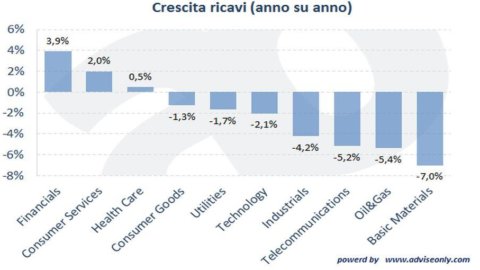
As one could have imagined, the quarterly results proved to be anything but solid, both in terms of results and in terms of expectations. In aggregate, according to data collected by Bloomberg, revenues decreased by 1,93% compared to the same quarter of 2012, while earnings per share (the classic earnings per share) fell by 10,5% (well beyond expectations).
The weakness of these results can be grasped even better if we break down the index by sector, obtaining the data contained in the graphs (Click on the image to enlarge and scroll):
What do these two graphs tell us?
First, it's clear that this isn't a total meltdown: within each sector there have been companies that have done well. The overall view, however, is that European companies - in a rather uniform manner also in the various sectors - are struggling to compensate for the drop in domestic and global demand with sufficient cost reduction to keep profits stable. In fact, in detail, i margini they keep going down (understood as EBITDA margin: ratio between profits generated by the operating part and revenues), as well as i profits generated in the last 12 months per share (EPS).
Secondly, European companies find it more difficult than US companies to respond to the challenging market environment. In fact, if we compare these data with those of the S&P500 presented last week, we note that in this first quarter of the year, American companies have been able to respond to the decline in turnover more flexibly through a cost reduction which made it possible to keep the margins stable.
As we have said several times, if we take a look at the index as a whole (Europe Stoxx 600), Europe continues to be a market in which valuations (EPS) remain below their historical average and therefore at a good price (given the financial value, the price at which you buy is important and, in the case of European shares, it is at acceptable levels). However, moving within the sector and in this context of high volatility is anything but simple.