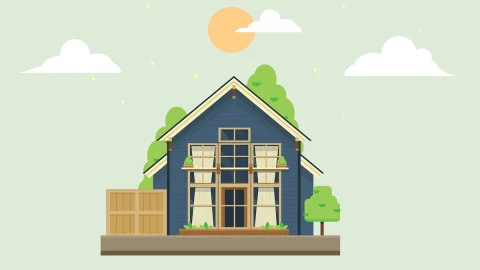
The hunting season to grab the CASE who possess a good energy rating will officially open Wednesday 7 December. The new one will arrive on that date directive on green houses from the "trilogue", Parliament, Council and European Commission. According to industry experts, the directive could be issued in a softer version with short deadlines compared to the original version, but in any case with the precise objective of achieving a progressive reduction in building consumption by 2050.
Hunting for properties with good energy classes
Therefore, for those who are looking for a home, it will become a priority to search the portfolios of real estate agencies for those homes that already have one good energy class. “The search for homes with good energy classes has already begun and we are already seeing it both for the new, with A classes, and for the existing” he says Alessandro Sesenna, of Remax Class in the Lobaccaro team. Remax is the largest real estate company in the world with over 150.000 operators. “For properties already on the market, the most sought after now are those who own one energy class from E up” says Sesenna again. “It must then be underlined that it is above all those who ask for this type of property young people, the most sensitive to energy saving".
According to a recent study by Bank of Italy (The capitalization of energy labels into house prices. Evidence from Italy” edited by Michele Loberto, Alessandro Mistretta and Matteo Spuri), the houses belonging to the 4 best energy classes have a value of approximately 25% more compared to those of class G.
Green homes: what to expect from the EU directive
There are several hypotheses in circulation regarding the content of the EU directive, but two main paths can be identified: one more severe and one more lenient. The 7th December the mystery will be revealed, but in the meantime let's see the hypotheses in circulation.
La The proposal of a directive approved by the European Parliament last March, raised quite a few discussions due to the tight deadlines it required for adaptation: the transition of all residential properties to class E by 1 January 2030 and to class D by 2033.
Now one is looming sweeter version in defining the steps to achieve energy efficiency, leaving more discretion to the member states who will probably have to independently define a timeline for the efficiency of buildings. But the final deadline will remain: reaching zero emissions by 2050.
Green homes: the situation in Italy
At the moment in Italy, the buildings considered priority are 5 million out of the 10 million properties in energy class E, F or G, therefore, even if the 2030 deadline is postponed, it will be important to organize in time. "The real estate sector represents over 30% of emissions in Europe, so it is essential to find a solution that is both environmentally and economically sustainable” he says Alessio Santarelli, General Manager of the Group MortgagesOnline. “Renovating 5 million properties means requiring 15 million Italian families to spend at least 20 thousand euros, for a total investment of over 300 billion euros. It will definitely be necessary implement incentives structural for the renovation of properties with a view to energy improvement, which support consumers while remaining sustainable for the state coffers".
Green mortgages: 35 euros less on the installment of a fixed rate
A viable path, says Alessi, are the green mortgages “which today are already more convenient than traditional ones and could be even more so if we thought about a tax relief or a dedicated state guarantee, similarly to what has already been successfully done for young people's mortgages”. “Green mortgages offer discounts on interest rates or on additional expenses, with an average rate of 25 basis points lower than traditional mortgages” says Alessi.
Here are some examples. If we take into consideration a fixed rate, which currently represents 96% of requests, and we simulate a 200.000 euro, thirty-year mortgage requested by a forty-year-old resident in Milan, the best traditional mortgage offer sees a TAN of 3,80% , installment 932 euros and APR 3,98%. If you look, for the same parameters, at a green mortgage, the installment is 35 euros less per month (897 euros), just as the TAN (3,49%) and the Taeg (3,63%) are significantly lower: the difference on the total interest is around 12.500 euros, calculates MutuiOnline.
The identikit of the green mortgage: durations over 30 years, larger amounts and lower LTV
Due to the increase in rates in the last year, an increase was observed in the share of requests for green mortgages with a duration of more than thirty years, which went from 1,3% of the mix in 2022 to 9,6% in 2023. The average amounts requested, equal to 173.136 euros, remained almost stable compared to 2022 (174.499 euros), and remain approximately 30% higher than those of traditional mortgages (around 135.000). The LTV (Loan To Value, the financial parameter that indicates the relationship between the amount of the loan and the value of the asset) is also confirmed to be lower than traditional mortgages: in 2023 it stood at 64,3%, compared to 72 % of other mortgages.
The south wins in requests for green mortgages
Particularly significant is the increase in requests for green mortgages coming from South and from the Islands, passed, on the total national territory, from 14,8% in the last quarter to 19,7% in October; in the same geographical area, the reduction in the average amount requested for green mortgages (from 150.181 to 137.978 euros) is interesting and counter-trend, probably indicating a lower cost of newly built homes. LTV is decreasing for all three geographical areas while the average duration requested is increasing, especially in the south and on the islands.