Former US Treasury Secretary Lawrence summers – a distinguished economist and nephew of two Nobel laureates in economics – defined Biden's economic policy as “the most irresponsible in decades”. He does not question – as the anti-Keynesians do – the intrinsic goodness of a super-Keynesian policy: he simply says that the stimulus is too great and will lead to overheating of the economy, with inflation and unsustainable growth rates. It would repeat, magnified, the taper tantrum of 2013.
The Nobel Prize Paul Krugman, on the other hand, is not worried, just as she is not worried Janet Yellen, ex-FED Chairman, who – as Treasury Secretary – defended his Chairman's powerful spending plans. The stakes are high, because a soaring interest rates would be fatal for a super-indebted world (in which Italy no longer feels alone!…). From this titanic clash between the great thinkers of the economy, what can be deduced?
It can be deduced that this anomalous crisis has disrupted supply and demand, but also the way to read both and to interpret the role of economic policy. Jacob Marschak, in a 1945 article, reviewed the explanations of the business cycle, drawing parallels between economics and other sciences. Seismology, for example, progresses because of better instruments, more refined theories and more frequent earthquakes. In the case of economic science, however, concluded Marschak, the earthquakes have done everything in advancing theory and practice…
The 'earthquake' of Great lockdown (copyright of the Monetary Fund) cannot fail to have influenced also those mechanisms which dictate the economy's responses to stimuli. Answers that bring into play not only economic and financial factors, but also psychological and political. There is therefore room for competent and reasonable people to have different assessments of the prospects of an economy passing through cold shower of the crisis to 'hot shower' strong fiscal and monetary stimulus.
The best answer, at this point, is to wait and monitor, ready to adjust depending on the data. Which data, for now, they do not bring water to Summers' theses. Yes, inflation is rising, driven by raw materials, but rates are actually falling – in the US and in Europe, including Italy. Two months ago, before anxiety about imminent inflation infected many, the most important rate – the yield on T Bond American 10-year – had touched if not exceeded 1,70%. In recent days it has even fallen below 1,50.
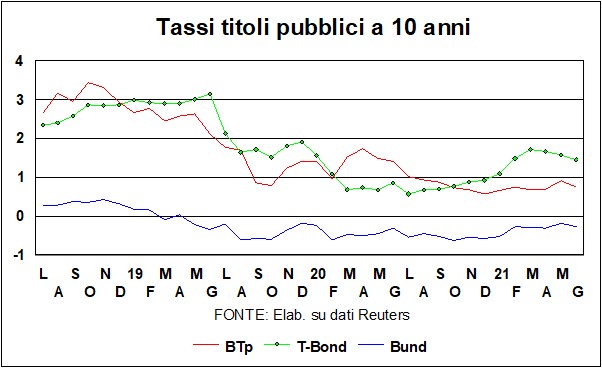
A booming economy – such as the US, which will already exceed its pre-pandemic level this year and is expected to grow by 6,4% – should push the long rates upwards, as should expectations of higher inflation and the need to finance huge public deficits. Why are these factors ignored by the market? As for theinflation, the answer seems to be that investors don't believe the price momentum presents a danger. As for the pressure of the question, if it is true that the stimuli in the pipeline they are strong, it is also true that there are unused resources in the economy: in short, there is still a output gaps to be used before the economy goes into zone of overheating.
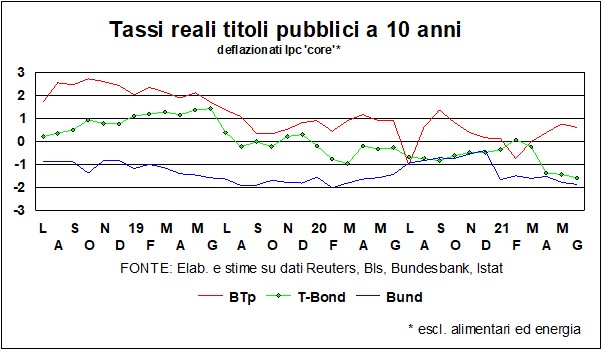
As regards public and current deficits, there are the Fed and the happy willingness of big investors to keep US government bonds in their portfolios. Meanwhile, inflation in America has had the effect of further lower real rates. Summers would say: even more fuel in the engine of the economy…
In Europe, rates are coming down, albeit slightly. Even in the Old Continent the economic prospects are improving rapidly, but here too there is a lot unused capacity, and warming is even further away than in America. L'inflation, then, even if it is clearly visible in producer prices, it only gives signs of an increase in the overall consumer price index. The index core (which excludes energy and food) remains below 1%, both in Italy and in the Eurozone. The spread drops a little, the yields of btp are well under 1%, and the real rate (calculated on the index core), is just above zero.
I usual hawks in the ECB Council (an Austrian, a Dutch and a German: it sounds like the incipit of a salacious joke…) they repeated the comedy part: we made a fierce face. The day after the meeting that sanctioned abundant purchases of public bonds to keep interest rates low, they specified that policies will need to be reviewed if inflation rises above 3% in all the countries of the Euro area. If we think that until recently it was heresy to think of a trend in consumer prices higher than 2% and that the Bundesbank itself lists the reasons why the acceleration in prices is transient, then it comes to think that they too run away laughing, while they pose as tough and pure.
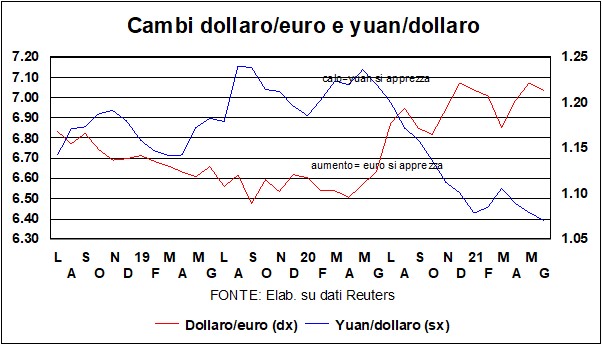
The change of dollar against euro (and let's not forget that, like all foreign exchange, it is determined by those capital movements that account for more than 90% of the supply and demand of currencies) is not much different than last month. Again, one would have expected one upward pressure, given the growth differential in favor of the US economy and the need to attract capital to finance a public deficit which this year will touch America, according to the OECD, 15,9% of GDP.
But another differential – that of real long-term rates, traditionally an important determinant of the exchange rate – has swung against the dollar. The markets are watching this in fascination economic policy experiment, which sees an economy, which is already flexing its muscles on its own, receiving massive fiscal stimulus, with a Fed who is watching with benevolent expectation and who has already declared his intention to keep the monetary policy tap wide open, with low rates and always generous QE. And this is another factor that compensates for the growth differential.
Where something has moved significantly is in the exchange rate of the Chinese currency. Against the dollar, it yuan strengthened to its highest level in more than three years. Here too, we could discuss growth differentials and interest rate differentials, but in the case of China, the exchange rate is also part of geopolitical games. The American offensive against Beijing has many fronts, and the currency one need not be part of the game: better to give the US the bone of a better competitiveness of the dollar, without dragging the yuan into the ring of confrontation.
I stock markets, we said last time, «remain on nice stable. And they're right». And there's nothing to repeat, at the risk of seeming repetitive. With a recovery whose risks – in Italy, in Europe, in America and in the world – they are all upwards, with accommodating economic policies e vaccinations proceeding – fast or slow, but always with an inexorable step – it is hard to see what could go wrong to change the mood of the Stock Exchanges (apart from, of course, temporary corrections). Of course, if Summers is right, there could be a surge in rates that would lead to financial upheavals capable of spilling over into real crises. But, all in all, we don't believe it (weighted judgment, this, that immense it is however a 'shopping advice').
There are alternative to stock investing? Sure, there's the cash, but, while this option is possible for individual investors, it is precluded for institutional investors, who must keep certain percentages, modifiable, but not up to zero, between shares, bonds, cash and various alternatives. And there are the corporate bonds, but there are not many that offer attractive returns.
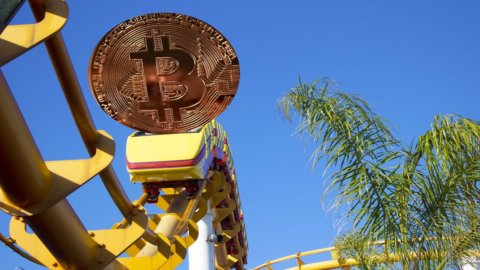
Among the alternatives there is also the Bitcoin. Some big funds, some time ago, proclaimed Bitcoin a asset classes, like other traditional ones. The Lancet have not been kept on Bitcoin in the past: we wrote that it was for lovers of extreme sports and/or roller coasters; we have always written that it is a solution in search of a problem. And in the last month, the facts have largely proved us right: his fall from the highs reached 40%. But there are those who do not give up: the young populist president of El Salvador, Nayib Bukele, declared that Bitcoin will acquire legal tender status in his country. And, he added, if 1% of the world's Bitcoin goes to invest in his country, El Salvador's GDP will increase by 25% (! ??). Congratulations.