Never as in this period are interesting insights and reading books on the subject of language. An increasingly modified language both by a society that has not only changed the relationships between different cultures but also within the culture to which it belongs, placing itself more and more in a concept of otherness: "What arises, opposes itself as it distinguishes itself and nothing is itself without being other than the rest. (Marc Auge)
This volume “THE OTHER'S LANGUAGES. Forms of otherness in the literary text" (Ed. Leo S. Olschki) collects the reports of Italian and foreign scholars present at the University of Lecce during the International Conference organized by the Department of Philology, Linguistics and Literature in 2005. The theme of linguistic and literary otherness is explored from different points of view, which converge in the individuation of a singularity of the literary text whose value is to restructure forms of thought, relationships between different cultures and cognitive fields.
If Alessandro Serpieri and Ann Lecercle, analyzing some Shakespearean dramas (Hamlet, Measure for Measure, Othello), identify the foray into the gray areas that attack the Logos and plunge into the abyss of the unspeakable, Anthony Johnson captures a value in Yeats' symbolism equally disturbing, which manifests itself in a style whose frequent obscurity is linked to the mystery of cognitive processes. A philosopher of language like Jean-Jacques Lecercle, referring to Deleuze's thought, points out how the concept of otherness is substantiated by an emotional fabric that welcomes the versatility of desire and the richness of the oneiric experience. The incursion into another space and into linguistic universes not always recognized as literary is a value in itself, observes Ronald Shusterman, an expert in the philosophy of language.
What is at the center of the other reports on different authors, from Charles Kingsley to Henry James, from Pinter to Antonia Byatt, from Salman rushdie to Hanif Kureishi to Marina Warner, is the awareness of art's ability to originate forms of creative thought. As Angela Locatelli writes, the artist speaks «obliquely and figuratively», as he is an expression of the paradoxes that cross the experience of each individual and the language that gives him a voice.
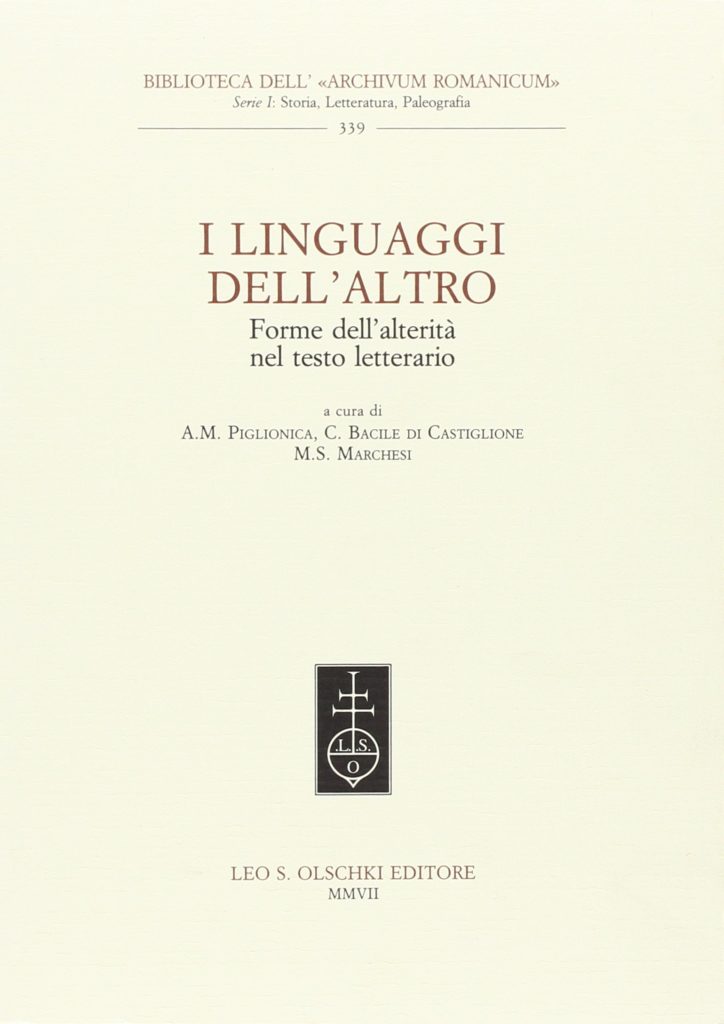
THE LANGUAGES OF THE OTHER. Forms of otherness in the literary text. Proceedings of the Conference «The languages of the Other/other» (University of Lecce, 21-22 April 2005)Edited by Anna Maria Piglionica, Claudia Bacile di Castiglione, Maria Serena MarchesiLibrary of the «Archivum Romanicum». Series I: History, Literature, Palaeography, flight. 339