We all say it and repeat it: without health there is no full life, then instead we behave as if health does not require attention and rational behavior. The healthcare model «A health» (One Health), launched byWorld Health Organization, it is based on a global vision of living beings that includes both humans and animals that inhabit our planet, a planet in which water, air, soil and vegetation intertwine their characteristics together with health and social services.
It is the sum of all these factors that generates the state of health in the world, in the continents, in individual countries and in local communities. We know that socioeconomic determinants – such as poverty and education – can be risk factors for health, as can many lifestyle habits and the presence of toxic contaminants in the environment. These and other factors affect our state of health and the onset, or otherwise, of acute and chronic diseases: from infections to non-communicable diseases (including tumors). Over time and with the extraordinary progress of medicine, culture has become predominantly oriented towards the treatment of diseases and assistance to the sick, developing diagnoses, therapies and rehabilitation.
The health market is born
This led to the birth of a large market: the health market. As with other markets, it also pursues the same goal: the increase of turnover through the growing medicalization of society. Diagnostic tests, drugs, food supplements and medical devices tend to increase in terms of both quantity and cost, often without making significant contributions to health.
In particular in our country, thanks to the National Health Service, the medicine market can count on a faulty mechanism because those who pay (the State) do not choose and do not use the products they purchase; whoever chooses the products (the doctor) does not pay for them and does not use them; and, finally, those who use the products (the patient) do not choose them and do not pay for them. This large market which globally adds up to various hundreds of billions of euros for public and private expenses he managed to mask his irrationality. In fact, it is not logical to spend human and economic resources to treat diseases that are ultimately avoidable (this will be repeated several times during the various chapters).
Health: Over 50% of chronic diseases and cancers are preventable
In fact more than 50 percent chronic diseases, such as type 2 diabetes, heart, lung and kidney failure, stroke and heart attack, can be prevented; more than 50 percent of tumors it is avoidable, and despite this every year in Italy around 180.000 people die from cancer. What must be done to avoid diseases and tumors has a very specific name that cannot be pronounced enough in medicine: "prevention".
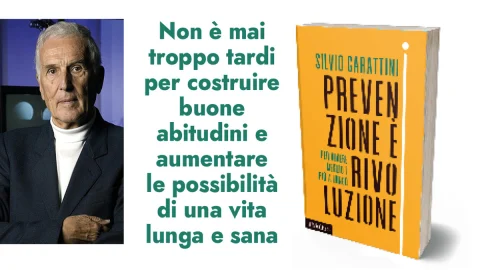
Health: prevention is the revolution that makes you live better and longer
La prevention, therefore, enter conflict with the market because it can scale it down by reducing the possibility of certain avoidable diseases occurring and at the same time determining a great benefit for the National Health Service which would become more sustainable. National health service which, let us not forget, is a great "good" that we must also be able to ensure for our children and grandchildren.
La prevention must be the result of one cultural revolution in which the belief that many of the diseases which increase mortality they are avoidable acting basically in two directions which must then converge: personal decisions and those of local, regional, national and international institutions.
Individuals and institutions must change direction and converge
Le individual decisions citizens must be the result of a personalized change of their own bad lifestyle habits. We can all improve our behaviors by keeping in mind that health is not only a right, but also a duty. Implementing good lifestyle habits is a "healthy selfishness" because over time we avoid diseases that significantly change our life, shortening it and making it full of suffering with a limitation of our freedom of action. Having avoidable illnesses brings unnecessary inconvenience and suffering to our family members and those close to us. Not only that, the excess of diseases makes the economic development of a community and an entire country more difficult. Finally, good lifestyle habits, avoiding diseases, are an act of solidarity because they allow the National Health Service to use the available resources better, to the benefit of all.
On the other hand, a more sustainable and more efficient service improves the health conditions of the entire community. The institutional decisions they are multiple and always modifiable and improvable. They must first of all support and encourage personal decisions by improving laws and regulations that allow the adoption of good lifestyle habits. They must change everything that can improve socioeconomic determinants, remembering that poverty and poor education are the most important risk factors for health. If prevention is to be a cultural revolution, schools of all levels and specializations are an essential element, so we need to create competent and dedicated professional figures for this purpose. In particular the schools of medicine and their specializations must have prevention as their center of attention. Unfortunately it cannot be exhaustive because everything concerns health. For example, the prevention of mental disorders was not discussed because we would like to make it the subject of another book. Many of the decisions that institutions must make at various levels are unpopular because they touch on cultural beliefs and economic interests that are difficult to change. It must not be forgotten that the enormous medicine market cannot have a tendency to decrease: like any market, in fact, it naturally tends to increase in size.
.