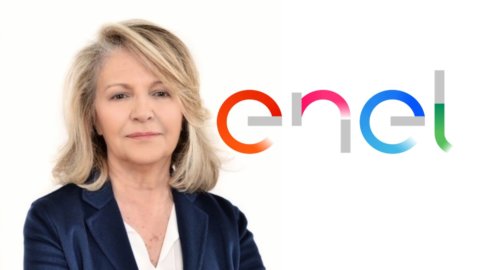
Sustainability, solid governance and gender equality: they are certainly three levers for development but they are also three battles that characterize the professional and civil identity of Patricia Grieco, one of the most esteemed female managers in Italy today. They call her “the Lady of Corporate Governance” because, as well as first woman to be president of Enel, Grieco also sits on the boards of directors of three listed companies such as Ferrari, Amplifon and Anima Holding and is the President of the Italian Corporate Governance Committee and Vice President of Assonime. Hers is an all-round commitment, in which expertise is intertwined with boundless passion. She talks about it in this interview with FIRSTonline.
Grieco, you are known in the financial community as the "Lady of corporate governance" not only because you are the President of the Italian Corporate Governance Committee but also because at the top of Enel and in the other listed companies in which you are on the Board, your main commitment is directed – in addition to gender equality – to the promotion of good corporate governance practices: how did this professional passion of yours come about and are you happy with the results achieved?
“To tell the truth, I've always had a professional passion for good governance because I think that correct management and transparency are the main foundations of business ethics. As President of Enel, my commitment to good governance has made a quantum leap because I found myself in a group with very complex governance, which controls around 900 companies and which has 14 listed companies worldwide. Implementing virtuous and uniform practices in different regulatory systems according to the various countries in which Enel operates was and is an extraordinary challenge, which has made Enel an exceptional training ground for skills and knowledge of good corporate governance. The Presidency of the Italian Committee for Corporate Governance, which has just launched the new Code of self-discipline for listed companies in line with European and international best practices, then allowed me to refine my skills and contribute to gathering results for the system - Country with which I am very satisfied”.
In fact, the Committee recently approved the new Corporate Governance Code for Italian listed companies: what are the most important changes and what will concretely change for the companies that adopt it?
“With the new Self-Regulatory Code, which will come into force in 2021 and will apply to listed companies but will also be a reference best practice for others, Italy objectively places itself at the level of European and international best practices. Its innovations are mainly five: 1) the simplification of the structure of the Code, which facilitates its adoption and application; 2) the sustainability of the business activity, placed at the center of the tasks of the boards of directors, committed to making companies less risky and more profitable because they consider the impact of the business activity and its risks under all profiles and take into consideration not only the creation of value for the benefit of the shareholders, but also the interests of the relevant stakeholders, in a long-term logic; 3) the proportionality of the rules based on the size of the companies and their control model, so as to favor the listing of even the smallest companies and those with a strong ownership concentration; 4) engagement, which aims to foster and strengthen dialogue with shareholders, beyond the meetings and road shows; 5) the neutrality of the Code with respect to the various corporate models, whether traditional, monistic or dualistic".
The fact that sustainability is one of the central pillars of the new Code means that the aim is to make everyone understand that the sustainability on which the future of businesses depends is indeed the environmental one - which is linked to the European breakthrough of the Green Deal for the transition energy – but is it also the economic, social and governance one, which is no less important than the first?
“Yes, sustainability is the determining factor of the so-called ESG investments (“environmental, social and governance”), the acronym that indicates sustainable and responsible investments. The new Code reflects the awareness that the success of a company is sustainable if it does not create value only in the short term, if it takes into consideration the interests as well as the shareholders of all the relevant stakeholders for the company, if it pays attention not only to economic and financial risks but also to environmental and social ones and if he knows how to pursue profit in a lasting way by making the most of all the forms of capital at his disposal, from human to intellectual, from material to natural and from social to financial ”.
How much is the new Code worth for a large group like Enel and what will it change in terms of sustainability?
“Sustainability is already the cornerstone of Enel's entire strategy aimed at both decarbonisation and the electrification of consumption, which makes Enel not only the great protagonist of the energy transition but a real front-runner in the world. The new Code will only strengthen Enel's way of doing business in Italy and around the world”.
Of the more than 200 companies listed on the Italian Stock Exchange, how many will actually be those that will adopt the new Self-Regulatory Code and for those who ignore it, are there at least moral sanctions?
“The Code is voluntary and the measures are proportional and also for this reason I expect all companies listed on the Stock Exchange to adopt it. There have been differences in the past in the degree of compliance with the various recommendations, which discounted a dimensional effect with an oscillating percentage, in 2019, between 77% for medium-large companies and 59% compliance by small companies. The enhanced proportionality of the new Code should further facilitate adherence to the recommendations. Anyone who does not adopt them will have to explain it to the market (rule of "comply or explain”): that's why there is no need for sanctions in case of non-adhesion; the market will provide reputational effects for the company itself”.
In addition to the presidency of Enel, you have the opportunity to closely observe the progress of the new governance rules in companies that operate in very different fields such as Ferrari, Amplifon and Anima Holding, of which the board of directors belongs: what are the differences about governance in these four companies?
“The fundamental principles of good governance are the same for everyone, regardless of the sector in which a company operates and so it is also for the four companies that I know closely. In all the principles of the Code they have made great strides forward”.
In addition to a new corporate governance, for years you have been a champion of gender equality and the advancement, on equal merit, of women in companies: a recent survey has shown that in 12 years the women present in Italy on the boards have passed from 170 to 811 but that only 14 lead the companies. Doesn't that seem like a very unsatisfactory result to you?
“Unfortunately this is the case: there is still a long way to go in Italy and in the world to give women the role they deserve, even at work. In addition to the scarce presence at the top of companies, the wage gap that penalizes women is also striking. Sustainability is also this: making sure that companies understand that diversity – not only of gender – is a value and that gender balance is not a concession but a condition that must be ensured on equal terms”.
In your professional experience, have you developed any recipes for supporting the promotion of the role of women in the company as well?
“It's a complex commitment that must aim at making women grow at all levels, inside and outside companies, and which starts from training, pushing girls to undertake scientific study paths where they are still under-represented. In the corporate sphere, policies aimed at a fair representation of women in selection processes and at increasing the representation of women in positions of higher responsibility must be pursued”.