It deals with 96 marbles of the Torlonia collection, the most important private collection of classical statuary. On display works such as: Dace prisoner similar to the specimens of the Forum of Trajan, next to the recently restored portraits of Domitian and Antinous, while the Hercules composed of 112 pieces, already exhibited in Rome, will dialogue with the sculpture of Leda with the swan.
The scientific project is curated by Salvatore Settis and Carlo Gasparri highlights the exceptional importance of the history of the Torlonia Museum in Lungara, founded by Prince Alessandro Torlonia in 1875. A collection that is the result of a long series of acquisitions and some significant movements of sculptures between the various residences of the Family up to the creation of the Museum Torlonia. The Torlonia Collection is due to the Torlonia Family's passion for collecting antiquities which finds its fulfillment in the Torlonia Foundation set up with the aim of preserving and promoting "The Cultural Heritage of the Family for Humanity" to be handed down to future generations.
The sections of the exhibition:
Section I: Evocation of the Torlonia Museum
The itinerary begins with a spectacular evocation of the Torlonia Museum – inaugurated by Prince Alessandro in 1875 – located in via della Lungara, where the 620 sculptures were exhibited in 77 rooms. Famous among these is the vast gallery of 122 portrait busts: «an immense treasure of erudition and art» (PE Visconti). In the Milan stage, the first selection will be enriched by the imposing Consular Sarcophagus of Via Ardeatina MT 395, with a group of Roman togati, who will welcome visitors, and two new busts (Domitian MT 539 and Antinoo MT 398) to complete the gallery of faces already present in the Roman exhibition.
Section II: Excavations Torlonia (XNUMXth century)
Prince Giovanni and his son Alessandro drew many sculptures from excavations around Rome, in archaeological areas such as the Caffarella and the Villas of the Quintili, Sette Bassi and Massenzio. Other finds came from excavations along the Via Appia and the Via Latina or from estates in Sabina and Tuscia, or still in the area of Portus Augusti. In this section, in the Milan office, the colossal Dace MT 412 will be hosted, which for reasons of capacity given its weight could not have been placed in Villa Caffarelli, and which in the imposing halls of the Gallerie d'Italia will find the right space to be admired in all its grandeur.
Section III: Villa Albani and the Cavaceppi Studio (XNUMXth century)
Many of the marbles in the Torlonia Museum come from two large eighteenth-century nucleuses: Villa Albani, commissioned by Cardinal Alessandro Albani (1692–1779) to house his collection of sculptures, purchased by Prince Alessandro Torlonia in 1866 and still owned by the family, and the marbles from the studio of the sculptor Bartolomeo Cavaceppi (1716–1799), which bear witness to his activity in the restoration and trade of ancient sculptures. Upon his death, Giovanni Torlonia bought all of Cavaceppi's marbles at auction, saving them from dispersion.
Section IV: The Collection of Antiquities of Vincenzo Giustiniani (XNUMXth century)
The Marquis Vincenzo Giustiniani (1564–1637) promoted a sumptuous printed work in 1636-37, the Justinian Gallery, with 330 engravings reproducing many of his ancient sculptures. The most substantial nucleus of antiquities, purchased by Prince Giovanni Torlonia in 1816 and which in 1856–59 passed to his son Alessandro, who assigned it to the Museum.
Section V: The Collections of Antiquities of the XNUMXth-XNUMXth centuries
A selection of sculptures documented in collections from the XNUMXth and XNUMXth centuries, passed to the Torlonia family as part of larger acquisitions (Albani, Giustiniani, Cavaceppi), or by direct purchase. In the last room, a copy of the sumptuous volume of the Torlonia Museum (1884) with the phototype reproduction of all the 620 sculptures in the Museum.
The exposure “The marbles of Torlonia. Collecting Masterpieces. The Torlonia Marbles. Collecting Masterpieces” arises from an agreement between the Torlonia Foundation and the Ministry of Culture - with the General Directorate of Archaeology, Fine Arts and Landscape and the Special Superintendence of Archaeology, Fine Arts and Landscape of Rome – authentic example of collaboration between public and private in the name of culture.
Galleries of Italy (Intesa Sanpaolo museum) Piazza della Scala 6, Milan – from 25 May 2022 to 18 September 2022
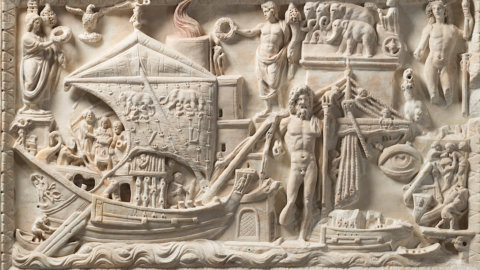
Cover image: Torlonia Collection, Relief with harbor scene, ©Fondazione Torlonia PH Lorenzo de Masi