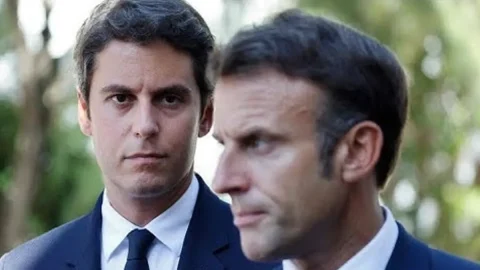
Gabriel Attal is the new French Prime Minister in place of Élisabeth Borne. Very loyal to the French president Emmanuel Macron, the thirty-four-year-old Attal is the most popular politician among the French and the youngest prime minister of the French Fifth Republic, surpassing Laurent Fabius who was appointed in 1984 at the age of 37. Among other names, there were Sébastien Lecornu, Minister of the Armed Forces, and former minister Julien Denormandie. But in the end Macron decided to focus on the young Minister of Education to relaunch a second mandate that has so far been uphill and strengthen the ties of a majority that appears divided and weakened.
Who is Gabriel Attal?
Gabriel Attal was active in Socialist Party for about ten years before joining Working, Macron's party, in 2016. The following year he was elected deputy for Hauts-de-Seine. In 2018 he joined the government as Secretary of State for Youth, at just 29 years old. He was then appointed spokesperson for Jean Castex between 2020 and 2022. Eventually he was assigned the post of minister delegated to public accounts, before moving to Ministry of Education six month ago. From that moment on, his popularity soared, to the point that polls indicated him as the French's favorite minister.
His approach to educational reforms, from the ban on the Islamic robe to the return of grade school exams to new measures against bullying, attracted attention and made him popular. Attal could embody the freshness and authority necessary to revitalize the Macronist government, even if his style and the decisions adopted could generate criticism and discussions, especially in the educational sector. He is also the first openly gay French prime minister, married to Stéphane Séjourné, an MEP from Macron's party.
France: why did Borne resign?
Le Borne's resignation were widely expected, given that Macron had already indicated the possibility of a government reshuffle in the previous weeks.
France is in a serious situation internal political crisis, with the European elections just around the corner and polls showing the far-right party, Marine Le Pen's Rassemblement National, in the lead. Macron, with three more years of presidency ahead of him, seeks to strengthen his position ahead of these challenges, including the Paris Olympic Games in 2024.
Pension and immigration reform are fatal
Borne, a historic exponent of the French Socialist Party who later joined Macron's party, led a minority government, depending on the support of the centre-right Républicains in parliament. Leading a government that did not have an absolute majority to pass laws made his partnership an uphill battle. During your tenure, you faced criticism for your frequent use ofarticle 49.3 of the Constitution, a legislative procedure that allows you to bypass the vote of deputies. This move provoked the anger of the opposition, part of the majority and many French citizens, who protested en masse for several months.
One of the most contested reforms was that of pensions, promulgated in April 2023. Borne had invoked Article 49.3 twenty-three times in eighteen months, a frequency second only to Michel Rocard's government between 1988 and 1991. Furthermore, in December, he had to give in to extreme pressure right in immigration reform, sparking further controversy.
Despite the protests, popular indignation and an increasingly fragmented society, Macron had not given in to the call for resignation. Until yesterday. Can Gabriel Attal rise to prominence without overshadowing Emmanuel Macron? This will probably be the equation that will decide his political future.