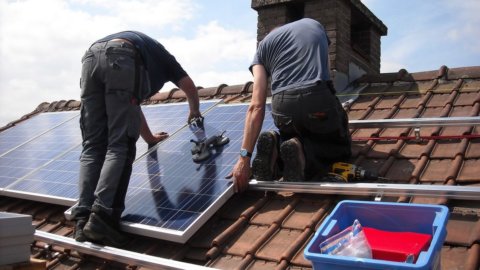
We install ours solar panels and we begin to bless the saved energy. The IRS helped us with the concessions dedicated to green energies placed on the roof of our house, or perhaps on the shelter of the canopy that protects the car. But woe to forget about the taxman when we have instead to deal with the energy exchanged with the national electricity system through the GSE, the Energy Services Manager who acts as an intermediary in the generally applied formula for our domestic solar system. We are talking about the "network on the spot", the system in force for over a decade which from next year will probably be replaced by a new discipline which will privilege, however confirming the basic criteria of the current system, the nascent CER, renewable energy communities.
How the exchange in place works (for now).
The dedicated meter that governs metering, installed by the grid operator in parallel with our normal electricity meter, counts the excess energy fed into the national electricity system from our solar panels. The one we don't consume even though we are endowed with a storage battery which stores it, returns it to us when needed (it is almost always advisable to install it) but also contributes to re-entering it into the network. The GSE then remunerates us for this energy that we produce and do not consume with transfers to our account current in two phases, which each year take into account the adjustments and advances estimated for the following year.
But this "intelligent system" also does another thing, which is important precisely because of the possible tax implications (we will talk about it in detail below): measure the balance between the energy that we draw from our electricity supplier, as in a normal user when "ours" is not enough for us, and all that instead we give to the network when we are able to do so.
All simple, all automatic once we have correctly activated the exchange on the spot practices with the GSE, which the installer of our system usually does directly for us, dealing with both the contract with the GSE and the request for installation of the "exchange" counter.
Give and take: I still pay the bill for what I draw from the grid and I can't supply power directly with my solar panels (in the meantime, I still pay the entire bill because my supplier, with the now deregulated market, can be any private operator ) and then through the GSE I am reimbursed for everything I have contributed to the national electricity system, where the electricity will then be bought and sold between operators through the Power Exchange.
Lenient tax but not always
But it is precisely this reimbursement that can hide two interlinked pitfalls. The first is rather trivial and can be defused with a simple check on the type of our solar system. If our system is installed in areas strictly pertaining to the property we own (typically the roof but also the garden or the car park shed) the reimbursement contribution received through the Gs "has no fiscal relevance", in short we do not pay taxes on this contribution. He made it clearRevenue Agency since 2009 with a series of responses to specific requests for a ruling.
Attention: this only applies to solar systems installed in direct areas relevance. If our system was installed in any area that cannot be assimilated to the appurtenance, for example in the land lent in any capacity by a neighbor, or for example in a state-owned area taken under concession, all the revenues relating to the solar system in any capacity should be subjected to taxation, in a very similar way to what happens to an entrepreneur who produces and sells energy.
Having ascertained the nature of our installation, are we fine and do we owe anything to the taxman? Not at all. Here is the eventuality that all owners of a domestic solar system must always and in any case take into account: any "surpluses".
Beware of surpluses: always taxed at a marginal rate
As we have explained, the exchange meter accurately calculates the balance between the energy withdrawn from the network and paid with the bill and that transferred to the network and reimbursed through the GSE. If the balance is negative, i.e. we have consumed more energy than that supplied, we must do nothing for tax purposes: all possible taxes will be counted and automatically applied at source by whoever sends us the bill and by whoever sends us refunds. It's useless to deal with it. If, on the other hand, the balance is positive, i.e. we have supplied more energy than that withdrawn from the grid, the surplus is considered a "surplus": an additional asset that we have produced, which we have sold and which therefore must be taxed as if we were a renewable energy entrepreneur who produces energy and sells on the market.
Practically? The consideration for any surpluses must be taxed by inserting it in the annual tax return under the item "other income". This means that these sums are added to our cumulative income as they are subject to the highest tax rate, thus significantly reducing the net benefit relating to this item.
The implied message? Our photovoltaic system is all the more convenient when we are able to cover our consumption with the self-production of solar panels, not exceeding the balance between withdrawals and contributions of electricity to the grid. That's why the storage batteries they are almost always a convenient choice.
How to check and manage surpluses on the Gse portal
No one will automatically tell us whether or not we have surpluses. We have to verify, but we can do it relatively easily by accessing the dedicated area of the GSE Internet portal or with our credentials (those obtained when we registered directly or through our installer) or with the Spid.
First warning: upon activation of the contract with the GSE, the latter must be notified whether to have the surplus liquidated or to keep it on credit to be reported in balance in the following year. If no option is exercised, the second is automatically activated, i.e. theprovision. In the absence of a different option, which must be exercised every year in January by the 31st on the GSE portal, the previously exercised option remains valid.
What to choose? In the meantime, if we expect not to have surpluses, we should choose the provision option, otherwise, all in all, it would be better to have them liquidated despite the inevitable tax blow.
If we choose the liquidation of the surpluses, the GSE reclaims the consideration with the same methods used for the other refunds together with the payment of the adjustments for the exchange on the spot, made by 30 June of the calendar year following the one in which we have accrued the surpluses . After the payment and in good time for the tax return, the GSE always makes available to us in our area of its portal, the formal certification of the liquidation of the surpluses that we will have to attach to the tax return.
Regarding the options that we can exercise, here are the detailed steps to proceed with the option or the correction of the choice made previously: from the GSE portal we access to the customer area with credentials or with Spid; let's go to the section Gse services and click Login in the area Exchange on the spot; we select Contract management and then Existing contracts; we click on Surplus liquidation and then Modification; we select the field Yup or the field No. without forgetting to finally click on Save. The game is done, and eventually we talk about it in January of the following year.