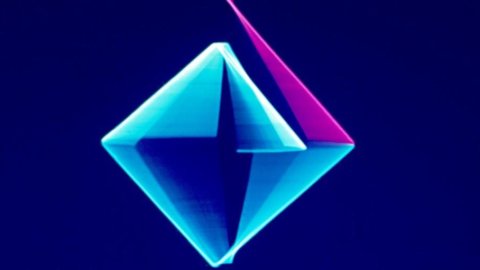
The retrospective, curated by Valerio Dehò with the patronage of the Municipality of Pistoia and the Tuscany Region, presents in Palazzo Fabroni (via di S. Andrea 18) a path that brings together 155 vintage photographs in black and white and in color, conceptual and optical art, and "photographic sculptures", where the originality of Chiavacci's thought will be highlighted, which originates from his original abstract vocation and his binary concept of form and space.
When in the XNUMXs Gianfranco Chiavacci approaches experimentation around technology, with an unconventional use of the camera, he reflects a sensitivity shared by a large sector of the international art world. His attention to the binary number system, which the artist exercises in successive declinations, and with different mediums, starting from the previous decade, expresses the need to synthesize an inevitable relationship with the "machine", both in the physical structure and in the theoretical apparatuses .
Chiavacci autonomously elaborates this tension (also partly autobiographical, linked as it is to his profession as a programmer which placed him in daily contact with electronics) between the artist and the inescapable presence of technology.
As the curator Valerio Dehò recalls in his text in the catalogue: "Chiavacci's photography wants to be total, not flat and banal, but on the one hand it reveals all its physicality of chemistry and physics that interact with light from the white of the unexposed to the black of the fully exposed. Furthermore, it can also become abstract, as it is no longer linked to emotion, to memory, to stopping fleeting sensations, thus leaving the natural, marking "a path to rediscover the artificial creation and expansion of physical experience."
The work, every work of art, asserts itself as a deviation from a system of rules. And this is exactly what happens in Chiavacci's photographs, when the luminosity, the colour, the effects of movement are rendered according to a possibility understood by the instrument (this is the method) but not foreseen by its rules (and here is the language) .
The abstract objects that appear in photographic prints contain a two-dimensional character that goes beyond their physical nature. We are in the seventies and Chiavacci sees in the simple action of photoimpression of film future accesses to digital three-dimensionality. Thus, Chiavacci's almost fifty-year research on "binary grammar" (an articulated path, very rich in variations and departures from itself) becomes clearer and more visually effective precisely in the phase in which it deviates from the representation in code.
Speaking of himself, Chiavacci recalled how "it occurred to me spontaneously to think of a work in which it was possible to obtain the maximum modifications with a rigid, pre-calculated grammar or syntax, and therefore to create, instead of the electronic bit, the spatial bit".
"Total Photography" provides a synthesis of fifty years of research and bears witness to a rigor, by no means formal, which surprises as well as its extraordinary ability to experiment with new solutions and paths, using numerous materials and as many expressive techniques.
Gianfranco Chiavecci was born on 1 December 1936 and died on 1 September 2011 in Pistoia, the city where he has always worked and lived.
Interested in historical art since he was a boy, in the early fifties he began to paint, first as a simple self-taught by observing the works of the past and then, following the exhibitions and increasingly the Tuscan artistic environment, drawing inspiration from those of contemporary art. His first pictorial works date from the mid-1964s and show an interest in the informal climate of those years and in the lessons of international abstract art that he knows through catalogs and magazines. He approaches the experiences of Visual and Kinetic Art with whose exponents he comes into contact in Florence, in particular in the Galleria Numero di Fiamma Vigo, a lively place of debate on the problems of artistic research. In 65-1985, he began a relationship of friendship and collaboration on a theoretical level with fellow artist Fernando Melani which would last until his death in XNUMX.
In 1962, for work reasons, he began to attend the IBM courses for programmers and this introduced him to scientific thinking which is reflected in the first attempts to borrow computer language into painting. The use of the binary language, on the then mammoth electronic computers, and the study of its logic already found application in the first works of 1963. The assumption of the binary, defined by the artist himself "as a two-state logic and as a technique-process instrumental to create and experimentally investigate the formal world pertaining to two-dimensionality” becomes the founding nucleus of his theoretical and operational research until his last works in 2007 when he declares that he has reached a conclusive state.
The artist never uses the computer machine for the production of the works but the binary logic inherent to it as a logical-executive process; therefore his interest in him is not for the technique but for the thought that supports it. The vast artistic production is often accompanied by theoretical texts presented independently or on the occasion of personal exhibitions.
Particularly interesting is the research begun in the early XNUMXs concerning photography that he has always practiced and of which he knows the main historical exponents and experimenters of the avant-gardes and the post-war period. Also in this case Chiavacci is interested in the logic of the medium, in the executive process of the birth of the photographic image, in the possibility of intervening on the linguistic aspects and in the image's capacity for abstraction. This research, which will last constantly until the mid-eighties, takes place in parallel with the pictorial one; although more experimental, like this it reaches qualitatively very high and interesting results from an innovative point of view.
Implemented both with simple means and with sophisticated techniques and materials, it offers unprecedented results in the Italian field, which were still pioneering for this discipline in those years. Gianfranco Chiavacci's photographic production embraces not only conceptual reflections on photographic processuality but research on the movement of the object in space, on dimensionality, on color and on the definition of time: all this in harmony with the speculations of the best thought of those years. In 1977, in the text Making photography, he made public the theory and the results of his work.
In 2007 in a vast anthological exhibition in Pistoia for the first time the two paths, the pictorial and the photographic one, are compared.
GIANFRANCO CHIAVACCI
Total photography
December 8, 2013 - February 9, 2014
Pistoia, Palazzo Fabroni - Contemporary visual arts (via Sant'Andrea 18)
INFO www.comune.pistoia.it/musei