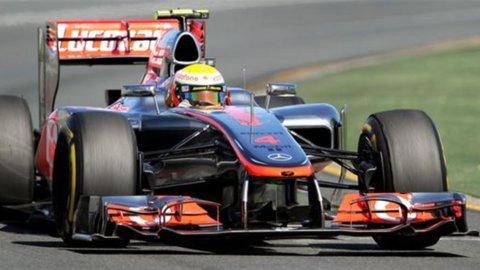
At the start, one certainty: it won't be another season monopolized by the Red Bulls. There's actually another one: it will be unlikely that Ferrari will change the course of the recent history of Grand Prix racing. It's too early for everything: first weekend of the season; atypical Melbourne circuit, it runs on a road surface, therefore very particular in terms of technical yield; and as if that weren't enough, the first day on the track also saw rain, which could also tell the story of him in the race on Sunday. Soon, therefore, to churn out analyses. But reigning world champion Vettel was relegated to 6th place at the end of qualifying, behind his teammate Webber (he plays at home, he can be there), but also Michael Schumacher's Mercedes, Grosjean's Lotus, but above all two McLarens who monopolized the front row at the start… Well, all this says that the wind has changed.
Which is exactly what the brains of Formula 1 wish for. Not out of dislike for Vettel and Red Bull, on the contrary: they are young, they speak to young people with a modern language of marketing and trends; are theexample of how and how open, global and democratic Grands Prix are, giving even outsiders the chance to beat historical names such as Ferrari and Mercedes, and thus sign the Great Book of Racing in gold letters. And young people are precisely the target of this Formula 1, which knows exactly how its charm today is more stuff for, let's say, mature enthusiasts than for kids.
Data speaks loud. THEEntire categories of thought that have marked the past decades – the automobile, its technology, speed, risk, heroism… – today have much less impact on the emotions of the new generations. The results of sales of specialized newspapers and targeted television audiences confirm this unequivocally. And this happens in Italy: the cradle of motoring, of racing, of the love of speed, risk, etc. Let alone abroad. Some argue: Ferrari's fault: when Schumacher won in a flurry, the world seemed intoxicated by his deeds, TV and newspapers and sponsors and allied races pulled like drug addicts, governments on the other side of the world passed out to the sound of millions dollars to have the honor of organizing a Grand Prix.
Real. Partly. Already in Schumi's time the whole F.1 system was showing the first cracks. Newspaper sales and TV viewership began to stutter, perhaps with the exception of Germany which continued to mix pride, Deutschland-uber-alles and beer like a gigantic and itinerant Oktober Fest. And GP requests from the extreme world were pressing, yes. But driven by an emotion that is basically not rooted, not strong enough to become a tradition, as it was in the last century in Europe and a little in South America. Today's F.1 is increasingly in the East: the real money comes from there. But with sinister crunches. The Shanghai GP is emblematic: it floats on a now rooted and incurable red (leaks, not Ferrari); for now the leaders - including politicians - of China do not want to give it up, but will it last? Ditto the various Abu Dhabi, Bahrain: colossal investments and futuristic architectures excellent for the covers of the planetary glamorous press. But real gains…
And let's not talk about car manufacturers. About ten years ago, they decided everything themselves: regulations, future projects, division of loot. Now, with a deep-rooted auto crisis, even with the famous emerging markets that can't help but fill their streets with Ferrari and Mercedes and BMW, the big brands have taken a big step backwards. It remains Daimler Benz, basically. Fiat's support for Ferrari is tepid, and if anything serves to guarantee Luca di Montezemolo ample autonomy that otherwise he might not have. But F.1 feels all this, and how.
And then (and let's go back to a few lines ago) here's what Bernie Ecclestone and his cohorts are in absolute need of new blood, of change. And of this, in the season that is about to start, we should have some. New technical regulations (especially the prohibition of the famous 'blown' exhausts) and Pirelli tires with a generally softer compound, therefore probably less durable and with a more evident degradation that could force the drivers to stunts such as counter-steering, should lower the 2010-2011 excessive power of the Red Bulls. And therefore give away more level, less predictable races, even more full of overtaking. What we saw up to pole position in Melbourne, with Vettel and Webber overtaken by the McLaren drivers and at least flanked by the Mercedes, seems to be going in this direction. 2012 is already a historic World Championship, thanks to its 6 world champions at the start. But if the last on the list, the returning Raikkonen, should really go fast with the non-pharaonic Lotus (for now, in qualifying in Melbourne, the less celebrated team-mate Grosjean was ahead of him), this too would give some of boost to the championship, to the vintage, within the movement.
Five final lines on Ferrari. Everything awaits it, we all await it. Even Ecclestone, who from the height of his 80 years, albeit very lively, still deludes himself about a possible enthusiasm on the planet for the Reds. Even Flavio Briatore, who admits in the press that he is a fan of the Prancing Horse, which he beat first by managing Benetton and then Renault, and again thanks to drivers (Schumacher, then Alonso) who ended up in Maranello. But the F2012, the latest and highly anticipated red weapon, is a disappointment for now. Once again: it's early, we're still in qualifying for the first GP. However…