- aid to families and businesses to counter the dear energy and inflation, recently renewed with the Aid Quater decree, will cost 5,5 billion in 2022. But much more is needed to extend the aid expiring between November and the first quarter of 2023 (January-March): around 20 billion according to estimates by theObservatory Italian Public Accounts (Ocpi) coordinated by Giampaolo Galli. If then the measures – elimination of system charges, discount on fuel, tax credit for businesses, social bonus – were extended to the entire year, the bill would rise to 80 billion. A colossal figure, obtained – specifies Ocpi – excluding new one-off measures that weighed on 2022 for over 12 billion. “These data – concludes the Observatory – highlight the urgency of define priorities to deal effectively with the coming months without putting unsustainable pressure on the public budget". But let's see in more detail the analysis of the Public Accounts Observatory.
Expensive energy: Italy is the European country that has spent the most on aid
Italy - observe the researchers Michela Garlaschi and Federico Neri who oversaw the analysis - is the country that in 2022 "spent the most as a percentage of GDP (3,25 per cent) compared to the main European countries (France, Germany , the United Kingdom, Spain and the Netherlands) to counter the rise in energy prices”. Many of the measures adopted by the Draghi government expire in November and December of this year. Part of the expiring measures were extended with the Quater Aid Decree; other measures will be included in the 2023 Budget Law.
Dear energy: the expiring measures of the Draghi government and how much it costs to extend them
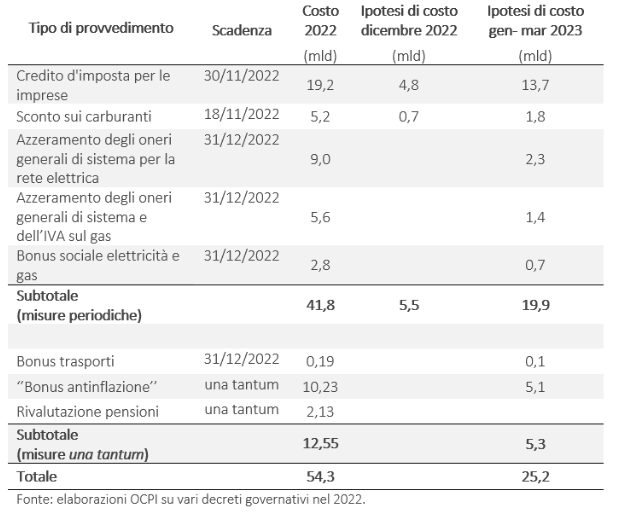
As seen from the table, extend the tax credit for companies in the first three months of 2023 (January-March) "would involve an outlay of 13,7 billion taking into account that on the TTF market the future price of gas for delivery in March 2023 (130 euro/MWh) is slightly lower than the average values recorded in 2022 to date (136 euro/MWh)".
Lo fuel discount it was renewed until November 18 at a cost of 558 million. Considering all the decrees that have provided for this measure since March, the total expenditure of which was 5,2 billion, the cost of the renewal until December 31st would be 682 million. Extending it until the end of March would cost 1,8 billion considering the average oil price in 2022 equal to 89,7 dollars per barrel).
The bill rises dramatically when you intervene on the general system charges, the VAT zeroing and on social bonuses to mitigate the costs of electricity and gas bills. The first two measures are already financed until the end of 2022. To extend them to the entire first quarter of 2023 would cost 3,7 billion. Even the social bonus is funded until December 31st. Extending it until March 31st would cost 0,7 billion but the bill could go up if the Isee criteria for accessing the benefit were expanded - as the government seems to want to do. Then there are the One-off such as transport bonus and anti-inflation bonus.
Renewing all aid is very expensive: you have to choose
Summing up, for the remaining months of 2022, 5,5 billion are needed just for the renewal of the tax credit for businesses (4,8 billion) and the discount on fuel (0,7 billion). for the renewal for a single quarter (January-March) of the zeroing of system charges, the discount on fuel and the tax credit for businesses could require around 20 billion. On an annual basis, it would be a good 80 billion. This account is made by excluding new one-off measures which, as we have seen, weighed over 2022 billion on 12. the urgency of defining priorities to deal effectively with next winter without putting unsustainable pressure on the public budget.