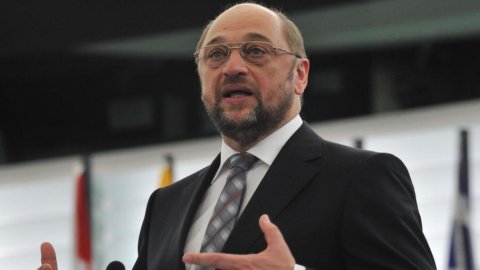
“Certainly it is crazy and wrong to act only on the cuts front. Income and consumption must also grow. There is no contradiction between investing in the future and consolidating budgets, two paths that can easily coexist”, argues Martin Schulz, 58, a German socialist, outgoing president of the European Parliament.
“You can't go overboard with excessive rigor. Budgetary austerity alone is not enough. We also need policies for economic growth”, said Jean-Claude Juncker, 59, a Christian Democrat, Prime Minister of Luxembourg for over eighteen years and President of Luxembourg for the last eight years of his mandate in the country, in an interview with Corriere della Sera. of the Eurogroup (the body that brings together the finance ministers of the 18 states belonging to the Eurozone).
“Until now, the European Commission has always consulted Berlin and Paris before taking any decision. Now the time has come to say enough!”, says Guy Verhofstadt, 61, Prime Minister of Belgium for ten years, president of the liberal-democratic parliamentary group for five years, at a press conference in Strasbourg a month ago on the occasion of the last session plenary session of the European Parliament. Who, to a journalist who asked him what his priorities were for Europe, he replied trenchantly: "There are three: work, work, work!". Martin Schulz, Jean-Claude Juncker and Guy Verhofstadt are three of the five official candidates for the post of President of the European Commission. Almost of the same age, born in three places randomly enclosed in a handkerchief of Europe which also includes the two EU capitals, Brussels and Strasbourg - these are the three "thoroughbreds" among which the game will be played, barring unlikely though not impossible coups scene, the match for the conquest of the most coveted seat of Berlaymont, the building in Brussels headquarters of the Commission. Both because in the Strasbourg Assembly they represent respectively the socialist and democratic groups, the popular group and the liberal-democratic group, which in the legislature that has just ended were, above all the first two, the most numerous groups in the European Parliament; and because they have a respectable political curriculum. However, the other two candidates seem to be out of the game – the Greek Alexis Tsipras, 39, leader of Syriza, candidate of the European Left Party, and the German Ska Keller, 32, candidate of the European Greens – since the numerical consistency of the formations policies to which they belong is much smaller. Also considering that their curricula are much less brilliant than those of the other three candidates.
The candidates vying for the presidency of the Commission, in the light of the changes introduced by the Treaty of Lisbon, therefore remain those three: Schulz, Juncker and Verhofstadt. Provided that the game ends in the first phase. The new rules, which are applying for the first time, require each European political party to propose a candidate for the presidency of the Commission before the elections. That the Council (in which the governments of the Member States are represented) express a single candidate by qualified majority "having regard to the elections to the European Parliament and after having carried out the appropriate consultations". This means that the European Council, barring any twists and turns, will direct its choice on the candidate of the party that has won the elections. At this point it will be up to Parliament to express itself with an absolute majority vote (half plus one of its members) on the designation of the Council.
In the event that this result is not achieved, the ball will again pass to the same Council, which will have one month to present a new candidacy. It is assumed with the same procedure, but the Treaty does not clarify this. Concretely, in the light of the new (and rather vague) procedure introduced by the Lisbon Treaty, it is only possible to reiterate that, in the first instance, the candidates for the presidency of the EU Commission should be those of the two parties most represented so far in the Strasbourg Assembly (Schulz and Juncker). With Verhofstadt which could come out in the second round if Parliament does not reach an absolute majority on the first proposal from the Council.
Even if no one can exclude that, in this case, the Council may return to the procedure adopted hitherto, that of an agreement in the Council between the governments "after carrying out the appropriate consultations", according to the formula reaffirmed by the new Treaty. On the other hand, realistically, in a historical context characterized by a widespread malaise among European citizens due to the heavy effects of an overly long economic and social crisis which has not yet been completely overcome, a malaise which is expressed in a growing lack of love for politics and also for Europe, a delay in electing the president of the Commission would further aggravate the discontent of the citizens. And it is perhaps to avoid this further drop in consensus that an indiscretion that has been reverberating in European circles for more than a month could have some foundation, as spokesperson for by the French Green MEP Daniel Cohn Bendit (however dryly denied at a press conference in Strasbourg by Guy Verhofstadt).
According to this rumor, the presidents of the three most numerous parliamentary groups in the Strasbourg Assembly (popular, socialist and democratic, liberal-democratic) in a private meeting would have undertaken to meet in Brussels immediately after the elections to define the new organization chart European Union in the light of the results of the polls. In the meantime, the most accredited forecast by insiders is that the presidency of the Commission could go to the socialist Schulz, the stable one of the Council to the Christian-Democrat Juncker, and that of the Parliament to the liberal-democratic Verhofstadt. A hypothesis which, if it were to materialize, would confirm the practice, increasingly widespread in Brussels and Strasbourg, of bringing together decidedly larger majorities on individual measures than in most national parliaments. “We approve laws by judging their contents on the merits, often regardless of partisan considerations”, is the reasoning generally given by European deputies. And it would be the confirmation of a desire for Grosse Koalition, or broad agreements as we say, which pervades the hall and the parliamentary halls of Brussels and Strasbourg. As well as the seats of governments of quite a few EU Member States.
If this hypothesis of agreement were to be carried forward, it will be necessary to understand what its political foundations could be. In a nutshell, how will the confrontation between the champions of austerity to the bitter end and the supporters of policies of concrete support for the economy, the reopening of the credit taps to businesses (but with what resources?) and the revival of employment be resolved. And, again, to what extent will the majority of European countries still have to adapt to the "indications" coming from Berlin via Brussels?