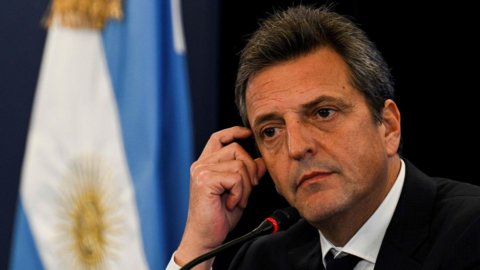
The polls are contradictory, but there is one certainty: the race to become president of Argentina it will be a fight to the last vote between the outgoing Minister of Economy Sergio Massa, of the centre-left, and thefar-right outsider Javier Milei. The second largest economy in South America will decide its fate in three weeks, on Sunday 19 November, after a first round which surprisingly saw the Peronist Massa come out on top, against all predictions on the eve.
It is in fact an entirely Argentine paradox, observed the Latin American press, that for which a representative of the establishment, minister in the most difficult months of Argentine history with inflation at an all-time record (138% in September) and widespread social tension , still garners the favor of a large part of public opinion: even 36,7% in the first round, against 30% for the challenger Milei and just 24% for the candidate of the moderate center-right Patricia Bullrich.
Argentina elections: Bullrich is the unknown in the presidential race
The latter officially declared its own a few days ago support for Milei for the run-off, but according to the polls at the moment the endorsement does not seem to be an ace in the hole for the beneficiary: not all of the right-wing electorate is in fact convinced by the hawkish recipes of Javier Milei, who proposes to completelydollarize the economy Argentina, in a phase in which a dollar can be bought with almost 400 pesos on the official market and with over 1.000 pesos on the parallel one, the most used and so-called "blue". L'anarcho-capitalist, as he defines himself, doesn't even like the industrial world and the financial markets, which are worried about him excessive ease. The latter, however, seemed to please the voters, who in the primaries of August 13th had rewarded him greatly, so much so that he became the favorite for the Casa Rosada: now however - despite the sum of the votes for him and Bullrich it would comfortably exceed 50% - only the CB Consultoria poll gives Milei the lead, and very slightly (50,7 to 49,3), against Massa, while Analogias reports the Peronist candidate at 42%, against Milei's 34% and a substantial 18% undecided, with 6% voting blank.
Voter inertia works in Massa's favor in Argentina's elections
Beyond the polls, it is precisely the inertia that seems to have turned in favor of Massa, former head of cabinet of President Cristina Kirchner and a particularly appreciated in the international community, starting with the International Monetary Fund with which the 51-year-old former mayor of Tigre has been very skilled in negotiating, especially in recent months, obtaining new financing and a more comfortable installment of the debt. Another important endorsement for Massa is that of neighboring Brazil, Argentina's first commercial partner and today represented by Squid, which is part of the same large socialist political family. Lula is still the most popular leader in South America today, and even if he is avoiding explicitly "rooting" for Massa, the Argentine candidate himself has admitted a great political and personal closeness with both the Brazilian president and his Economy Minister Fernando Haddad .
Massa supported by Lula, the communication strategy is identical
A connection, that between the Brazilian and Argentine governments, in reality even deeper and probably more decisive than how it is told, given that Massa hinged his comeback in the electoral campaign precisely on the collaboration with the team of image and communication experts who brought Lula to win the elections a year ago. The team led by the advertiser Chico Kertész, after having put the figure of the Brazilian politician, dented by legal affairs and almost two years in prison, back on track, also gave a turning point to that of the unpopular (at least initially) Massa. The strategy was clear, and so far it has paid off: no demonizing comparisons between Milei and Bolsonaro, no personal attacks on Milei but only on his proposals. So Massa avoided the usual good vs bad narrative, instead inviting voters to reflect on the consequences of his opponent's recipes.
Argentina elections: here's what Massa is banking on
In particular, the Minister of Economy is shaking it bogeyman of cuts to subsidies, at a time when poverty is rampant at 40% and the cost of living has more than doubled compared to last year. In Argentina the state aid network is very broad, and for example supports the most disadvantaged families by paying with public resources up to 80% of the cost of electricity bills and 71% of gas bills. The most current theme is that of Buenos Aires public transport, the cost of which for the citizen, according to the narrative proposed by Massa, would increase 20 times if Milei were to become president. In favor of Milei However, there is another piece of data that emerged from research by the University of San Andrés: 59% of Argentines are actually in favor of eliminating social subsidies.