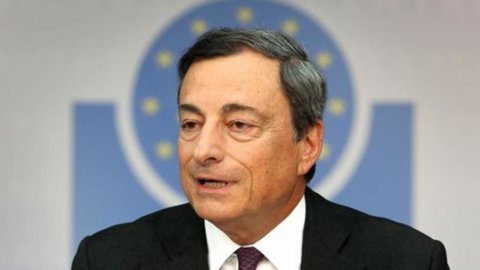
Il ECB President Mario Draghi he has been reiterating it for some time: the central bank can only buy time but cannot replace the reforms that governments have to make. And in today's press conference, after the board approved a new rate cut and launched a consistent Abs floor, wanted to be even more explicit on the point. "There is no monetary or fiscal stimulus that can have effects in the absence of important legal interventions", ruled Draghi, underlining that only after the reforms will it be possible to benefit from the margins of flexibility already provided for in the treaties, which obviously do not imply "any overcoming of the rules ”.
For Draghi, the discussion on flexibility within the framework of the Stability and Growth Pact "cannot call into question the essence of the Pact". A response to the interpretations on the part relating to public budgets of his Jackson Hole speech delivered at the end of August on which he wanted to clarify. “There have been many interpretations of this discourse, I think I was very clear – he said – the idea is that there are three tools to give new impetus to growth: structural reforms, monetary policy and fiscal policy. My conclusion is that there is no monetary and fiscal stimulus that can have effects without ambitious, important and convinced structural reforms”. On fiscal policy, you defined the Stability and Growth Pact as "our anchor of confidence", stating that the rules cannot be violated. In the rules, you explained, there is flexibility but this discussion should not be such as to endanger the essence of the Stability Pact. Furthermore, within the framework of the Pact, decisions can be taken which support growth and which, at the same time, contribute to the consolidation of budgets”. The ECB president also added that from a confidence-building perspective, which is one of the reasons why growth is lacking in several areas of the Eurozone, it would be much better if we had a very serious discussion on structural reforms first and flexibility afterwards. “This is my suggestion – he concluded – However, it is not my responsibility if my speech has been interpreted badly or well. I think my message was very clear."
For Draghi it is necessary not to frustrate the fiscal consolidation and at this point reforms must necessarily gain momentum. As if to say: be quick because flexibility is not "at no cost". An “insufficient step in the implementation of structural reforms in the countries of the Eurozone represents for the ECB one of the risks for an already worsening recovery. The recovery in the Eurozone, expected at very moderate levels, weakened further. According to what was announced by Mario Draghi, the first indications on the trend in the third quarter signal that the momentum of the European economy has slowed down and that inflation will remain low also in the coming months, before climbing back towards the 2% target set by the ECB in 2015 and in 2016.
In particular, the already modest recovery, “is held back by high levels of unemployment, a large gap in productive capacity, continued negative growth rates of private sector loans and necessary fiscal adjustments of the public and private sector". In the observations of the ECB the loss of cyclical momentum could curb private investment with the growing geopolitical risks may have a negative impact on business and consumer confidence. And to this is added the risk of failure to implement the reforms.
Draghi indicated that important legal interventions could be launched through a "sharing of sovereignty" of individual countries with the community authorities. However, the president of the ECB wanted to draw a sharp and clear line on his intentions: no negotiations with politics. “I don't talk to political leaders to ask for reassurance about what they intend to do, this is not the correct institutional dialogue. There is no great compromise,” he said, commenting on the speech he gave in Jackson Hole and the subsequent contacts he had throughout Europe. “The point I wanted to clarify in Jackson Hole – she added – is that it is very difficult to achieve the objective of an inflation rate of 2% with monetary policy alone. We need growth, we need to reduce unemployment and to do this we need other things, fiscal policies and structural reforms. There is no negotiation, each of us must do his job. We do monetary policy, the others do other things”.
On the other hand, if structural reforms have many costs, Draghi recalled that the lack of growth is already a cost in itself. “This is what we see at the moment: high unemployment, in many countries at historic highs, low growth for many years and many countries that are still very far from the growth levels of 2007, in some then wages entering the labor market are those recorded in the 80s”, he observed, reiterating his previous proposal: “Wouldn't it be better, then, to bring this area too, that of structural reforms, within the same type of framework that we already have for budgetary discipline? It is not a matter of loss of national sovereignty but of sharing common rules with others as has already happened in monetary policy with the ECB and the euro" which "in my opinion, would have many benefits" not only at the level of the political reform process which would be facilitated but also in the creation of a real common market "with a consequent increase in opportunities, for example in the mobility of workers".
On his talk with Prime Minister Matteo Renzi, maintained the strictest confidentiality: the contents "remain confidential" and "there will be no other declarations in this regard".
While waiting for governments to decide to make their own moves, the ECB has chosen to do its part and buy more time. Not only did it surprisely cut rates to a new record low of 0,05% from 0,15% but it also approved a plan to buy ABS and covered bonds designed to have a substantial impact. A move that comes close to the start of the financing measures for banks conditional on the disbursement of credit, the so-called Ltrto, scheduled for September. Furthermore, the Eurotower council remains "unanimous in the possibility of resorting to unconventional instruments" in case of worsening. The meeting also discussed Qe, ie quantitative easing following the example of the Fed, BoE and Bank of Japan with massive purchases of government and private bonds. “There were some Council members who were in favor of doing more and others who wanted to do less. The decisions taken represent the compromise point”, explained Draghi, adding that the measures adopted today “were not decided unanimously”. In other words, if there is unanimity on the need to intervene, the how still remains a point of debate. “It is not that we are unanimous regardless of what is decided – Draghi pointed out – it is not a question of a blank check, we are unanimous in intentions, but when it comes to discussing individual measures there may be differences”.