Terrible August, that of 2013, the winds of war hanging over Syria. Many knots have come home to roost. And throughout the world, in a sort of redde rationem that begins on the global horizon and ends in the national crisis, proving the correctness of the theories that make the link between nation and internationalization the fundamental nexus for understanding the red thread of history. First, let's look at the world under the lens of the economy innervated by the ring of international politics. There are two most relevant phenomena. The first is that of the turning point undertaken by globalization.
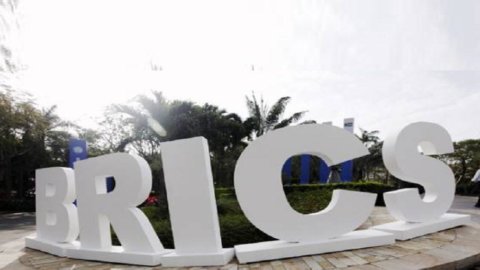
The sustained growth rate of the BRICS has not come to an end, but at the end of the first phase of their growth, as the Kaldorian theories of development and Myrdal's reflection taught us. The rapid growth based on capital goods and the creation of urban proletarian and middle classes has come to an end. In non-communist countries this has given rise to a class of peasant and agricultural bourgeoisie which allows the overcoming of growth based only on the accumulation of capital goods, but which must also be based on consumption thanks to the agrarian reforms which have characterized nations such as Brazil and the ' India, although to a lesser extent and much less articulated in a private ownership sense, as in India for example, is still dominated by a very strong community culture.
India's backwardness with respect to the internal market and its backwardness in the field of monetary circulation has exploded these days to the surprise of all those who think that the economy is understood by reading statistics and not by studying history and anthropology . The majority of Indians do not exchange money but goods and even the money is not mostly hoarded in banks. The growing degree of interrelation in the world economy shows all the limits of this backwardness in the field of monetary circulation. It is growth itself that highlights the problem and in this situation causes the depreciation of a currency so scarcely hoarded. We expected it, we who don't believe that everything is always in balance, from the USA to India to Papuasia...
China, on the other hand, finds itself in a true cul de sac because the agrarian bourgeoisie has not formed and the cities are filled with clandestine non-citizens who cannot consume as they should the urban masses and in this way China falls into all the traps of countries with bureaucratic economies and state capitalism directed by terrorist dictatorships: the decline begins with the productive overcapacity of capital goods magnified by the disastrous financial revolution which upset secular balances, while creating global asymmetries thanks to the entry of the Middle Empire into the WTO in 2001. This collapsed the “post Bretton Woods” unequal relationship between global metropolitan economies and global peripheral economies. Asymmetrical competition is now becoming an obstacle to the growth of China itself, which is unable to create an internal market, while - paradoxically - it exports forced labor all over the world to seek energy and arable land which it is unable to produce at home due to the direct bureaucratic-terrorist economy.
The chaos of Russia is different: it suffers from the isolation of a great prisoner and solitary nation among a hostile Europe that wants its energy resources, but does not allow it to expand thanks to demented competition rules (which are causing the whole European industry to decline due to falling margins and absence of consolidation accused of a sinful monopoly having forgotten the sacred text of Sylos Labini on "Oligopoly and technical progress"...) and a China with which it must negotiate for the US and European refusal to reformulate the overall face of the post-war world cold. In fact, it has been imagined that we can continue to produce growth by excluding Russia from Europe and from the world market: only in 2011 was it admitted to the WTO, ratifying a tragic incapacity of the USA to understand the new post-Reagan and post-Gorbachev world.
The BRICS will grow less and at a slower pace and this reclassifies all growth in South America, except Mexico and Colombia, which have chosen a path not so linked to the furious cycle of commodities. Which, moreover, is now collapsing, dragging the dependent commodite countries with it… All the other countries will be forced to reclassify the relationships between the mining and oil and gas industries and the world cycle, increasingly turning towards both the internal market and the towards new foreign markets. This is basically what their middle classes, which have mobilized in recent months, are asking for and which express well the theories of Tilly, Hamson and myself when we studied the phenomena of collective mobilisations.
Phenomena that are determined only in ascending phases of economic and political cycles and to impose changes in the consumer agenda. Now the middle classes of those countries want infrastructure, intangible assets such as culture, quality of life and thus rediscover every tradition (the political cycle) that can prepare their organizational solidarity. Here is secularism in Turkey and indigenism in some South American countries, as has already happened there and as it will soon happen in much more widespread forms: see the case not only of Bolivia, but above all of Peru, the epicenter of all political cultures south american. This will have profound consequences for the exploitation of mineral resources, opening a new chapter in South American energy history.