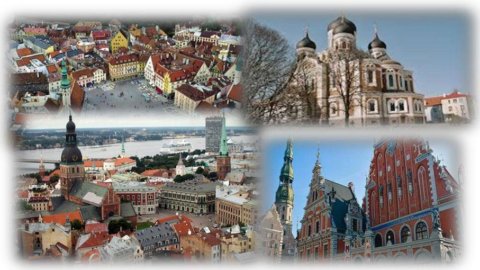
“Georgia, Chechnya, Ukraine… who will be next?” asks the professor Vyatautas Landsbergis leader for the struggle for Lithuanian independence and first democratic president, now dean of the European People's Party, in conversation with the envoy to Vilnius Andrea Tarquini on the Republic of 8 September last. There are worrying signs. Despite the reassurances received from the visit of the president of the United States to Tallinn (the capital of neighboring Estonia) on 4 September and the decision by NATO to create 5 new bases in Eastern Europe, the three Baltic republics, which have been members of the European Union and NATO for 10 years, experience the possible retaliation of the mighty Russian neighbor.
I NATO jets they have intervened 68 times this year on interception missions along the border. AND “accidents” follow one another such as Moscow's bizarre request to extradite 1.500 Lithuanian citizens who belonged to the Russian Army on charges of desertion or the seizure in September of the Lithuanian fishing vessel "Sea Dog" with 28 crewmen for alleged trespassing. Furthermore, as in Ukraine, Russia complains of the discrimination to which it is subjected Russian-speaking minority in Estonia and Latvia and supports their claims.
The situation is different Lithuania which can boast, compared to its northern neighbors, a distinctly citizenship monoethnic (85% of Lithuanians) who favored the adoption of an inclusive citizenship policy, granted to all applicants without prior language exam. Lithuania is also experiencing a difficult economic and social moment due in part to the Ukrainian crisis with the ensuing sanctions and counter-sanctions and the weakening of the prospects for the Russian economy. The population growth rate is -1,06 (2012), among the lowest in the world.
The population, thanks to the crisis and emigration, decreased from 3.335.000. 2009), and the one that can boast the highest GDP 2.934.479 billion US dollars in 2014 (2.032.000 for Latvia, 1.311.870 for Estonia). It also ranks first for cumulative foreign direct investment of 46 billion euros, against 2013 billion in Latvia and 23,3 million in Estonia.
According to the "spring" forecasts of the European Union, (Eurpeon Economic Forecast Spring 2014) the GDP growth of Lithuania which this year is expected to be at 3,3 % and will reach 2015% in 3,7. Unemployment will drop from 10,6% in 2014 to 9,7% in 2015, the percentage of debt to GDP will be limited to 41,8% (41,4% in 2015) and inflation will stop at 1% (1,8 .2015% in XNUMX). Note that Lithuania, despite having been the first to declare independence from Moscow will be the last to join the Euro on January 2015, XNUMX (Estonia and Latvia have already been part of the eurozone since the beginning of this year).
In 2013, Lithuania's global exports to the rest of the world grew by 2012% compared to 6,5, reaching a volume of 24,6 billion euros. A similar percentage increase was recorded on the side of imports which reached 26,5 billion euros (+6,5%).
The top five countries supplieri from Lithuania are there Russia (29,3% market share, largely composed of natural gas supplies on which Lithuania depends for 92% of its needs), the Germany (10,3 %), Poland (9,4 %), the Latvia (6,1 %) and theNetherlands (5,2%), with Italy ranking sixth with 3,9%. The main markets for Lithuanian products are Russia (19,8%), Latvia (9,8%), Estonia (9,7%), Poland (7,4%), Germany (7,2%), Belarus (5,2%), while Italy is in 16th place, with a share of 1,7%.
According to Istat data, the interchange Italy-Lithuania it went from 1,208 billion euros in 2012 to 1,444 billion in 2013 (+19,6%) with a trade balance surplus in our favor of over 612 million euros. Italy is the 6th supplier country with a share of 3,9% (1,029 million euros), recording a significant increase in exports equal to 27,3%. In addition to exceeding the symbolic ceiling of one billion euros for the first time, there is the highest growth rate recorded by the top ten supplier countries.
Driving our exports to Lithuania stands out the machinery and mechanical applications sector which, in addition to being the first export item and constituting a fifth of our exports, grows with an impressive +58,7%. Another driving area is that of machinery and electrical parts which is growing significantly: +63,4%. The Fiat Chrysler Group, in particular, it recorded significant success thanks to the 500 range and the commercial vehicle line, thus emerging from a product and image crisis that had made the Group's presence marginal in Lithuania. In 2013, the Group became the second best-selling brand after Volkswagen and overtaking Toyota and Hyundai/Kia, while the 500 continued to be a highly successful car in 2014 as well, resulting in the best-selling model in the month of January.
After the important result of 2013, the data provided by the Central Statistical Institute of Lithuania confirm, also for the first half of 2014, a strong growth of Italian exports towards Lithuania. Italy, with exports amounting to 565,1 million euros, confirmed itself as the sixth supplier country with a share of 4,53% and an increase in exports of 24,7% compared to the same period of 2013. The most dynamic sectors of Italian exports were fruit and vegetables (+11%), wines and beverages (+20%), clothing (+37%), footwear and ceramics (almost doubled), machinery (+24%) and furniture/decor ( +82%). Lithuanian exports to Italy also grew, reaching 219 million euros in the period considered (+14,5% compared to the first half of 2013) where Italy figures as the fifteenth customer country (sixteenth last year).
Leading sectors of Lithuanian exports to Italy were dairy products, timber and furniture/furnishings. Lithuania's business and employment attractiveness benefits from its proximity to the Scandinavian countries and Russia, a one of the fastest internet networks in Europe and a policy of incentives for foreign investments and low costs for setting up new businesses. Lithuania is reaching levels of vit was excellence in some sectors such as that of biotechnology and laser technologies, where Lithuanian companies in the sector hold the 50% of the global market working with over 100 countries including USA, Japan, Israel and Switzerland.
Another highly dynamic sector is that ofITC: according to official data, 13 of the 20 largest enterprises in the sector of the Baltic republics are located in Lithuania, employing about 40.000 people. Among the other Italian companies active in the country, Alenia, Selex, Technip, Foster Weelher Italia and Way Lab operate in the technologies, the Marzotto group in the textile sector, Del Verde, Paeseni, Enovita in the agri-food sector, Unicredit leasing, MSC container transport , Mantuano in clothing. There is also an Italian-Lithuanian Chamber of Commerce (www.ilcc.it).
Like the other former "Baltic tigers", Lithuania also had to face the financial crisis in 2009, with a 15 percent recession, one of the most violent in Europe. A particularly bitter awakening after the "miracle" of the post-Soviet years. Civil servants have met pay cut, from 5 to 50 per cent, ministries have reduced their workforces. Retirees have also been affected. All this without generating serious social and political tensions. Today there is no shortage of problems, aggravated by tensions with the cumbersome neighbour, but growth has resumed. When adults talk to young people who grew up after independence, they joke how they were able to face with composure the drastic measures required to emerge from the crisis and respect the parameters necessary for fattening in Europe: "You don't like austerity ? You should try communism."