Dear energy, payments from the Public Administration, ITA Airways and the 2023 Budgetary Planning Document. These are all the dossiers on the table of the new centre-right government and in particular of the next finance minister. Here are the latest analyzes ofObservatory on Italian Public Accounts of the Catholic University of the Sacred Heart of Milan coordinated by Giampaolo Galli, following the resignation of Carlo Cottarelli, elected senator of the Republic.
Actions against energy price increases in Europe in 2022
All European countries have implemented initiatives to contain the impact of energy boosts on households and businesses. L'Italy it is the country that in 2022 spent the most as a percentage of GDP (3,2%) to counter energy price increases. The difference compared to some countries (France, Spain, Finland e UK) can be explained by the fact that price increases have been less significant than in Italy. However, there are many countries that have had similar price increases to Italy that have spent much less (e.g. the Belgium). In total, eight EU countries spent less than 1% of GDP: Slovenia, Belgium e Norway (0,8%), Cyprus (0,7%) Estonia (0,5%), Sweden (0,3%), Finland e Ireland (0,2%). These differences, according to the analysis ofSYHO, may be due to the high weight of the manufacturing industry in Italy, largely energy-intensive and "gas-intensive", and perhaps to political factors, even if it should be remembered that Italy's interventions were all made without budgetary deviations . Among the major European countries, Italy is one of those that has made the most use of measures aimed at the most needy families and businesses most affected by the price increases.
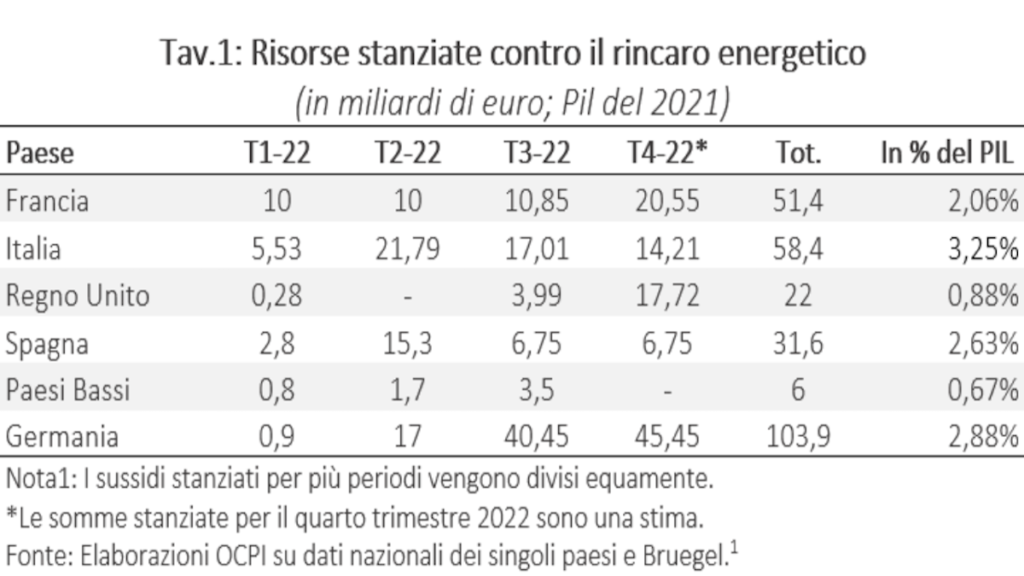
Therefore, comparing the amounts already foreseen, the greatest aid (compared to GDP in 2021) was disbursed by Italy (3,2% of GDP). Germany and Spain follow (respectively 2,9 and 2,6% of GDP). Lower levels are instead recorded for France (2,1% of GDP), the United Kingdom (0,9% of GDP) and the Netherlands (0,7% of GDP).
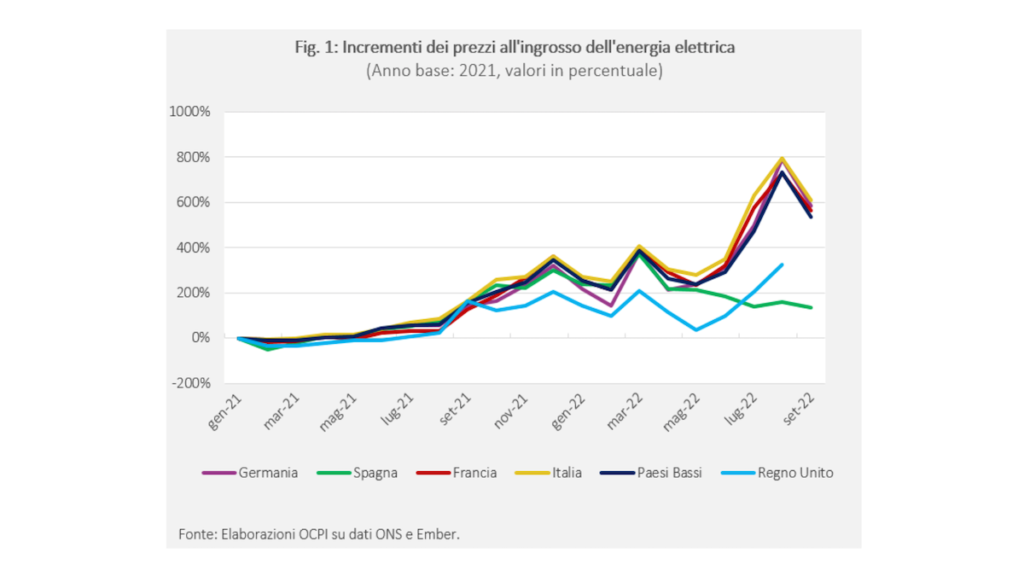
One factor that could explain differences between individual state interventions is thetrend in electricity and gas prices in individual countries. To compare the price trend in the last two years net of state interventions on final consumer bills, Fig. 1 shows the percentage increases in wholesale electricity and gas prices compared to a base period (January 2021) . As can be seen, the major EU countries show highly correlated trends for the wholesale electricity market, with the exception of Spain and the United Kingdom.
PA payments: notable improvements, but still major delays
In recent years there has been a dramatic improvement in timing payment of public administrations. The available data even seem to indicate that average delays are now in line with those of the other major countries. However, there are many situations, even in central administrations, in which times remain too long and probably are not yet such as to satisfy the criteria imposed by the 2011 European Directive. According to theCpi analysis, the times of various ministries and some municipalities remain pathological.
In the important sector of medical devices there have been great improvements, but especially in the central-southern regions the times are higher, in some cases by a lot, than those established by the Directive. It is also likely that many governments prefer to pay large companies first and then small companies, over which they have more market power.
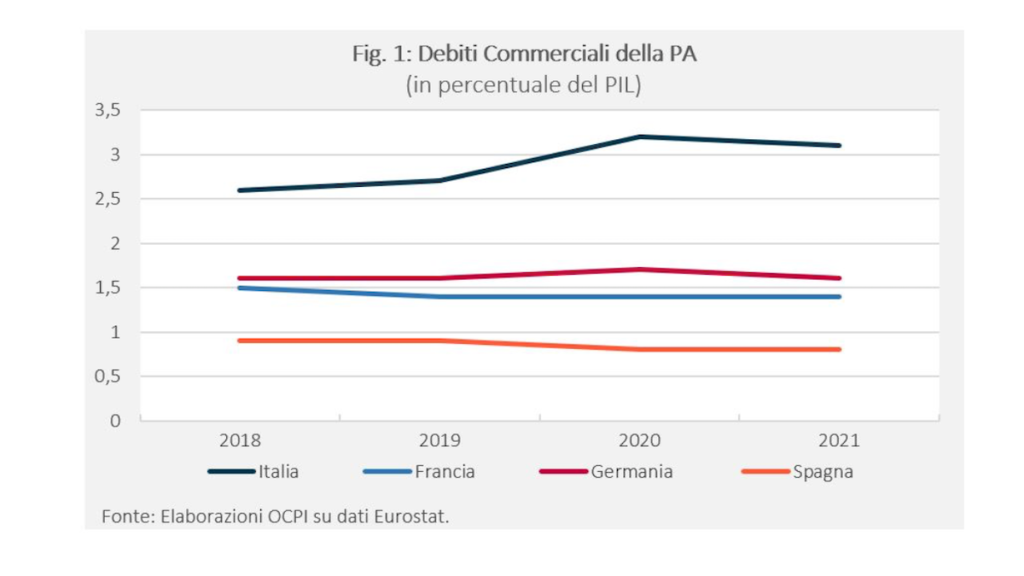
Based on the data Eurostat, the stock of trade debts of the Italian PA is equal to 55 billion euros (2021 data) and is the highest in the European Union as a percentage of GDP (3,1%). Spain, France and Germany are between 0,8 and 1,6%.
However, it should be noted that the stock of trade receivables reflects delays, but also the size of public administration payments. Using MEF data on 2021, the stock of debt that has reached maturity and not been paid would only be around 8 billion.
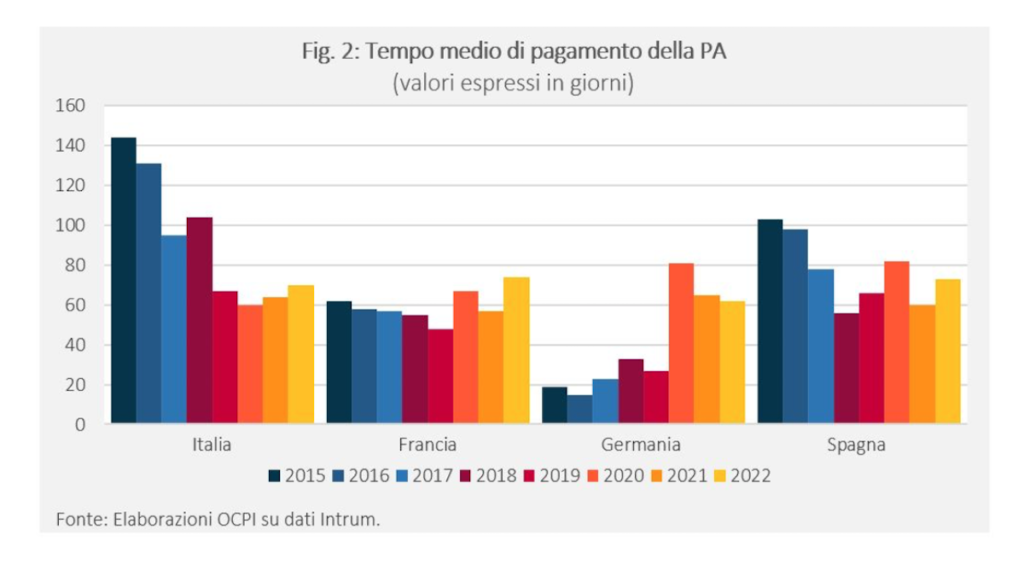
The data from Intrum sources seem to agree with the MEF. The latest report (2022) analyzed a sample of around 11 companies and the results confirm the improvements that have taken place in recent years. In fact, the Italian PA has more than halved i payment times from 144 days in 2015 to 70 days in 2022, with a minimum reached in 2020 (60 days). The data for the last few years are in line with those of the other main countries. It should be noted that if for Spain and Italy there has been a decrease in the average payment time, the same has not happened in Germany and France, where there has even been an increase, probably also due to the difficulties deriving from the Covid-19 pandemic .
ITA Airways: the turning point with Certares?
The long history of the now former Italian flag carrier, now ITA Airways, may have reached a definitive turning point with the agreement reached for the sale of the company between the government and Certares, an American investment fund (but with a European subsidiary that would be directly involved in the operation to take into account the legal constraints on ownership in order to be able to serve the European market).
The Observatory offers an analysis on the cost incurred by the taxpayer in the last 20 years to maintain a company that has almost always presented operating losses which the public budget.
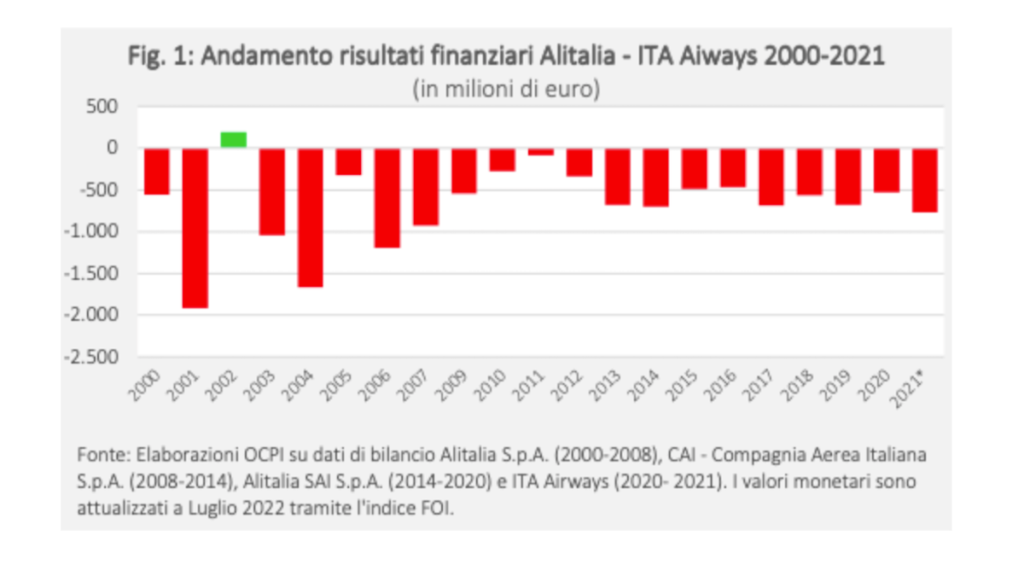
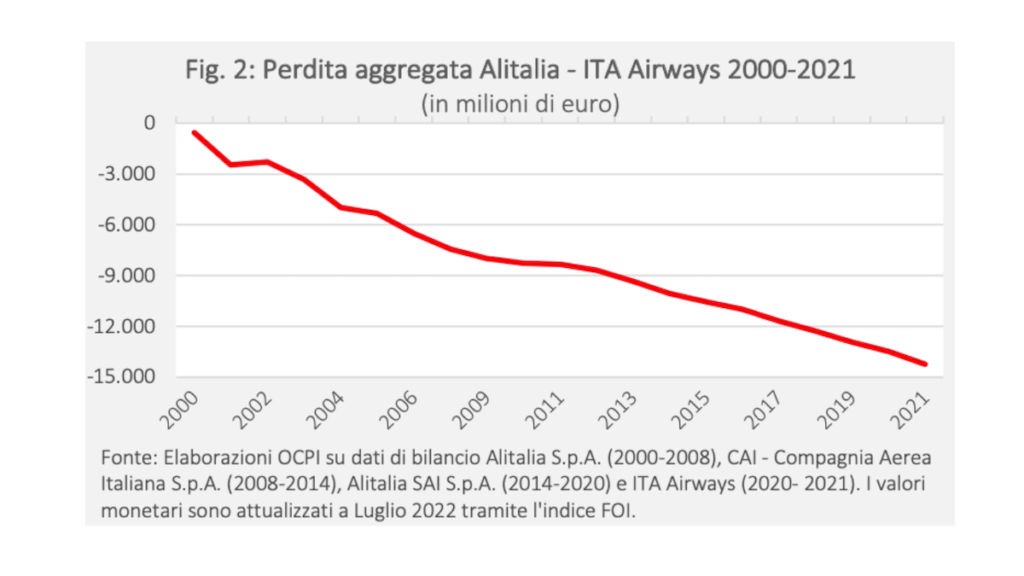
Fig. 1 shows the net financial results of the company in its various denominations starting from 2000 at current monetary values (July 2022). At the end of 2021, the cumulative losses of the new millennium amounted to more than 14 billion euros (Fig. 2). The cumulative data from 2017 to today indicate that the overall loss of the airline in the period of extraordinary administration is around 3 billion euros.
Le accumulated losses over the years they have not been fully covered by public funds but, in part, also by the private shareholders who have alternated in the share capital of the company; in 2017, however, the Observatory estimated the net cumulative burden on taxpayers at around 9,4 billion euros, which corresponds to 10,4 billion updated to July 2022 prices. To these must be added the additional funds allocated under form of bridging loan from Gentiloni government in 2017 for the relaunch of Alitalia SAI. and interest not paid within the established deadlines, for a total payable by taxpayers of 1,6 billion euros. Such debt with the State, it will not remain the responsibility of NewCo ITA Airways and must be returned by Alitalia SAI SpA through the distribution of the assets of the extraordinary administration. As the owner of all the shares of ITA Airways, the MEF also undertakes to cover the losses of the air carrier which at the end of last year already amounted to 149 million euros (only for the period 15 October - 31 December).
The choice of Certares, compared to the alternative one of Lufthansa, offers advantages, such as the maintenance of a larger shareholding by the MEF and therefore the possibility of influencing the governance of the future company, but also risks, first and foremost that of having to continue to repay, at least in part, the future losses of the company. And at least so far maintaining a role of the public sector in the management of the airline has not served to defend its market shares which have dramatically reduced.
The 2023 Budgetary Planning Document
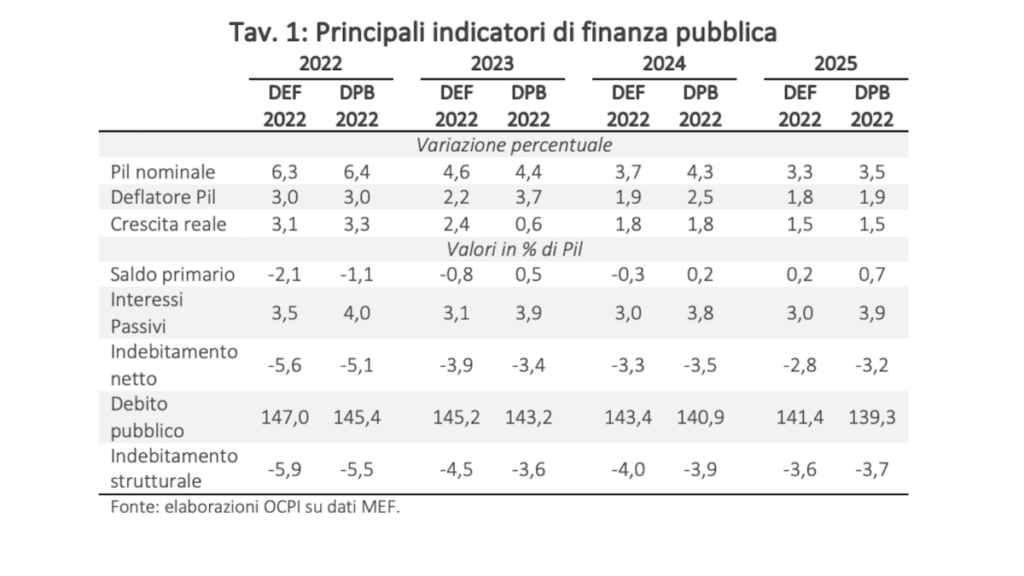
Il 2023 Budgetary Planning Document, despite its title, for now contains only trend-based macroeconomic and public finance forecasts, i.e. subject to legislation in force. At the same time as NADEF, growth forecasts for next year have been revised downwards due to the increase in energy prices and the increase in interest rates. However, according to theSYHO, most of the public finance indicators are revised and improved since inflation causes an improvement in the primary balance and a reduction in the debt/GDP ratio.
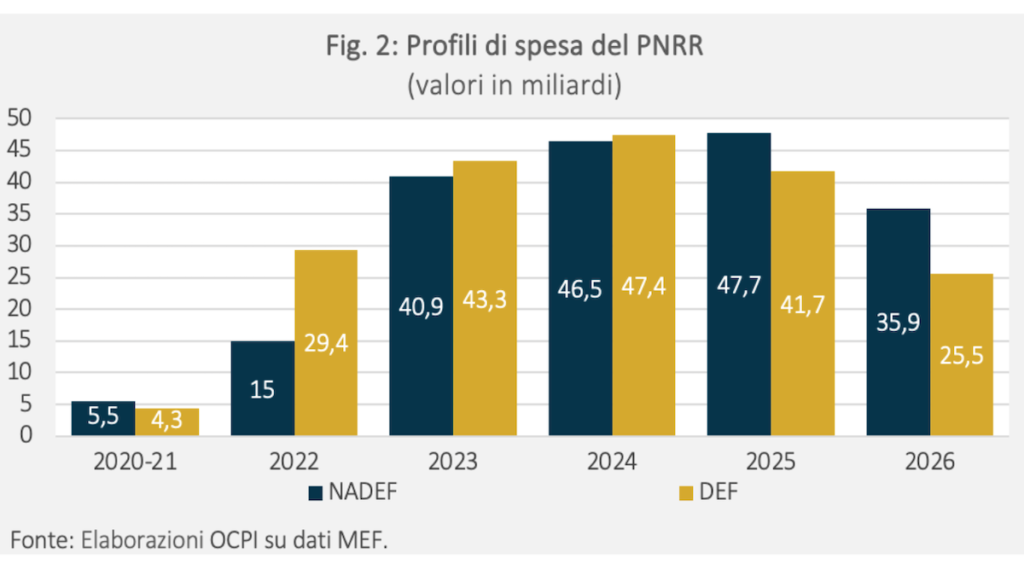
Although all the objectives of the PNRR have been achieved, there is a slowdown in the use of funds compared to what was forecast in April since DEF: 15 billion in 2022 instead of 29,4.
The risks compared to this scenario are all on the downside and it will be up to the new government to define programmatic objectives consistent with the dual need to support the economy and, at the same time, achieve a gradual reduction in the debt/GDP ratio in the coming years: a very gradual path was expected in the DEF, with a return to pre-pandemic levels (about 135% of GDP) within a decade. The challenge will be to reconcile the objectives of the recovery plan with the need to support the economy in a very complex situation due to the high energy prices.