The introduction of new 20% tariffs by the United States on European products, in force from 9 April, risks having a significant impact on theItalian economyAccording to Istat they are 3.300 Italian companies which are particularly vulnerable: those that produce and sell pharmaceuticals, mechanical products such as turbojets and turboprops, jewelry, food, wine, oil and furniture.
L'Italy is the third European country which exports the most to the United States, behind Germany and Ireland. According to the Economic Observatory on Foreign Markets of the Government, in 2024 Italian exports to the USA exceeded 64 billion euros, with a growth of 42% from 2019 (the year before Covid) and a slight decrease compared to 2023. The Confindustria Research Center indicates that the beverages (39% of extra-EU exports), the motor vehicles (30,7%) and the pharmaceutica (30,7%) are among the most exposed sectors.
According to Confindustria, the duties could cost Italy up to 20 billion in two years
According to the economists of Confindustria, that yesterday they cut the estimates on GDP growth, the ongoing wars and the American protectionist escalation could cost the country up to 20 billion euros in two years. “The European challenge is to maintain and increase the presence of industry and workers in Europe” is the comment today by the president of Confindustria, Emanuele Orsini. “To do this you need a extraordinary plan on three chapters: investments, cutting red tape for eliminate internal tariffs, and recovery of competitiveness on key factors such as energy. We count on a compact and responsible response from all political forces to arrive at an action that is immediate and tangible” concluded the leader of the industrialists.
The entire wine supply chain damaged: damages for 2 billion
Among the most affected sectors, the wine sector stands out: Federvini estimates a potential damage for a sector that is worth over 2 billion euros in exports and involves 40 thousand companies and 450 thousand workers. "The measure will also have significant impacts on consumers and operators overseas: there are thousands of them US company employees involved in the import and distribution of these products, and the price increase will not be limited to the duties imposed, but will extend to the entire commercial chain" Federvini highlights, while Coldiretti estimates that the duties will cost Italian wineries 6 million a day. Federvini expresses deep regret and strong concern for "a choice that represents a serious step backwards in the principles of international free trade and that will seriously damage transatlantic trade. We have already been through this, and we know well how much it can cost: in the past these measures have led us to lose up to 50% of exports to the USA. Now more than ever, we need unity and determination on the part of the our institutions to contain the devastating effects of these unnecessarily protectionist and anti-historical measures", says the president of Federvini, Micaela Pallini. Many labels will disappear from the tables of American consumers, which cannot be replaced by local production, while in Italy and Europe a serious production and employment crisis is looming.
Parmigiano Reggio could hold up better as it is “premium”
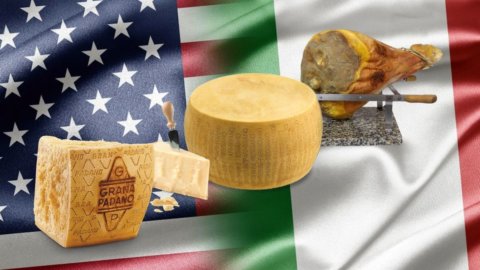
Looking at other Italian food excellences, the president of the Parmigiano Reggiano Consortium, Nicola Bertinelli, underlines that the Emilian cheese could resist better thanks to its premium positioning, and reiterates that the tariffs will damage especially American consumers, without actually protecting local producers. “The news does not make us happy, but Parmigiano Reggiano is a premium product and the increase in price does not automatically lead to a reduction in consumption,” says Bertinelli. “We will work to find with the negotiable way to make it clear that a product like ours is not in real competition with American parmesan: these are different products that have different positioning, production standards, quality and costs. We will roll up our sleeves to support demand in what is our first foreign market and which today represents 22,5% of the total export share”, he states. Parmigiano Reggiano covers about 7% of the market for hard cheeses in the stars and stripes and is sold at a price more than double that of local parmesan. Today, he concludes, the real enemy of milk producers are not their foreign counterparts, but the products that are called 'milk' or 'cheese' even though they have no connection with land and animals, such as cellular fermentation foods”.
Olive oil will have Turkey as its main competitor
Trump's tariff axe will also hit the'olive oil but, compared to the previous administration, not that of a single country, then Spain, but all of them. The difference is substantial because, at the time, importers and distributors were able to redirect their purchases to other suppliers, first of all Italy. Today this is not the case. The The United States is not self-sufficient for olive oil, having a production that barely covers 5% of consumption (15-18 thousand tons production and 350-360 thousand tons consumption). About 330-340 thousand tons arriving in the States will therefore be taxed at source. But some nations come out less bruised while others are more affected. Spain, Italy and Greece (which have been imposed duties of 20%) export olive oil to the United States for approximately 280 thousand tons, with Spain being the first exporter with 130-150 thousand tons, followed from Italy with 100 thousand and by Greece with 15-20 thousand. It is likely that the market shares lost by Spain, Italy and Greece will be absorbed by Turkey, which has one taxation limited to 10% and which has an export potential of 200 thousand tons of olive oil
The Risk of the Proliferation of the Italian Sound: The Tarot Cards of Made in Italy
On this line is also Coldiretti, according to which the increase will not only result in a loss of sales for Italian companies, but also in the worsening of the phenomenon of the so-called "Italian sounding“, with the proliferation of imitations of Made in Italy products, the 'fake' products. To the drop in sales we must then add the damage in terms of depreciation of production, from calculate supply chain by supply chain, linked to the excess of supply without outlets in other markets. We must now work on a diplomatic solution that is carried forward at a European level, says Coldiretti.
The simulations of SVIMEZ (the association for the development of industry in the South) estimates that the 20% duties on agri-food, pharmaceutical and chemical they might reduce Italian exports by between 13,5% and 16,4%. The sector of the fashion and furnishings would defend themselves better, with a possible reduction of -2,6%. The regions could be hit differently by the new tariffs. For Liguria, Campania, Molise and Basilicata, the United States represents the first outlet market. While, overall, Lombardy, Emilia Romagna and Tuscany are the regions with the most overseas sales (Istat 2023 data). According to the Cgia of Mestre, the regions of Southern Italy – particularly Sardinia, Molise and Sicily – would be the most at risk, due to the poor diversification of their exports.
For the strongest luxury brands, not much will change
America is also a huge player in luxury fashion. If tariffs hit European fashion products, there is no doubt that prices would increase in the US market. Personal luxury goods alone are expected to bring in about $83,3 billion in revenue in 2025,” says 10 Magazine USA editor Dora Fung.The strongest brands such as Hermès, Chanel, Louis Vuitton They will probably be fine. Their desirability is so high that price increases will not necessarily stop their customers from buying; they have already increased their prices every year steadily, and their fans keep spending".
The government is looking for partners other than the US
The Foreign Minister, Antonio Tajani, he is not willing to give up the goal of achieving the goals by the end of the legislature 700 billion euros in exports, even if with the overseas tariffs the road could be uphill. And so, if on the one hand there remains hope for the resumption of dialogue with the United States, on the other it is clear that it will be necessary looking for new partners. Yesterday at question time in the Chamber he said he had an action plan to strengthen Italian exports, focusing on all the most promising markets. These include India, Mexico, Brazil, Serbia, Turkey, the United Arab Emirates and Saudi Arabia, but also countries in South East Asia (Thailand, Vietnam, Indonesia and the Philippines), Africa (South Africa and Algeria) and Central Asia (Kazakhstan, Kyrgyzstan, Tajikistan, Turkmenistan and Uzbekistan). Towards these markets, considered "high potential", we will try to accelerate the penetration of Italian exports through subsidized loans, creation of commercial networksservices of export support. In parallel, we will try to consolidate the Italian presence in traditional markets, starting from Germany.
Importers and Exporters Strategies. Recession Fears in the US
Donald Trump has insisted that these tariffs will not raise prices for American consumers and that if anyone will pay the cost, it will be foreign countries.US importer can choose to absorb the costs, but this would affect its profits. Some importers argue that paying duties of 20-25% would completely wipe out their profit margins and put them out of business.
If importers do not want to absorb the cost of the tariff themselves, they can try to force the supplier who sold them the goods to lower prices to compensate for the duty. Or they can pass the costs on to their customers, in the form of higher prices. Every case is different, depending on the influence, more or less great, that a company can exert on other companies. In any case, the tariff war is fueling fears of recession in the United States: According to Goldman Sachs analysts, the probability of a recession within the next 12 months has risen from 20% to 35%.