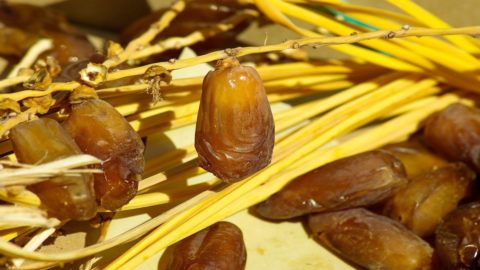
In the recurring rituality of lucky foods to be eaten absolutely in the first days of the year with propitiatory purposes, the date is one of the five protagonists of the table together with the lentils, which for their shape resemble coins and therefore are good omens of future riches; to grapes of which it is obligatory to eat 12 berries, one for each month of the year, being careful not to find a sour one which would negatively mark the month, because, as the proverb says, "brings money all year round"; with the pomegranate, fruit of the plant sacred to Juno and Venus, symbol of fertility and wealth; to the red chillies in charge of driving away bad luck with their internal fire and the pointed shape to be used against the "evil eye".
Finally, the date, associated with dried figs, is attributed a less venal function than the first fruits but no less important for this, that of ensuring a new year of life and sweetness.
The Romans called it with a pet name, Palmula, which expressed all the tenderness that dates have reserved for Roman culture.
Although these were the exotic food par excellence, Rome borrowed from the East the total sublimation of the nutritional effects of this fruit used as a supplement after long crossings in the desert, without in the least altering the glycemic response, the East had deified the palm plant for the persistence of its leaves surpassed all other botanical species.
The palm enters Roman culture as a sign of victory for the charioteers, for the emperors, for the adepts of the god Mithras until it becomes a symbol of victory over sin in the nascent Christian faith. The etymological root "foin" which identifies this fruit in ancient Greek is also shared by the denomination of the Arab Phoenix, a mythical bird that foreshadows the Christian resurrection.
This etymological sharing expresses all the complexity of a fruit that associates physical refreshment with psychological refreshment up to the achievement of victory over both earthly and heavenly goals.
An interesting essay by prof. Giuseppe Nocca, agronomist, nutritionist, Professor of Food History at the Bio Campus Foundation in Latina: "Palmula dates in antiquity, Anthropological and Archaeological Survey", published by Arbor Sapientae Editore.
The reader is taken on a long, interesting and engaging journey into the anthropology of food which also crosses archeology, classical literature and art in a transversal way, to discover completely new aspects of the palm tree as such and on the date as its fruit.
Its "eternity" from ancient times to today is determined by the fact that the date was, and is, a real food supplement, as it is free of proteins and fats and rich in many vitamins. Furthermore, contrary to what one might think if taken in controlled quantities it can also be consumed by people subject to a low-calorie diet or who suffer from hyperglycemia.
Nocca's essay also dwells on the anthropological aspects of the plant. The vegetative characteristics of the palm and its longevity (in some cases it has reached up to 300 years) as well as the longevity of its leaves, compared to other evergreen essences, project a timeless condition over time which finds its most perfect synthesis in the concept of immortality .
Immortality has its roots in the human condition of struggle and overcoming suffering which always fluctuates between fatigue and refreshment, pain and joy, struggle and victory, defeat and triumph. The palm is then assumed both as a sign of an earthly goal achieved and as a hope and wish for success, a victory.
In Roman times, the sweetness of the date was so appreciated that it was not only an ingredient in aristocratic recipes, but also a widespread gift for new year greetings; in dates, the sweetness is combined with the uncertainty of the future in an attempt to overcome the anguish of daily suffering.
In the sweetness of the date man rediscovers his desire for serenity and immortality, since sweetness belongs only to God and, by wrapping his head with palm leaves, man tries to project an exquisitely human condition into a supernatural dimension . A desire for sweetness and happiness that goes up to our times as we said at the beginning.
Typical fruit of northern Africa and western Asia up to the Tigris and Euphrates rivers, the date, fruit of the Phoenix Dactylifera, has always linked its history to that of man.
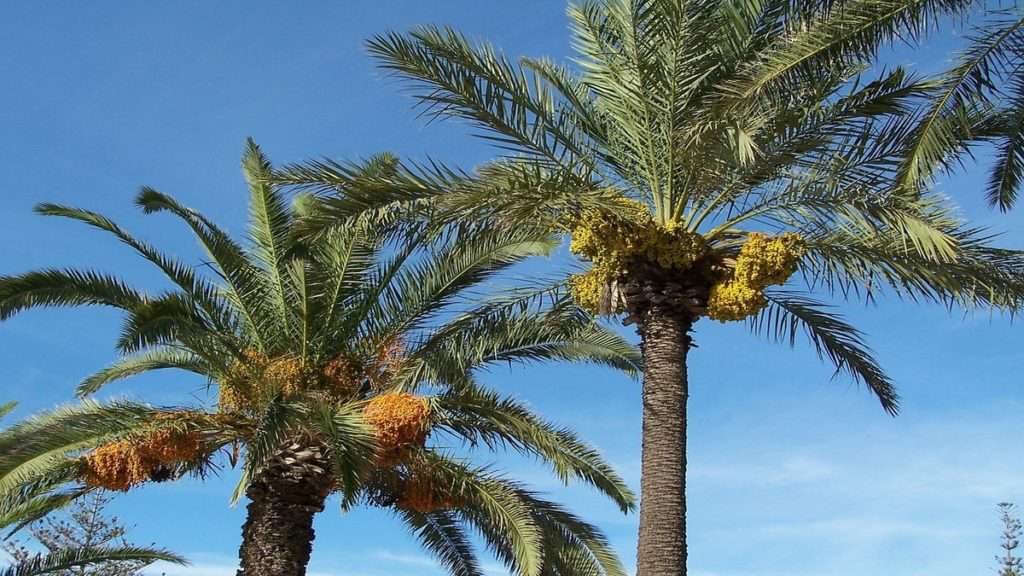
According to Muslim tradition, the date is the fruit of paradise, a miraculous fruit due to its numerous nutritional virtues. In the Koran, it is mentioned in particular in Maryam, the nineteenth Sūra dedicated to the birth of the Madonna.
In fact, not everyone knows that Muslims recognize in the Virgin Mary (Maryam), the mother of Jesus ('Isa), as well as a reference model for spirituality and popular piety.
A recognition that comes from the Prophet himself. To Mary who gives birth to Jesus - the Sura reports - a voice says: «Do not be afflicted, for certainly your Lord has placed a stream at your feet; shake the trunk of the palm: he will drop fresh and ripe dates on you.'
And dates are the first food Arabs eat at the end of Ramadam. The common practice during Ramadan is fasting from sunrise to sunset. The meal before sunrise is called suḥūr, while the one after sunset is called ifṭār. Tradition has it that at sunset the fast is broken by eating a date, because this is what the Prophet did
The importance of dates in the food uses of Arabs, Greeks and Romans is linked to the great nutritional properties of dates. Let's look at them closely.
First of all, the fruit has a high energy power which makes it appropriate in diets in case of physical debilitation and fatigue: in fact, it provides about 253 calories per 100 grams (50-70% sugars from carbohydrates, 20-30% water) 2,7 .0,60% protein and XNUMX% fat.
Given the low protein content, dates are also suitable for low-protein diets.
The pulp of the fruit is above all rich in magnesium (about 50-60 mg per 100 g of product). but there are also large quantities of iron, potassium, copper, zinc, calcium, manganese and phosphorus. For all these components it is considered a valid aid against anemia. It is also a tonic for nervous and muscular activity, and due to the considerable quantity of mineral salts it is also considered as a natural remineralizer
In the date we also find all the essential amino acids, and modest amounts of vitamins, especially those of group B (B1, B2 and B6).
Popular natural medicine has also always found a useful curative function in the use of dates. In the form of a decoction it was prescribed to relieve sore throats and catarrh, and as an anti-inflammatory for the digestive system.
And that's not all because the most recent research has allowed dates to be attributed other important properties such as promoting brain health thanks to their antioxidant properties, reducing the risk of neurodegenerative diseases and improving memory, cognitive ability and anxiety and finally inhibiting the formation and activity of free radicals, associated with cellular aging and the onset of chronic diseases.
In short, if someone thought that eating dates on New Year's Eve was just a superstitious game by reading "Palmula dates in antiquity, Anthropological and Archaeological Survey" by prof. Giuseppe Nocca will have to largely change his mind.