

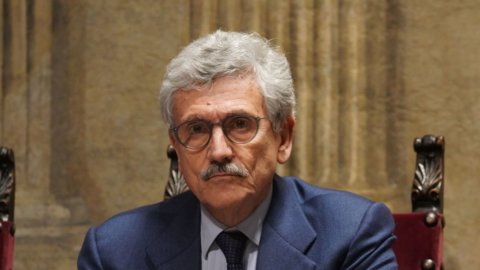
In the latest book by Massimo D'Alema, “Great is the confusion under heaven. Reflections on the crisis of the world order”, published by Donzelli Editore, there is a beacon that illuminates and indicates the ways to Western wayfarers who move along the streets of the world fearing they will experience the last years of democracy. The lighthouse is called "transition management", because there is no doubt, for D'Alema, that the West will have to get used to not being the only beautiful one in the realm anymore, but will have to share his power with many other protagonists. This phenomenon also has a name, it is called "multilateralism". And Europe can be the absolute protagonist. We talk about this in the conversation-interview with the president of the Foundation for political culture, Italianieuropei, who is returning to Italy by sea from the Peloponnese.
President D'Alema, what did the decision to finance the recovery with the Recovery Fund mean for Europe and Italy?
“It was a very important turning point. Europe has finally implemented an expansive policy after many years in which austerity was privileged. But the most important thing from a political point of view was the German breakthrough. Germany was the real leader of the "frugal" countries, and she abandoned them. It is also true that the German turning point arises from the international situation. In other words, from the fact that Germany understood that its own economic power would not hold up in an international context of trade war between China and the United States, an extremely unfavorable context for an exporting economy like the German one. In Berlin, therefore, there was a choice of strategy, but also a strong national interest in supporting European recovery, including that of Italy, since our economy is strongly intertwined with the German one, with our small and medium-sized industry working for example in the automotive sector. Ultimately, if the Italian system collapsed there would also be damage for Germany. In short, Europe has rediscovered not only its ideological and ideal reasons, which are also important, but also the material ones. Hence the importance of the turning point”.
Has Germany therefore accepted that leadership role in Europe that many have asked it to assume in recent years?
"Yes. After being very reluctant and stingy towards Europe, Germany has also generously assumed a leadership role. Perhaps the real turning point in Europe was this. And Italy had the merit of supporting it. It's not that she could have done much more, but what our country had to do, it did ”.
Can we therefore hope for a leap in quality also in the direction of an even closer European political union?
“We don't know, we can only hope. Instead, we know that now we need to make intelligent use of these resources. We are facing a great challenge for everyone, and for our country. Now we must concentrate on using those large economic resources to support growth, so that it is effectively the lever for real change for the Italian economy. Use all this money well, don't waste it: now we need to devote ourselves above all to this".
This European turning point seems to be the only positive thing that has happened in the world in recent months: around us there are only cracks, all international alliances are in crisis, from NATO to the UN, the Arab League, NAFTA.
“It's true, there is a serious crisis in the system of international relations which is also leading to an escalation of tensions. In this context, the only positive note was the resumption of European initiative, above all in the field of economic and development policy. This new-found European solidarity seems to me to be the starting point, the rest is rather problematic. Furthermore, we are linked to the prospects of the American elections, but not in the sense that if the Democrats win, everything changes. Unfortunately I think that the tensions between the US and China, for example, are destined to last regardless of the outcome of the American elections. However, it is very important to go back to having an American leadership that is able to talk to Europe. We must end the disaster of this administration, which has been harmful to the United States and the rest of democracies.
From his book we understand that the West has used up its supply of fascination with the rest of the world. What has eroded its cultural, economic and political hegemony? Do you think we have the perception of this decline in the West?
“I think the current US administration is a manifestation of this decline. Whether Trump is aware of it I don't know, but if an administration is born with the slogan of making America great again, it somehow understands that its greatness is declining. And the perception of a relative decline certainly exists in the Western world. Then there are different reactions to this perception. Once an American thinker, president of the Council on foreign relations, one of the most important cultural institutions of American foreign policy, said that the West would need a leadership capable of reducing its role without disturbing the rest of the world. I think that the role of the West is destined to be reduced. The real problem is how to manage this transition from a world centered on the West, its values, its models, to a multilateral world. The Western reaction may be to reject this prospect even through the use of force or in any case by exacerbating all international relations. Or it could be that of intelligently managing the transition towards a multilateral world in which, however, we try to make our heritage of values count. The big problem concerns the culture of the ruling class. Unfortunately, today in the Western world the push that is called sovereignty is very strong, which is actually a subordinate reaction from a cultural point of view. This trend in which you react by showing your muscles, in my opinion, is a losing line in the medium term and can create enormous damage. This is the basic thesis of my book. Instead, we need to manage this transition through a dialogue that does not mean giving up on our values, but certainly having a more inclusive vision of the world, which also takes into account the values of others".
After 1989 it seemed that a new era was beginning, in which democracy and freedom would triumph. And it is true that the number of free countries in the last forty years has increased from 29 to 45%. But there have been wars, terrorism, chaos. What went wrong?
“It must be said that since 1989 and at least for fifteen years there has been the greatest success in the Western world. The collapse of the Soviet system was the start of the expansion of democratic systems, in Eastern Europe and, as a reflection of the end of the Cold War, also in Latin America, where American support for dictatorships waned because they he was more motivated by anti-communism. At one point it seemed that even the Arab world could be involved, although this turned out to be an illusion. But this process has taken place. And he also expressed himself in two forms of thought, as we recall, one, that of Francis Fukuyama, according to whom human history ended up leading to a universalization of the Western model, with the market economy and liberal democracy they became the model accepted by all; and the other view, more pessimistic, but which proved to be more well-founded in the long run, that of Samuel P. Huntington, for whom instead the end of ideologies would have opened conflicts of civilization. This is what happened, because a part of the world perceived the idea of an expansion of the Western model as a threat to its own cultural identities. Islamism was perhaps the most dramatic form of this reaction; but there was also Chinese nationalism and that of other Asian countries. The fascination of the West gradually went into crisis over the course of the new millennium up to the crisis of 2007/2008 in which that model of development was shattered. And we have never essentially gotten out of that crisis. So it is true that democracies have increased, but at some point they have lost their appeal. Twenty years ago no one would have doubted that Clinton was the leader of the world. Today the leaderships of non-democratic countries are much stronger, much more prestigious. The trend towards expanding democracies has abruptly stopped. And even those countries that formally remained democratic have taken on the turn of highly authoritarian democracies, such as Turkey or Russia. While the autocracies are back in the Arab world. This happens because authoritarian models produce stronger and sufficiently stable ruling classes to be able to pursue medium-term objectives. The fragility of democracies arises from the social compromise on which they were based, the growth of inequalities and the concentration of wealth and power have taken away the credibility of democratic systems and the traditional ruling classes, paving the way for the growth of populisms".
So has the post-American century begun?
“It is a fact that everywhere in the world the weight of the Americans has decreased. In the Middle East, for example, Russia has regained its role, which seemed like a marginalized country. And this brings us back to the role of Europe. It is not a question of Europe playing a game of autonomy from the USA. Europe was strong when it pushed the Americans towards a less muscular, more intelligent policy. When you influenced the US with the strength of your diplomatic tradition, your culture, your vision of the world. At the moment there is the problem of defining a strategy for the Western world, American pressure is pushing for it to be a strategy of closure, of hostility towards the Chinese. And I fear that this will lead to a fracture of the world, pushing Russia into an ever closer working relationship with China. But this new bipolarity between the West and all those who are not Western risks being very different from the one with Soviet Russia because that was a country in decline. Today, if we combine Russia's natural and military resources with the innovative power of China's economy, we face a much more dangerous adversary. And then why should we have them as antagonists? There is no reason. I find, for example, that there is a lot of hysteria in this campaign on Chinese expansionism. Of course, China is a great power, but I think the threat of 5G is a hoax, from a security point of view, there is no threat. In the sense that it adds nothing to the current situation. That is, even today through the Internet, the network, etc. etc, everyone can hear everything. I think that this anti-Chinese hysteria is useless and dangerous".
Are we moving towards de-globalization?
“Deglobalization is the return to the sovereignty of nation states. The moment duties are imposed, borders are controlled, people's movements are limited, we are moving towards this new state of the world. Globalization is the free movement of people, goods, capital and ideas. This trend had already started a few years ago, but the pandemic has accelerated the process”.
How bad is this state of affairs?
“I think globalization is a trend that cannot be reversed. I believe that we will go towards a globalized world where, however, the weight of nations will once again be more relevant than it has been up to now. At a certain stage, the so-called "glocal" theory had spread and had been successful, according to which there would have been globality and then the local dimension. A very strong current of thought in the developed world. In my opinion, we are now on the way to having a world that will remain globalized to a certain extent, but in which the national element will once again have an important weight. All of this becomes negative if this national element degenerates into the form of nationalism, of mutual hostility, if forms of cooperation are not established. The question is always that of governing the processes. Ungoverned processes are not a good thing, including, from this point of view, financial globalization. The so-called vision of deregulation, in which every process is left to itself, is no longer tenable. The real alternative is between a governed globalization or the return of nationalisms”.
Mediterranean: let's start from the chaos that followed the so-called Arab spring. Why was Obama's speech in Cairo that had raised new hopes in the end a major failure?
“Meanwhile, Obama was unable to translate that beautiful speech into political action. Secondly, that so-called Arab Spring movement had the effect of strengthening political Islam. It was quite predictable: by the time you switch to democracy, there could be little doubt that the Islamists would win the election. The West thus found itself faced with the fact that the Arab Spring destabilized the autocratic systems, the military dictatorships of which they were firmly allied, and brought to power the Islamist elites who had a strong anti-Western charge. This has been the effect of democratization. At that point the West changed gear and greeted the coup in Egypt with celebrations because the military was back with whom it was possible to continue doing business. Democracy had a price which was to start a political debate, a process of integration with the Islamic political forces. There is no democracy in the Arab world without Islamism. It was a naive idea that the Western democratic model could assert itself in the Arab world. And Obama's somewhat naïve speech was”.
Libya: is there still room for a strong role for Italy after the arrival of new players such as Turkey and Russia?
“There could have been a role for Italy ten years ago. And the Libyans were interested in this process, but they didn't find support. Having not been there, Italy must now ensure that there is a role for Europe. Either we all win or we all lose."
The Israeli-Palestinian conflict seems forgotten: why?
“We have forgotten it, but not the Arabs. It remains in their sentiment and is one of the sources of hostility towards the West. Sentiment among other things founded. The fact is that events have occurred that have completely changed geopolitics in the region and in the Western world. On the one hand, the conflicts that have exploded in the Arab world, the civil war in Syria, the war in Yemen, the growing conflict between the Gulf countries and Iran, have shifted the focus. First of all that of the Arabs. The Saudis have sought an anti-Iran relationship with Israel. Which has never happened before. There had always been more or less an alliance of the Arab world in support of the Palestinians and today it is gone. Then there was a second element, and it was the growth of Islamism that created growing anti-Islamic sentiment in the West. And in the face of the Islamic threat there has been a rapprochement between Christian fundamentalism, especially Protestants, especially in the USA, and the Jewish world. The result was a sort of common front between Christian fundamentalism and Jewish fundamentalism in an anti-Islamic vein. Not only in the US, but also in other Western countries, a part of the Jewish world has sided with the right. And it wasn't like that before. The Jewish world was generally aligned to the left, also due to the Memory, due to the anti-Semitic persecutions that had a strong right-wing matrix in European culture and tradition, including in America. Thus very deep cultural fault lines opened up and the Palestinians eventually found themselves isolated within the Arab world while they lost the support of an important part of public opinion in the Western world".
What is the situation now?
“The Israeli right has taken advantage of these changes with its essentially liquidating policy on the Palestinian question. A policy that has had the opposition of a democratic minority in Israel in even dramatic forms. Like the appeal of Yeoshua, the greatest Israeli writer and intellectual, who asked Europe to boycott his country because the dream of a democratic Israel is being destroyed by transforming it into a South Africa before Mandela, with second-class citizens, Jews, those of series B, the Israeli Arabs, and then those of series C, the Palestinians, who live under military occupation, deprived of any right, civil, of property, and even of the right to security as demonstrated by the many civilian victims. In recent months, Europe has expressed strong opposition to the project of annexation of the Territories, of Jerusalem, of the Jordan valley. Even if the European capacity for initiative is blocked by the pro-Israel veto that comes from the more radical right. It is paradoxical that Israel's main foothold in Europe is Orban. The project is now at a standstill because even Netanyahu, also due to his internal personal events, has not had the courage to carry it forward. But it is hard to see how the idea of a Palestinian state can take shape without a radical change in Israeli policy of which there are no signs. So much so that the real issue Palestinians are talking about today is whether it makes sense to keep the Palestinian Authority standing, and whether they shouldn't now accept a South African scenario. That is, starting to fight for their rights in a regime of military occupation. Added to this is a fact. It is we European citizens who keep the Palestinians economically by relieving Israel of the obligation to provide for the populations of the territories occupied by her army. I don't know until when. At some point the Europeans might say, sorry but why do we have to pay?”.
Africa is the reservoir of our fears: what is the right policy towards the youngest continent on the planet?
“Immigration to Europe is very minimal compared to inter-African immigration. We should help a process of integration between African states and support the African Union to grow as a large regional body by helping the training of the ruling class. And also favoring an intelligent emigration willing to return to the continent".
Will the pandemic cause a real change in the way of life? Will we be better or worse?
“This is always said after every important event. Basically nobody knows. Some things have changed for the better, for example we talked about the awakening of Europe. Others for the worse. For example, in some parts of the world the pandemic has favored authoritarian tendencies, even justified by the emergency, but which risk remaining beyond the emergency. It is too early to take stock. I hope that the biggest positive change the pandemic can bring is a change of leadership in the US. For the rest, I fear that we will only have to make a serious assessment at the end of the year, also because there is a fear that there may be a second wave of the virus. So it's a little early. I don't want to say how Ciu En Lai replied to those who asked him for an opinion on the French Revolution: that it was too early. But it's really early."
As always, I consider D Alema's analysis of the world to be complete, shareable and strategic