Organized as part of the advance transfer operation of the entire Studio Brancusi of the renovation works of Centre Pompidou in 2025, this exhibition is a unique opportunity to discover every aspect of the work of this immense artist, considered to be the inventor of modern sculpture. His last and only exhibition in France was in 1995 (curated by Margit Rowell at the Center Pompidou). The artist's studio, a jewel of the Musée National d'Art Moderne collection since it was bequeathed to the French state in 1957, is at once where he lived, worked and contemplated his sculptures. Supplemented by loans from important international collections, it constitutes the matrix of the exhibition.
The exhibition brings together an exceptional collection of sculptures and plays on the dialogue between the Studio Brancusi casts and the original works in stone or bronze, on loan from many private collectors and museums (Tate Modern, MoMA, Guggenheim, Philadelphia Museum of Art, Art Institute of Chicago, Dallas Museum of Art, National Art Museum of Romania, Craiova Art Museum, etc.).
Discovering the artist's Parisian studio
The tour itinerary adopts a sensitive approach from the beginning, highlighting the shock of the discovery of his Parisian studio, located in Impasse Ronsin in the 15th arrondissement, frequented by numerous artists and enthusiasts for several decades. The heart of the exhibition evokes Brancusi's sources of inspiration (Auguste Rodin, Paul Gauguin, Romanian vernacular architecture, African art, Cycladic art, Asian art, etc.) and highlights his creative process, including the choice of direct carving , the aesthetics of the fragment, the serial process and his work to bring out the form. A partial reconstruction of his studio emphasizes the material dimension of his work (materials, tools, gestures).
The exhibition places Constantin Brancusi's life in a broader artistic and historical context through a rich corpus of documents (letters, press articles, diaries, deeds, etc.), which recount his friendships with avant-garde artists such as Marcel Duchamp, Fernand Léger and Amedeo Modigliani. The visit follows a thematic itinerary organized around the artist's main cycles of works and highlights the key challenges of modern sculpture: the ambiguity of form (Princess X), the portrait (Danaïde, Mlle Pogany), the relationship with space ( Maiastra, Bird in Space), the role of the base (The Newborn, The Beginning of the World), the effects of movement and light (Leda), the representation of animals (the rooster, the fish, the seal) and the relationship with monumentality (The kiss, infinite column).
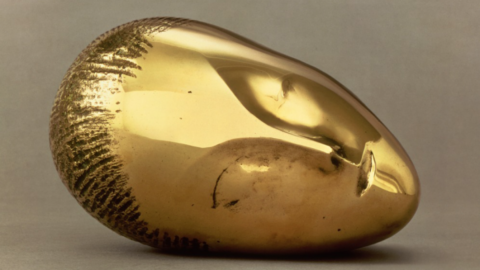
Cover photo: Constantin Brancusi, The Muse endormie, 1910
Collection Center Pompidou © Succession Brancusi – All rights reserved (Adagp) © Center Pompidou, MNAM-CCI/Adam Rzepka/Dist. MRI-GP