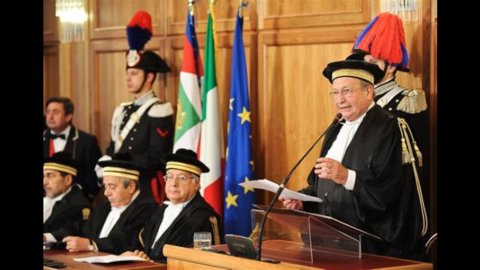
The Court of Auditors "is strongly sensitive to the alarm on corruption also raised at European level and believes that also thanks to organic, clear and simple rules the phenomenon can be hindered, eliminating margins of uncertainty and ambiguity". This was stated by the president of the accounting judiciary, Raffaele Squitieri, speaking today during the inauguration of the 2014 judicial year.
“Moreover, the importance of a prevention strategy that makes the moment of sanctioning illicit conduct residual, even if necessary – he added -. Prevention must be developed through the constant monitoring of the activity of both public management and the market in general, using tools that guarantee maximum transparency in the activity of the public administration”.
On the subject of corruption, the "various and concrete proposals" of the Court of Auditors have "often remained unheeded", added the Attorney General of the Court, Salvatore Nottola, pointing out that, with the "necessary resources and legislation that allows greater effectiveness and incisiveness the Court can play a fundamental role in the fight against corruption”. Nottola also calls for a stop to the amnesties, which weaken the compensatory and dissuasive effects of the action of the accounting judiciary and prosecutors, "thwarting an often burdensome and costly activity".
NO TO NEW MANEUVERS
“The eventuality of new interventions to correct the deficit that reproduce a vicious circle that slows down the recovery must be avoided – continued Squitieri -. The medium-term objectives defined at European level still constitute a severe constraint for the management of the budget and public debt, also in view of an economic cycle which we hope will turn favourable”. For the number one in the accounting judiciary, 2014 will be a year of “very demanding challenges, which require radical changes in the behavior and tools used so far. The country will have to demonstrate new capabilities: knowing how to reform its institutions and rules, directing everyone's contribution to the overall recovery".
2014 IS A YEAR OF CHALLENGES
In general, according to Squitieri, 2014 opened “in a still difficult economic context, even if, towards the end of 2013, there were the first signs of recovery. The hints of easing of financial tensions do not exclude the fact that much remains to be done to relaunch the economy. Budgetary policy in Italy moves with persistent difficulties between the apparently conflicting needs of economic growth and the rebalancing of public finances. An economic recovery that is slow to incorporate the positive external impulses which leads to constantly revising downwards the estimates on the expected growth of the GDP. And this is reflected in a worsening of the public budget which restricts the room for maneuver for development support policies”.
BANK CREDIT, SPENDING REVIEW AND TAX EVASION
Il bank credit "it continues to stagnate - continued the president of the Court of Auditors - and harnesses the strength of the recovery, which also for this reason remains much slower than in other European countries, which in itself is already far behind compared to other world areas"; Also the review and rationalization of public spending “they represent a fundamental cornerstone of the government's action”, since “there is ample margin for the reabsorption of inefficiencies and management distortions. Continuing in the direction of only non-selective spending cuts, such as linear ones, proves to be no longer sufficient, and also exposes one to the risk of results much lower than expected. In particular, it is advisable to ensure that, even when setting up new independent bodies and authorities, privileged remuneration structures are not determined”.
As for evasion, "it is necessary to continue the recovery action of the taxable base subtracted from the tax obligation, an essential condition for reducing the level of the tax burden", concluded Squitieri.