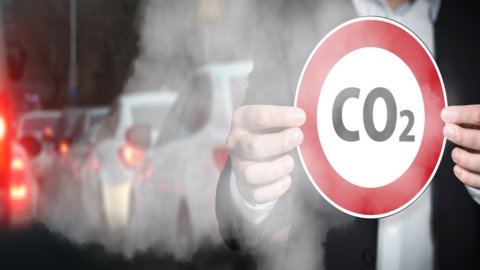
La new european carbon tax su transport e warm-up - the ETS2 system – it is not just a tool to reduce emissions: it is a strategic lever from 300 billion of euros to free the European Union from energy dependence on Petroleum, support families and accelerate the ecological transition. This is what an in-depth study by Transport & Environment (T&E), Europe's leading organisation for the decarbonisation of transport.
What is ETS2: Petrol, Diesel and Heating Under the CO2 Price
Starting since 2027, the EU will introduce ETS2, a new form of pricing with emissions CO2 which will directly hit the fossil fuels used in road transport and construction. This mechanism, which will complement the existing ETS for industries, will put a carbon price on petrol, diesel and domestic heating fuels.
The principle is simple: the polluter pays, and the proceeds are invested to accelerate the transition to clean energy and support the most vulnerable. According to the T&E study, ETS2 represents an unprecedented economic and environmental opportunity: between 2026 and 2032 it could generate almost 300 billion euros.
Impact on citizens: more efficiency, but fair redistribution is needed
The principle behind ETS2 is simple: putting a price on CO₂ emissions means making the use of clean energy sources more competitive and pushing citizens, companies and governments towards more sustainable choices. With a price of CO₂ set at 55 euros per ton – the level recommended by T&E to maintain stability and predictability – the impact on the price of gasoline would be limited. Indeed, according to the organization, the cost at the pump would still be lower than the real average of the last twenty years, taking into account inflation and advances in vehicle efficiency.
However, the introduction of the ETS2 system will inevitably lead to a increase in the cost of fuel and heating, with the risk that the ones paying the highest price will be the families low-income groups, which allocate a greater share of their revenues to this consumption. This is where the most important challenge comes in: making the transition fair and sustainable also on a social level. To do so, T&E proposes that at least half of the ETS2 revenues be redistributed directly to families with lower incomes, while the other half should be reinvested in the green transition, with concrete measures to facilitate the purchase of accessible electric vehicles, strengthen public transport and develop charging infrastructure.
How to make ETS2 sustainable
To avoid the effects of ETS2 hitting families before the benefits arrive, T&E suggests that the European Commission grants a grant now loans to member states, so as to immediately finance compensation measures and investments in green infrastructure. These loans, according to the study, could then be repaid with the ETS2 proceeds themselves, without having to wait for them to be collected.
Another recommendation concerns the carbon price stability. T&E proposes to reform the Emissions Market Stability Reserve, the European mechanism that regulates the supply of CO₂ allowances, to keep the price around 55 euros per tonne. A stability that would guarantee confidence in the markets, but also certainty for families and investors.
Finally, the study highlights that ETS2 cannot operate in isolation. If complementary policies as car emissions standards or zero emission zones are slowed down or not implemented, the ETS2 system will have to compensate by increasing the price of CO₂, with significant economic and social consequences. For this reason, T&E calls on the European Union to strengthen the integration of effective climate measures in the National Energy and Climate Plans (NECP), and to set binding targets for the electrification of large corporate fleets.
Comments
“ETS2 offers a €300 billion opportunity to free Europeans from their dependence on oil, the import of which is an unsustainable economic burden, and to reduce pollution from road transport,” he said. Esther Marchetti, Clean Transport Advocacy Manager of T&E Italia –. Social concerns are concrete, but they can be overcome by redistributing part of the funds to the most vulnerable families and investing the rest in electric mobility and public and shared transport, for a more just and sustainable transition”.