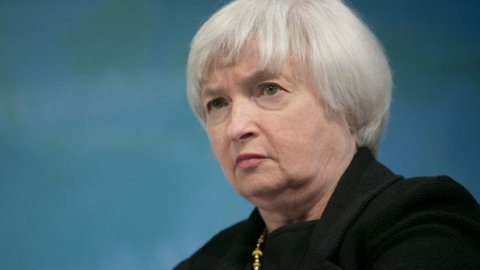
What can be expected from the appointment of Janet Yellen as Fed chair? It is appropriate to distinguish between what pertains to monetary policy and the rest of the Fed's responsibilities. In terms of monetary action, the most plausible thing is that there will be continuity under the governorship of Ben S. Bernanke. This means that unconventional monetary policy operations, i.e. Quantitative Easing, will presumably continue (but can it still be called unconventional after several years that it has been in place?).
Perhaps, the Yellen presidency could even slow down the exit from these active policies, delaying the so-called tapering. This expectation derives from the fact that, also by virtue of her cultural background, Yellen has always been deployed in the field of monetary "doves", as revealed by her track record in the office. That is, the new President belongs to the group of those who between the two classic objectives of the Fed, the control of inflation and the support to reduce unemployment, has always given more weight to the second than to the first.
An important note in this regard is that Yellen's candidacy, as it will be recalled, defeated that of Larry Summers, generally credited as the monetary "hawk" alternative, ie more oriented towards anti-inflationary policies and less sensitive to the employment issue. From this point of view, the appointment of Janet Yellen also means the victory of a more interventionist school (in the Keynesian tradition) rather than an embarrassingly liberal approach. In fact, among his other slips, from Chief Economist (and Senior Vice President) of the World Bank Larry Summers argued that it would be optimal to move the most polluting productive activities from rich to poor countries because the loss of human lives that such pollution entails would be less .
This is not because the same pollution produces fewer victims in poor countries, but because, Summers estimated, the value of life is lower in poor countries than that of life in rich countries. Naturally, this reasoning caused a scandal but, at the same time, it reveals the unscrupulousness and questionable values of the proponent. Even more worrying, however, was Summers' track record when, as Secretary of the Treasury, he delivered the final blows to the Glass-Steagall Act, completing the financial liberalization that, today we can say, having seen the Great Crisis from 2007 onwards , has not done well for the United States and the Western world.
In this regard, it is useful to remember that Janet Yellen is not only an economist and a public official who thinks with her head, but she is also the wife of George Akerlof, one of the sharpest thinkers who have advanced the analysis of choices in market failure situations. Akerlof, Nobel prize winner for economics in 2001, together with Spenser and Stiglitz, wrote his main paper in the late XNUMXs. This is the famous "The market for lemons", i.e. the market for bins, in which uncertainty about the quality of the good being traded can lead to situations of market dysfunction.
Well, it is curious to recall that, before becoming a classic and one of the most cited works in the history of the economics profession, the paper was badly rejected by three primary journals – American Economic Review, Review of Economics and Statistics, Journal of Political Economy – first to be published by the Quarterly Journal of Economics. Moreover, the editor of the Journal of Political Economy had judged Akerlof's contribution incorrect by arguing that "if this paper were correct, economic science should change" and, in fact, economic science has changed even following the publication of the " market for lemons”.
Janet Yellen's cultural background gives hope that the Fed will be able to play a more active role also in promoting the most effective possible implementation of the new regulation which, in fact and in law, has become the third major objective of the Fed. In fact, the legacy of the Great Crisis is that there can be no monetary stability without financial stability. And, then, Yellen as chairman of the Fed could prove to be a crucial pawn in strengthening and accelerating re-regulation interventions, without which we will constantly be at the mercy of new waves of financial instability. Everything remains to be seen if, having lacked a new Ferdinand Pecora (cf. my piece "To save Europe, it would take a lionheart and a month as a sheep" on Firstonline of 10/6/2012), someone else will know compensate for the absence.
Read also by Giovanni Ferri
"To save Europe it would take a Lionheart and a month like a sheep"