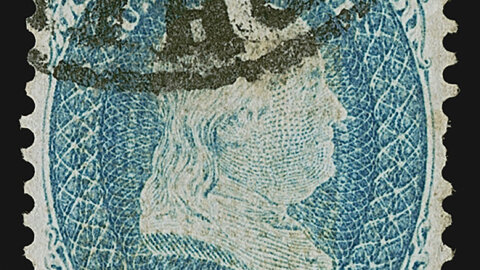
The experts of the Siegel auction house predict that theentire collection could realize come on 15 to 20 million dollars, with several individual stamps crossing the million-dollar mark and the rarest stamp in the collection, the One-cent “Z” Grill from 1868, on track to become the most valuable American postage stamp with an estimate among 4 and 5 million dollars.
The 100 best stamps from the collection will be auctioned at the New York Palace Hotel in Manhattan on Friday 14 June
The top lot of Friday night's sale will be the famous 1868 One-cent “Z” Grill, which returns to the auction block for the first time in 26 years. The remaining stamps will be sold the next day at the Collectors Club of New York at its new location overlooking Bryant Park.
William H. Gross was dubbed “the nation's most prominent bond investor” by the NY Times
Gross began learning about philately as a child when his mother gave him a stamp album full of new postage that she said would help him pay for college. When he went to sell the stamps, he learned that they were essentially worthless. However, Gross wanted to prove to his mother that stamps could be a good investment. In his first philatelic auction, he spent over 1 million dollars and decided to build the most important collection ever seen in the United States.
He he co-founded investment giant PIMCO in 1971, where he held the positions of managing director and chief investment officer until 2014. During his time at PIMCO, he received numerous awards, including Morningstar Fixed Income Manager of the Decade from 2000 to 2009 and Fixed Income Manager of the Year for 1998, 2000 and 2007. Gross became the first portfolio manager inducted into the Fixed Income Analysts Society Hall of Fame. in 1996 and received the Bond Market Association's Distinguished Service Award in 2000. In 2011, Institutional Investor magazine awarded him the Money Management Lifetime Achievement Award. In 2014, Gross joined Janus Henderson Investors as a portfolio manager of the Global Unconstrained Bond and Total Return strategies and as a member of the global macro bond leadership team. In 2018, Mr. Gross announced his retirement and his intention to focus on the William, Jeff and Jennifer Gross Family Foundation, a charity that provides financial support to those in need through contributions in three main areas: humanitarian efforts, education and healthcare. As of 2023, the foundation has donated more than $18 million to 67 nonprofit organizations and charities.
The exchange between collectors
Gross knew that he would not be able to complete his collection of United States stamps without the one-cent “Z” grid and was disappointed when it was outbid in the Siegel firm's Robert Zoellner collection auction in 1998. In that sale the record price of $935.000 was paid by the Mystic Stamp Company and the winning bid was placed by the buyer's 11-year-old son, Zachary Sundman.
At a 2005 auction held by the Siegel firm, Charles Shreve purchased the 24¢ reversed Jenny plate block for $2.970.000. The next day he traded the block of plates with Don Sundman for the dime “Z” grill. In what was called the “greatest stamp exchange of all time,” Gross completed his collection. This highly publicized event solidified the status of the One-cent “Z” Grill as the rarest and most valuable United States stamp.
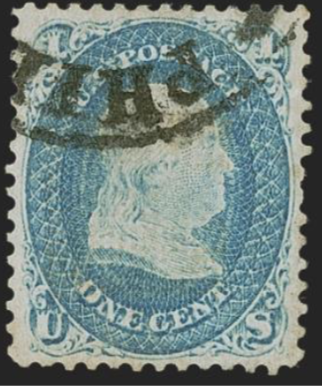
The history of the stamp
There are only two copies of the 1868 Grill dime “Z” surviving today. One was donated to New York Public Library in 1925, leaving the Gross-owned example as the only dime “Z” grill available to collectors. Even if a collector fills in all other spaces, a collection cannot be complete without the penny “Z” grid. Currently, the only collector is William H. Gross. For the past 26 years, no other U.S. stamp collection has had this stamp. To understand why the “Z” Grill is so rare, we must look to the United States Post Office after the Civil War. Postage stamps were still in their infancy, having been introduced only two decades earlier. Fears began to arise about the possibility of removing cancellations from stamps and using them a second time. The potential loss of postal revenue from cleaning and reusing stamps has inspired numerous individuals to create and patent methods that prevent stamp reuse.
One of the innovations is known to stamp collectors today as the “grille.”
This wafer-shaped embossing on the paper was made with a metal device. Each stamp on the sheet was imprinted with tiny pyramidal dots that broke the surface of the paper allowing the ink to penetrate the stamp instead of simply sitting on top of it. It was believed that this would make it very difficult, if not impossible, to reuse a stamp.
Grids were applied to U.S. postage stamps for about five years, starting in 1867. Stamp manufacturers experimented with different sizes and shapes in an attempt to achieve the right amount of protection. against cleaning without interfering with other aspects of stamp use. As early as the 19th century, stamp collectors recognized different varieties of grids on stamps, based on the size of the grid and the shape of the tips. More than a century ago, experts called the different grids “A” through “H.” The “Z” grid, so called because of its mysterious and distinctive characteristics, was included in the Scott Catalog (the bible of stamp collectors) and spaces for the different “Z” grids were added in the published albums.